YouSail category guide
Propellers are the primary means of driving a sailing boat under power: they convert engine torque into thrust that moves the hull, assists manoeuvring in tight spaces and provides reliable propulsion when wind and sails are unavailable. For sailors the propeller is not merely a propulsion accessory — it affects fuel use, engine load, handling under power and even sailing performance under sail. Choosing the right propeller requires matching the blade design, size and configuration to the boat’s hull, engine characteristics and typical use.
What this category includes
This category covers the propeller itself and associated items required for fitment and safe operation. Typical inclusions are fixed‑pitch propellers, folding and feathering propellers designed for sailboats, 2‑ and 3‑blade varieties, prop hubs and sacrificial anodes, shaft couplings and propeller nuts, and the mechanical or hydraulic gear needed for feathering mechanisms. It excludes engines, shafts, cutless bearings, shaft seals, propeller guards and specialised inboard reverse‑reduction gears, which are distinct installation components though closely related.
Purpose aboard a sailing boat
The propeller provides controlled propulsion for manoeuvring in marinas, motoring in calms, maintaining position in crowded anchorages, and making passages when sailing is impractical. Beyond raw thrust, propeller choice affects:
- Manoeuvrability: how the boat responds to throttle and reverse when berthing or docking;
- Fuel economy: engine load and RPM for a given cruising speed;
- Sailing drag: how much resistance the propeller creates when under sail, which affects speed and helm balance;
- Engine health: correct loading of the engine across its operating range, avoiding underloading or over‑revving.
Main product types and configurations
At a high level the market divides into:
- Fixed‑pitch propellers: one solid piece with blades set at a fixed angle; simple and robust.
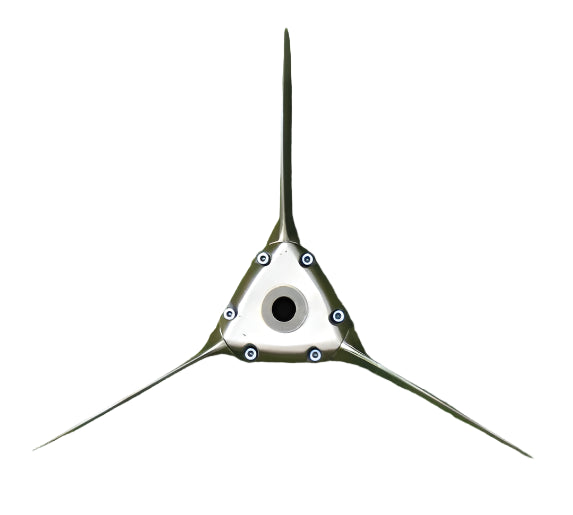
- Folding propellers: blades fold aft under waterflow when sailing to reduce drag; common on sailboats with outboard and small inboard engines.
- Feathering propellers: blades rotate on the hub so their pitch aligns with the flow when sailing, presenting a slim edge to the water and offering better sailing performance than fixed props.
- Clutching or controllable pitch systems: rare on smaller recreational yachts but available on some larger vessels; allow in‑board pitch adjustment while underway.
Propellers are made in different blade counts (two, three, four or more) and materials (bronze, stainless steel, aluminium, composite). Blade shape, cupping and rake are variables manufacturers use to tune thrust, cavitation resistance and ventilation behaviour.
When the category is essential
A propeller is essential equipment on any powered sailing vessel. The choice of specific propeller type ranges from basic essential (a simple fixed prop) to a performance or convenience upgrade (feathering or folding props) depending on how much sailing performance matters and the boat’s usual operating profile.
Key decisions that matter
Before buying, assess these factors. For each, the explanation explains why it matters at sea:
Boat size, hull form and displacement
The hull’s resistance profile dictates the thrust needed at cruising speeds. Heavy, full‑keel cruisers usually need more blade area or a lower pitch to produce thrust at practical engine revs; light planing or semi‑displacement hulls need less. Matching propeller diameter and pitch to hull and engine RPM range prevents overloading or under‑utilising the engine.
Engine power and gearbox ratio
Engine torque curve and gearbox reduction determine the shaft RPM at a given engine speed. Pitch and diameter must work within that RPM range so the engine can reach cruising RPM without excessive load. Wrong matching either starves the engine of load or makes it labour inefficiently.
Intended use: day sailing, coastal or offshore
Day sailors may prioritise simplicity and minimal maintenance; a fixed‑pitch prop often fits. Coastal cruisers who sail most of the time usually benefit from folding or feathering props to reduce drag. Offshore voyagers should favour highly serviceable, robust solutions with spare parts availability and, if possible, redundancy or simple hand‑repairability.
Crew size and skill
Systems that require in‑water servicing, blade alignment or more complex controls can be unsuitable for short‑handed crews or solo sailors. Powered feathering mechanisms or controllable pitch props add operational complexity that the crew must understand and maintain.
Sailing performance versus motoring performance
There is a trade‑off: propellers designed to give maximum thrust under power (larger blades, higher blade area) will usually create more drag under sail. Folding and feathering props mitigate this, but at greater cost and complexity. Decide which mode is primary for your boat.
Installation space and shaft size
Physical constraints — propeller clearance, propeller boss length, shaft diameter and distance to the hull — limit available diameters and hub options. Measure available skeg clearance, shaft centreline to hull, and whether a folding hub needs more axial space for blade travel.
Materials and corrosion resistance
Saltwater corrosion affects alloys differently. Bronze and stainless steel are common; aluminium is lighter but more susceptible to electrolysis in some installations. Consider sacrificial anodes and bonding, and whether the boat’s electrical system and zinc protection scheme are compatible with the chosen material.
Maintenance and repairability
Simple fixed props require little more than occasional inspection. Folding and feathering units have moving parts and seals that need periodic servicing. Offshore sailors should favour designs where replacement parts — hubs, blades, seals — are readily obtainable or where basic repairs can be made afloat.
Weight and balance
Propeller mass and its distribution at the end of the shaft affect stern trim marginally and rotational inertia, which influences throttle responsiveness and how quickly the shaft reverses direction under manoeuvring.
Product types explained
Fixed‑pitch propellers
How they work: Blades are fixed to the hub at a set pitch and cannot change orientation. They produce thrust proportional to shaft RPM.
- Where used: small to medium sailboats and many auxiliary engines where budget or simplicity is primary.
- Advantages: robust, low maintenance, economical, easy to replace.
- Limitations: greater drag when sailing, less efficient trade‑off between motoring and sailing performance.
- Best for: day sailors, trailer sailors, and cruisers on boats where motoring time is significant or sailing penalties are acceptable.
Folding propellers
How they work: Blades fold back on a hinge under water pressure when the shaft is turned off and hydrodynamic forces push them aft; when the shaft turns under power, centrifugal force and gearing open the blades to drive.
- Where used: widely used on sailboats where reducing drag under sail matters.
- Advantages: reduced drag when sailing, improved boat speed and pointing; simpler than feathering mechanically.
- Limitations: slightly less efficient under power than a well‑matched fixed prop, more moving parts and need for occasional servicing, can jam with weed or fishing line.
- Best for: cruising sailboats that balance motoring needs with performance under sail.
Feathering propellers
How they work: Blades rotate about their long axis so they line up with water flow when feathered. Under power they are rotated to a fixed pitch to deliver thrust.
- Where used: performance‑oriented cruisers and those who sail often and for whom minimizing drag matters.
- Advantages: closest to fixed‑prop efficiency under power while offering minimal drag under sail; good for passage makers.
- Limitations: more complex, require correct installation alignment and occasional servicing, can be heavier and more expensive.
- Best for: offshore cruisers and sailors prioritising sailing speed and pointing while retaining strong motoring capability.
Controllable pitch and specialised systems
How they work: Blade pitch can be adjusted while underway, typically by hydraulic or mechanical systems. These are uncommon on small recreational yachts.
- Advantages: flexible thrust control and potential efficiency gains across a range of speeds.
- Limitations: high cost, complexity and specialist servicing needs.
- Best for: larger yachts where the complexity can be justified by performance or manoeuvring requirements.
Understanding common specifications
Specifications you’ll see and what they mean:
- Diameter: the full circle described by the tips of the blades. Larger diameters generally move more water at lower RPMs, providing greater thrust at lower engine speeds, but require clearance.
- Pitch: the theoretical distance a propeller would move in one revolution in a solid medium; higher pitch equals more speed per rev but requires more power (or higher engine RPM) to achieve. Real‑world thrust depends on hull resistance and engine torque.
- Blade area / blade area ratio: the total blade planform area; affects ability to bite the water without cavitation. Heavier displacement hulls usually need higher blade area.
- Blade count: more blades can smooth thrust and reduce vibration; fewer blades often give slightly higher top‑end efficiency but can cavitate earlier.
- Material: influences strength, resistance to impact and corrosion, and weight. Consider compatibility with the vessel’s anode/bonding system.
Beware headline figures: quoted pitch is theoretical and will yield different actual speeds depending on hull form, prop slip, engine loading and sea conditions. Use pitch and diameter in context with engine/gearbox RPM range and hull resistance curves where available.
Compatibility and installation checks
Before you buy, verify these installation details:
- Available propeller clearance to hull, skeg and trailing gear; insufficient clearance restricts diameter choices.
- Shaft diameter and taper and existing hub or coupling sizing — different props fit different tapers and splines.
- Distance from shaft shoulder to hull face and any needed hub length for folding or feathering hubs.
- Direction of shaft rotation and handedness (right‑ or left‑handed) and whether a twin‑screw arrangement requires counter‑rotation.
- Compatibility with existing cutless bearing, stern tube and shaft seal arrangements; some props require more axial room or specific shaft lengths.
- Availability of service access: can you remove and refit the propeller and hub easily at the berth or is a haulout required?
- Electrical bonding and sacrificial anode requirements for the chosen material.
Specialist installation may be appropriate for feathering hubs or when changing shaft length or coupling type.
Day sailing, coastal cruising and offshore considerations
Day sailing
Priorities are simplicity, low cost and low maintenance. Fixed‑pitch props are common because they’re durable and forgiving for occasional motoring. Folding props are attractive if you value sailing speed, but ensure you can service them.
Coastal cruising
Expect more motoring hours and variable conditions. Folding or feathering props offer a useful balance between motoring efficiency and reduced drag under sail. Consider parts availability locally and ease of servicing between ports.
Offshore and remote passages
Reliability, redundancy and repairability matter most. Choose propellers with readily sourced spare parts and simple failure modes. Keep spare nuts, a hub key or simple repair tools aboard, and prefer designs a marine engineer can service at anchor or in remote yards.
Trade‑offs to weigh
- Simplicity versus sailing performance: fixed props are simple; folding/feathering reduce drag but are more complex.
- Thrust versus drag: larger blade area helps heavy boats under power but increases drag under sail.
- Initial cost versus lifetime service costs: advanced hubs cost more and need servicing; fixed props are cheaper initially.
- Permanent installation versus portability: some folding props are removable which can aid maintenance but may be lost or misaligned if not refitted correctly.
Maintenance and service life
Routine checks include blade condition, hub seals, shaft nut torque and anode condition. For folding and feathering units inspect pivot points, grease or service fittings, and look for fishing line or weed caught in the hub. Keep spares specific to your hub model. When corrosion, play in blades or damage appears, service or replacement should follow promptly — compromised blades change thrust and can damage transmission components.
Common mistakes and how to avoid them
- Buying to a single headline spec: Selecting solely on diameter or pitch without matching engine RPM and hull resistance leads to poor performance. Always combine prop specs with engine and hull data.
- Ignoring installation space: Oversized props that interfere with skegs or hulls cause noise, vibration and reduced efficiency.
- Underestimating power draw: A prop with too high a pitch will overload the engine; too low a pitch will make it overspeed. Consult an experienced rigger or naval architect if unsure.
- Overcomplicating for the crew: Installing complex controllable systems without the skillset to maintain them creates risk afloat.
- Assuming material compatibility: Mixing materials without proper anodes or bonding can accelerate electrolysis and corrosion.
Before buying — practical checklist
- Define primary use: percentage of time motoring versus sailing; typical voyage distances.
- Record hull type, displacement and any performance targets under sail.
- Note engine make, model, maximum continuous RPM and gearbox reduction ratio.
- Measure shaft diameter, taper, available axial space and clearance to hull or skeg.
- Confirm shaft rotation direction and whether twin‑screw counter‑rotation is needed.
- Decide on acceptable maintenance complexity and parts availability on common cruising routes.
- Ask suppliers about hub service intervals, spare part lists and whether the prop can be serviced afloat.
- Plan for sacrificial anodes and bonding compatibility with the boat’s electrics.
Prioritise safety and practical compatibility over theoretical efficiency. For many cruising sailors, the best propeller is the one that is well matched to the hull and engine, can be installed correctly, and can be maintained or repaired where you sail. Investing in correct sizing, appropriate material and practical servicing arrangements will repay in smoother berthing, predictable engine behaviour and better sailing performance.