Loading this page…

Loading this page…
Sailing club
Hunters Hill Sailing Club is a volunteer-run, family-oriented sailing club on Sydney Harbour at Woolwich (Hunters Hill area). The club runs Learn2Sail programs, junior and youth training, holiday camps and adult learn-to-sail courses, organises racing across multiple dinghy and sailboard classes, provides boat storage (racks and an adjacent cage), and offers its clubhouse for venue hire. The club emphasises youth development and community participation and posts events and course details on its website.
About
Hunters Hill Sailing Club is a volunteer-run, family-oriented sailing club on Sydney Harbour at Woolwich (Hunters Hill area). The club runs Learn2Sail programs, junior and youth training, holiday camps and adult learn-to-sail courses, organises racing across multiple dinghy and sailboard classes, provides boat storage (racks and an adjacent cage), and offers its clubhouse for venue hire. The club emphasises youth development and community participation and posts events and course details on its website.
Service area: Woolwich, NSW
Keep exploring
Hunters Hill Sailing Club is a volunteer-run, family-oriented sailing club on Sydney Harbour at Woolwich (Hunters Hill area). The club runs Learn2Sail programs, junior and youth training, holiday camps and adult learn-to-sail courses, organises racing across multiple dinghy and sailboard classes, provides boat storage (racks and an adjacent cage), and offers its clubhouse for venue hire. The club emphasises youth development and community participation and posts events and course details on its website.
The most distinctive thing HHSC teaches isn't a class or a course — it's the idea that sailing can reach kids other sports miss. The club runs "Ready, Set, Sail", a weekly resilience program supporting eleven students dealing with behavioural, attendance or mental-health challenges, and its partnership with Hunters Hill High School saw the school buy two RS Quest dinghies for a weekly Year 7 and 8 learn-to-sail program run as Tuesday afternoon sport. That schools-and-welfare strand fronts a pathway otherwise conventional in structure and unusually generous in delivery.
Entry starts with free Try Sailing sessions for seven-to-ten-year-olds — two Sunday mornings, boats and lifejackets provided — feeding into Learn2Sail, an Australian Sailing-accredited Optimist course with accredited coaches and three stages — Rookie, Momentum and Pro — with no time limit on progression. In-term lessons come bundled with annual membership, so families aren't paying coaching fees on top of joining. School-holiday camps in five-day and three-day formats run in spring, December and April, with a "Balmain Bus" shuttle from Elliot Street, Balmain for inner-west families, and Tweens and Teens camps put twelve-to-sixteen-year-olds into RS Quest and RS Zest dinghies for a racing twist: the basics of fleet, teams and match racing.
From there the competitive pathway is mapped in full: Transition to Green Fleet, then Green, Intermediate and Open Fleets in the Optimist — club boats available at first, own-boat commitment coming later — extending on to youth and Olympic classes. The club sails Optimists, Flying 11s, ILCAs, RS Quests and Zests plus 29ers, and a 2025 windsurfing reboot revives a board tradition that once sent RS:X sailors to open world championships. Events round it out: the Opti NSW Team Racing Championship, an "Optichicks" girls' weekend, interclub finals and a SheSails learn-to-foil clinic. Teenagers stay engaged coaching in Learn2Sail and RaceFleet — alumni teaching the intake.
Clarkes Point at Woolwich gives the club one of the more dramatic outlooks in Sydney junior sailing: panoramic views across the lower Parramatta River to Cockatoo Island and the harbour beyond, from a site neighbouring the Sydney Harbour Federation Trust lands. The sailing water is the river reach between the Lane Cove River mouth and the heads of the harbour — enclosed, tide-affected and shared with ferries and weekend traffic, which teaches young sailors early that rules of the road matter as much as boat speed. Racing runs from spring through early autumn with training continuing year-round, overseen by the Commodore and Race Officer with the Sailing Committee and class secretaries.
The clubhouse is a practical two-level affair. The lower level stores more than eighty boats alongside change rooms and the canteen, while the upper hall doubles as an indoor training space and social function room — marketed as a harbour-front venue for hire for weddings, parties and corporate events, with an Australian Sports Foundation campaign funding upgrades to air conditioning, roofing and glazing. Boat storage in the clubhouse and an adjacent cage is managed by a Boathouse Registrar with a waiting list, reflecting how tightly packed this popular site is.
Logistics are worth knowing before a first visit. Parking is at the Clarkes Point public car park, which is ticketed, though Hunters Hill LGA residents park free with a council swipe card, and the Margaret Street boat ramp sits nearby. Trust rules forbid leaving cars on the "Horse Paddock", the grassed strip between the two ramps. The club occupies its council site as licensee rather than leaseholder, an arrangement that has held because Hunters Hill Council has deliberately shielded the club from redevelopment pressure. It's a small footprint doing heavy lifting: eighty-plus boats, a hall, a canteen and a river full of kids.
The club began in 1961, launched as the Hunters Hill Junior Sailing Club and based at Onions Point where the Lane Cove River meets the Parramatta, and the "junior" in the name was the whole point — teaching kids to sail was the founding purpose, not an add-on. In 1971 the club shifted to its present Woolwich site at Clarkes Point, incorporating in 1986. Governance runs through a Management Committee elected at the AGM, with a Sailing Committee headed by the Commodore running racing and training — a structure that has carried the club through eras when membership waxed and waned from huge to flat.
The modern rebirth dates from the 2012 London Olympics' afterglow. January 2013 brought the club into the NSW Tackers launch, Yachting NSW financing a fleet of ten starter boats repayable over three years; fourteen kids and their families joined that first intake, coached by local sailing identity Jenni Bonnitcha with teenagers and university students supporting. Architect Julian Ashton helped drive the Optimist build-up as the family-membership model rebuilt numbers from around 120 to 249.
Results followed fast. By 2017 club juniors were taking first places at Australian championships and racing at European and world titles; the 2018 NSW Sailing Club of the Year award recognised the transformation. At the 2020 Optimist nationals held in Victoria, HHSC fielded the largest club contingent — some sixty travellers — and won a trophy typically claimed by home-state clubs.
That same year siblings Amelia and Matthew Quinlan (RS:X sailboard) and Sylvie Stannage (Laser Radial) contested the open world championships in Melbourne; Stannage went on to dominate ILCA 6 racing, winning the NSW & ACT Coast Championship repeatedly from 2023 to 2025 and contesting the 2025 Women's World Championships. Presidents Andrew Curtin, Maria Quinlan and Chris Stannage — the self-styled Chief Enthusiasm Officer — steered the rise.
Apollo Bay is a small working harbour on Victoria’s Great Ocean Road where sheltered inshore sailing meets the Southern Ocean. The character is a mix of protected harbour berths and an exposed open coast: pleasant day-sails and sheltered weekend cruising inside the bay, with demanding coastal passages immediately offshore where south‑westerly swell and strong winds from the Southern Ocean dominate. It suits coastal cruisers, trailer sailors who launch at the ramp, and experienced coastal sailors who understand bar and swell behaviour; it is not a casual open‑ocean anchorage for unprepared or

Look for a friendly club with beginner-focused training, accessible facilities and boats, a supportive community, clear safety practices, and opportunities to progress at your own pace.
Explore →
Tasmania has a mix of state marine parks, local harbour bylaws and environmental protections that affect where and how you anchor—so check the specific area’s rules before you go, aim to use designated anchorages or soft seabeds, and follow standard anchoring and biosecurity good practice.
Explore →
After reefing and beaching, do a visual and tactile inspection of the hull, centreboard/daggerboard and fittings for cracks, gouges, loose fastenings, retained sand/corrosion and deformities; address problems promptly and avoid sailing until significant damage is assessed or repaired.
Explore →
Late spring to summer is usually the best time for beginners to start learning to sail in Tasmania because the weather is generally warmer, days are longer and conditions are often more settled. Expect lighter to moderate winds with regular afternoon sea breees in summer, while spring and autumn bring more changeable and sometimes stronger conditions; winter is colder, wetter and typically windier with more fronts and swell.
Explore →
A practical guide for new sailors on picking the right Australian sailing club: training, boat access, racing, social fit, costs and the key questions to ask before joining.
Explore →A practical guide for recreational sailors planning visits to Albany and King George Sound. Covers the main anchorage areas, typical local weather patterns, tidal and current considerations, navigational hazards, on-the-water etiquette and a pre-departure checklist to help you plan a safe passage and enjoyable stopover
Explore →A practical, step‑by‑step guide for recreational sailors on Sydney Harbour covering navigation, local weather and tides, safe anchoring, berthing, common routes, rules of the road, and useful checklists tailored to Australian conditions.
Explore →
A practical, Australia-focused guide for planning and sailing around the Whitsunday Islands: weather and seasons, navigation and anchoring, moorings and parks, provisioning and charters, safety and common mistakes, plus checklists and next steps.
Explore →Burke Yachtsman Gear Bag 40L - Shop Now Zip Pay | Tamar Marine Skip to content 59 – 63 Holbrook Street, Invermay Online Shop Open 24/7 Products search Contact us 1300 MARINE $ 0.00 0 Cart Burke Yachtsman Gear Bag 40L $ 79.90 Colour Choose an option Black Blue Black Blue Clear - Burke Yachtsman Gear Bag 40L quantity + Add to cart Enquire about this product SKU BAGB-Y24/BLACK* Category Bags - Sail & Gear A Burke classic and customer favourite, the Yachtsman’s Gear Bag is built tough to handle wet, salty conditions while keeping your gear dry and protected. Made from double coated waterproof…
Explore →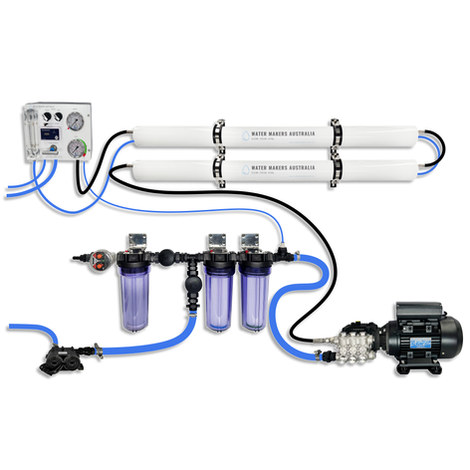
A two-membrane modular watermaker with 140 L/h nominal output, aimed at families and liveaboards that want more water per run.
Explore →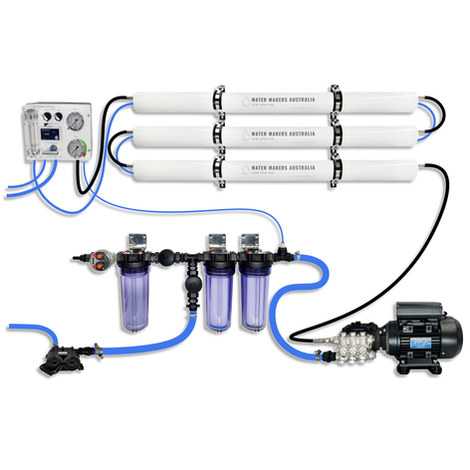
A three-membrane modular watermaker with 200 L/h nominal output and up to 240 L/h family-level marketing, for larger crews and heavy use.
Explore →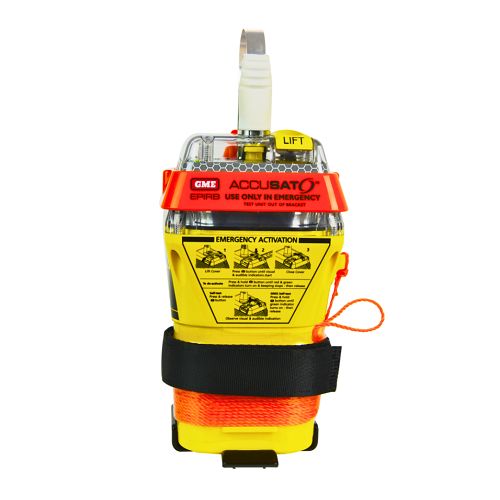
A 10‑year battery EPIRB with integrated GNSS (supports GPS and Galileo), infrared strobe and 121.5 MHz homing signal. Approved for worldwide COSPAS‑SARSAT operation.
Explore →