Loading this page…

Loading this page…
Sailing club
Army Sailing Club Association (ASCA) is a sailing club for serving Australian Defence members. The club operates the Army-owned yacht Rising Sun, moored in Sydney, and offers opportunities to sail (including twilight sails) and unit/branch experiential sailing training. Membership is available to serving Defence personnel; contact by email is provided.
About
Army Sailing Club Association (ASCA) is a sailing club for serving Australian Defence members. The club operates the Army-owned yacht Rising Sun, moored in Sydney, and offers opportunities to sail (including twilight sails) and unit/branch experiential sailing training. Membership is available to serving Defence personnel; contact by email is provided.
Service area: Rushcutters Bay, NSW (Sydney)
Keep exploring
Army Sailing Club Association (ASCA) is a sailing club for serving Australian Defence members. The club operates the Army-owned yacht Rising Sun, moored in Sydney, and offers opportunities to sail (including twilight sails) and unit/branch experiential sailing training. Membership is available to serving Defence personnel; contact by email is provided.
"Teach a soldier to sail and you teach them far more than sailing" might as well be the club's unofficial motto — its stated purpose centres on adventure training and experiential learning, using the sea to develop the leadership and resilience the Army needs. Newcomers need no experience whatsoever; the club undertakes to teach everything from the very first sail, and the syllabus is the ocean itself.
The numbers from the Gun Runner era show what that looks like at scale. Through more than seventy races a year — including the CYCA Blue Water Series and the Sydney Hobart — plus more than seventy-five days of offshore training on the east coast, the club and its yacht introduced over 200 soldiers annually to inshore and offshore sailing. Crews routinely included novices: the 2021 Sydney Hobart campaign carried as many as four first-timers in its eight-strong crew. That deliberate mixing of the experienced and the brand-new is the program's signature, turning every race into a leadership exercise.
The newer Rising Sun continues the model. The yacht is available to units and branches for experiential learning — a one-day sail for nine people, with a draft instruction template supplied — and her 2025 Hobart entry was structured as a formal training program cycling some sixty soldiers through Sydney-to-Melbourne passages. Membership brings an Australian Sailing number, as required across all affiliated clubs. There are no junior dinghy fleets or civilian learn-to-sail courses here, and none are needed: the club's students arrive as adults, often with sea time of a very different kind, and leave with offshore miles, race experience and a shared test of character behind them.
Rushcutters Bay has been the club's home water for decades, historically keeping its yachts with the Royal Australian Naval Sailing Association at the head of the bay. The club's base is on New Beach Road, placing it in the middle of Sydney Harbour's densest concentration of sailing clubs and within easy reach of the city — convenient for a membership whose day jobs are in uniform.
The home playground is Sydney Harbour, where an after-work twilight sail is the club's standard introduction for newcomers. The harbour offers everything a training organisation could want: sheltered water for first sails, busy traffic for teaching rules and lookout-keeping, and a short run to the Heads when the real lessons begin. Because crews are serving members posted in and out of Sydney, the harbour also serves as a constant — a familiar stretch of water that reconnects each new intake with those who came before.
Beyond the Heads, the east coast is the club's extended campus. Passages between Sydney and Melbourne, Sydney and the Gold Coast, and the annual run south to Hobart provide the offshore mileage at the heart of the training mission. These are not delivery trips; they are structured exercises in which soldiers stand watches, navigate, and learn to live and work in a moving, confined, occasionally frightening environment.
The 2021 Gun Runner campaign captured the spirit of the operation: the smallest boat in that year's Hobart fleet at 9.2 metres, she retired from the race yet replenished and sailed on to Hobart anyway. Finishing the voyage mattered more than the result — a lesson that translates directly to the club's day job.
The club's founding date isn't published, but its history can be told through the yachts that have carried its name south. The first Rising Sun — sail number 5376 — was a Morgan-Giles designed sloop launched in 1962, built at Garden Island by the Royal Australian Navy. Racing earlier as Franklin, with a first Hobart in 1965, she contested the 1993 Sydney Hobart for the Army Sailing Club under skipper Noel Sneddon, in a campaign linked to a program for disadvantaged children and carrying a sixteen-year-old school cadet among the crew.
The Jarkan 925 Gun Runner took over as the Australian Army yacht and made her first Rolex Sydney Hobart in 2017, finishing at the tail of the field under owner-skipper LTCOL Maurice Young. She returned in 2021 as the fleet's smallest boat at 9.2 metres, under skipper Murray Stewart with eight aboard including up to four novices; forced to retire, she replenished and sailed on to Hobart regardless. Between Hobarts she also lined up for the 2018 Noakes Sydney Gold Coast Yacht Race. In her prime, the yacht's program of seventy-plus annual races and seventy-five-plus days of offshore training was introducing more than 200 soldiers a year to the sport.
In 2025 a new Rising Sun joined the fleet, replacing Gun Runner, and immediately took on the Sydney Hobart as the centrepiece of a training program rotating around sixty soldiers across five offshore passages. The continuity across three yachts — Franklin's old hull, the little Jarkan, and now the new Rising Sun — shows a club that measures its history not in silverware but in the number of soldiers it has put to sea.
Ashmore Reef is a remote, uninhabited oceanic reef and low-lying island group in the Timor Sea that offers a stark, conservation-led sailing environment rather than typical recreational cruising. It is distinctive for its exposed coral reef, vegetated sand islands and strong legal protections, including tightly controlled access and traditional Indonesian fishing arrangements. Visiting from a recreational yacht is logistically challenging, subject to regulatory limits, and suited only to well-prepared offshore passages or research/management charters rather than casual day sails.

Before your first sail in South Australian waters check the weather and tide, make sure the boat and safety equipment are fit for the trip, confirm local rules and any area-specific hazards, and tell someone your plan.
Explore →
Look for a friendly club with beginner-focused training, accessible facilities and boats, a supportive community, clear safety practices, and opportunities to progress at your own pace.
Explore →
Yes — South Australian coastal waters include marine parks, aquatic reserves, harbour bylaws and local council restrictions that can affect anchoring, fishing, mooring and access; check the relevant state agencies, local councils and Notices to Mariners for location-specific rules and permit requirements.
Explore →
Reef as soon as the boat becomes hard to steer, uncomfortable, or when sails start flogging — reduce the mainsail first (to keep balance), then reduce headsail area; practise the reefing sequence and check sail trim and helm balance afterwards.
Explore →
A concise, practical guide to the points of sail and how to trim sails effectively for common Australian conditions. Learn the basics of wind angles, sail shape, telltales, reefing considerations and simple steps to improve boat speed and balance.
Explore →
A practical guide for new sailors on picking the right Australian sailing club: training, boat access, racing, social fit, costs and the key questions to ask before joining.
Explore →Practical guide for recreational sailors planning a coastal cruise from Sydney north to the Queensland border. Covers route options, weather and tidal considerations, planning checklists, common hazards, anchorages and practical examples for a safe, enjoyable trip.
Explore →A practical guide for recreational sailors planning voyages to Esperance and the Recherche Archipelago: what to expect, key planning considerations, common anchorages, safety and communications, equipment recommendations and sensible steps for a successful trip in this remote southern WA cruising area.
Explore →Burke Yachtsman Gear Bag 40L - Shop Now Zip Pay | Tamar Marine Skip to content 59 – 63 Holbrook Street, Invermay Online Shop Open 24/7 Products search Contact us 1300 MARINE $ 0.00 0 Cart Burke Yachtsman Gear Bag 40L $ 79.90 Colour Choose an option Black Blue Black Blue Clear - Burke Yachtsman Gear Bag 40L quantity + Add to cart Enquire about this product SKU BAGB-Y24/BLACK* Category Bags - Sail & Gear A Burke classic and customer favourite, the Yachtsman’s Gear Bag is built tough to handle wet, salty conditions while keeping your gear dry and protected. Made from double coated waterproof…
Explore →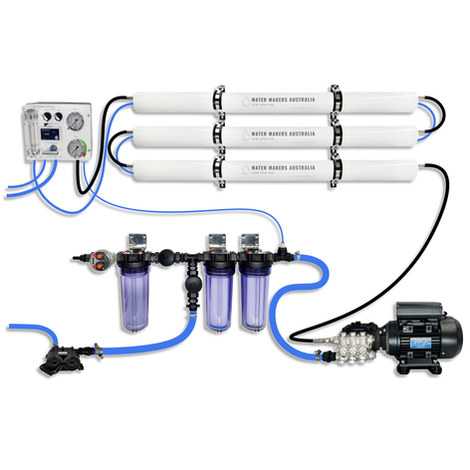
A three-membrane modular watermaker with 200 L/h nominal output and up to 240 L/h family-level marketing, for larger crews and heavy use.
Explore →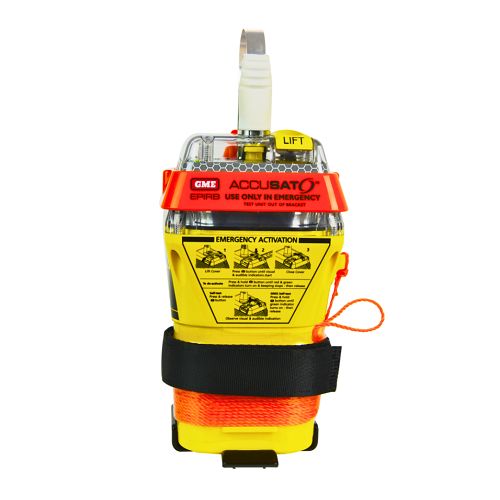
A 10‑year battery EPIRB with integrated GNSS (supports GPS and Galileo), infrared strobe and 121.5 MHz homing signal. Approved for worldwide COSPAS‑SARSAT operation.
Explore →
Self-contained, battery-powered plug‑and‑play autopilot designed for standard hydraulic steering systems.
Explore →