Loading this page…

Loading this page…
Sailing club
Kogarah Bay Sailing Club is a family-friendly dinghy club based at Dover Park, Blakehurst (Kogarah Bay) on the Georges River. The club runs regular class racing for Sabres and RS Aeros plus an Open dinghy division, a well-established Sailability programme for sailors with disability, a Tackers learn-to-sail school for children, and an active Radio Yacht section (International One Metre and similar classes). Club facilities include a clubhouse with showers, a jetty and pontoon, and an elevated radio‑yacht control area overlooking the course.
About
Kogarah Bay Sailing Club is a family-friendly dinghy club based at Dover Park, Blakehurst (Kogarah Bay) on the Georges River. The club runs regular class racing for Sabres and RS Aeros plus an Open dinghy division, a well-established Sailability programme for sailors with disability, a Tackers learn-to-sail school for children, and an active Radio Yacht section (International One Metre and similar classes). Club facilities include a clubhouse with showers, a jetty and pontoon, and an elevated radio‑yacht control area overlooking the course.
Service area: Dover Park East, Blakehurst — Kogarah Bay on the Georges River, Sydney (NSW).
Keep exploring
Kogarah Bay Sailing Club is a community, non-profit sailing club located at Dover Park in Blakehurst, NSW. The club runs organised sailing and racing programs for all ages, operates a Tackers sailing school for children (ages 7–12) with Australian Sailing–qualified instructors, hosts events and series races, and offers facilities such as showers. Contact details are provided on the club website.
The program that deserves top billing here is Sailability. From the southern end of Dover Park, with easy parking and good wheelchair access, volunteer crews run sailing for people with disabilities every second Saturday through summer and weekly in winter, from 9 am to 1 pm, charging just $10 a day with lunch available for $5. The operation runs on the dedication of named volunteers — Joe Naayen, Martin Henry, and Howard and Norma Courtney among them — and the team collected the 2010 Sydney South Volunteer Team of the Year honour for its work with disabled sailors. It is the kind of sustained, unglamorous community service that rarely makes headlines but changes lives week after week.
For youngsters, the club runs a Tackers Sailing School, Australian Sailing's games-based introduction for children aged seven to twelve. The full ladder is on offer: children begin at Tackers 1 Having Fun, progress through Tackers 2 Tricks & Techniques and graduate from Tackers 3 Sailing Fast. Each level asks 20 hours of participation, taught by an Australian Sailing qualified Instructor in small groups, with every boat and piece of gear supplied, and nobody needs to join the club to take part.
Courses run either as four-to-five-day holiday blocks or as a series of weekend and after-school sessions, with Secretary/Treasurer Cliff Lewis doubling as the sailing school contact. Graduates can step naturally into the club's junior-friendly Open class racing, where Herons and RS Quests give young crews forgiving platforms to race on. Formal Discover Sailing Centre accreditation is not recorded, though the delivery of the accredited Tackers syllabus speaks for itself.
The address is Dover Park East, Blakehurst, at the southern end of the park, where Kogarah Bay opens off the Georges River in Sydney's south; mail goes to PO Box 242 at Southgate Shopping Centre, Sylvania. The club describes its home water as a safe sailing location with great breezes from any direction — particularly from the south and north — and a world away from the congestion of Sydney Harbour. That assessment comes from sailors who could choose elsewhere, and the radio-yacht fraternity agrees: their account of the bay notes open water with breeze from almost every point of the compass, south, north and east especially, and the telling detail that in summer the smaller 'B' rigs are used as often as the full-height 'A' rigs — shorthand for a venue where fresh wind is the rule rather than the exception.
Onshore, the facilities serve all three arms of the club. The clubhouse has showers available to members, students and visitors, and the radio sailors enjoy an elevated control area overlooking the course, a 25-metre jetty and a broad, steady pontoon from which their metre-long racers are launched. For Sailability, the flat southern end of Dover Park, easy parking and proper wheelchair access make the logistics of adaptive sailing workable.
Kogarah Bay itself is a protected river inlet — shallow, enclosed and forgiving — which is precisely what a learn-to-sail program, a disabled-sailing operation and a family dinghy fleet all need. Like most river venues, it rewards sailors who can read a shifting breeze off the surrounding ridges and suburbs, and the enclosed water means the sea state rarely gets up even when the wind does — one more reason three generations of the same family can sail here on the same afternoon.
The clearest account of the club's beginning comes from someone who was there. Writing in the local historical society's journal, Graham Knowles stated: "In 1949 I was one of the foundation members of the Kogarah Bay Sailing Club." He remembered the early fleet racing VJs from a clubhouse that stood some 300 yards up the beach from the building there now. The club's own summary is vaguer, putting its age at merely more than 50 years as a non-profit, but Knowles's first-hand 1949 testimony is the firmer evidence, and it fits the trail that follows: in November 1952 three Kogarah Bay boats trailered north to Palm Beach and lined up in a fleet of roughly 200 starters at the NSW VJ state championships, an outing recorded in The St George Call.
The VJ years produced the club's most famous alumni. Grant McInnes was an 18-year-old sailing a second-hand VJ named "Johnny M" when he took up the sport here in 1964; alongside brother Ross he would lift the VJ Commonwealth Championship three years running — 1967–68, then 1968–69 and 1969–70 — in the celebrated "Big Mac". Their great mate Peter Grien, another of the bay's VJ sailors, bought the former championship winner "Chiasma", and the pair were bold enough to ring champion sailors Jim Hardy and Ken Beashel out of the blue for advice.
The skiff heritage got a salute in the early 1990s, when the Australian Historical Sailing Skiff Association's veteran 10-footers "Wee Georgie" and "Janis" dropped in on a club race day. The modern chapters are the Kogarah Bay Radio Yacht Club, formed in 2001 with seven members and grown past 30, which put on the Milo ARYA National Championships (2005) and the NAB ARYA National Championships (2011), and the Sailability team's Volunteer Team of the Year honour in 2010.
Apollo Bay is a small working harbour on Victoria’s Great Ocean Road where sheltered inshore sailing meets the Southern Ocean. The character is a mix of protected harbour berths and an exposed open coast: pleasant day-sails and sheltered weekend cruising inside the bay, with demanding coastal passages immediately offshore where south‑westerly swell and strong winds from the Southern Ocean dominate. It suits coastal cruisers, trailer sailors who launch at the ramp, and experienced coastal sailors who understand bar and swell behaviour; it is not a casual open‑ocean anchorage for unprepared or

Progress gradually by increasing exposure, practising specific skills, sailing with more experienced crew/skippers, and deliberately training for each new step—start in calm sheltered bays, then move to longer trips, busier waters, stronger winds and finally open coastal passages when you and your crew are consistently competent and comfortable.
Explore →
Late spring to summer is usually the best time for beginners to start learning to sail in Tasmania because the weather is generally warmer, days are longer and conditions are often more settled. Expect lighter to moderate winds with regular afternoon sea breees in summer, while spring and autumn bring more changeable and sometimes stronger conditions; winter is colder, wetter and typically windier with more fronts and swell.
Explore →
Pick a protected bay, estuary or river reach where you can rig, launch and arrive on calm water within a short, sheltered transit; choose a site with a good ramp or jetty, clear recovery options and a nearby sailing club, marina or commercial operator for local knowledge and help.
Explore →
Pick a stable, simple, forgiving dinghy with a single sail or basic sloop rig, affordable handling and easy maintenance—ideally one with a local class or school nearby so you can access coaching and spare parts.
Explore →A practical guide for recreational sailors planning day sails or short cruises around Batemans Bay, Broulee and the Clyde River. Covers local conditions, safe approaches, anchorages, launching, tides, common hazards, and checklists for trip planning and on-water decisions.
Explore →
A practical guide for new sailors on picking the right Australian sailing club: training, boat access, racing, social fit, costs and the key questions to ask before joining.
Explore →Practical guide for recreational sailors planning passage on the Hawkesbury River: how to plan around tides, choose anchorages, read local conditions and prepare the boat and crew for a safe, comfortable trip.
Explore →
A practical, Australia-focused guide for planning and sailing around the Whitsunday Islands: weather and seasons, navigation and anchoring, moorings and parks, provisioning and charters, safety and common mistakes, plus checklists and next steps.
Explore →Burke Yachtsman Gear Bag 40L - Shop Now Zip Pay | Tamar Marine Skip to content 59 – 63 Holbrook Street, Invermay Online Shop Open 24/7 Products search Contact us 1300 MARINE $ 0.00 0 Cart Burke Yachtsman Gear Bag 40L $ 79.90 Colour Choose an option Black Blue Black Blue Clear - Burke Yachtsman Gear Bag 40L quantity + Add to cart Enquire about this product SKU BAGB-Y24/BLACK* Category Bags - Sail & Gear A Burke classic and customer favourite, the Yachtsman’s Gear Bag is built tough to handle wet, salty conditions while keeping your gear dry and protected. Made from double coated waterproof…
Explore →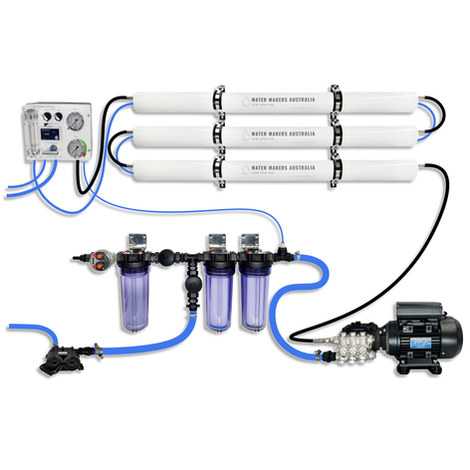
A three-membrane modular watermaker with 200 L/h nominal output and up to 240 L/h family-level marketing, for larger crews and heavy use.
Explore →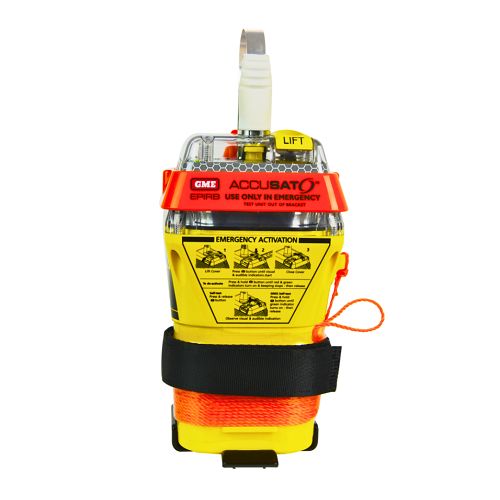
A 10‑year battery EPIRB with integrated GNSS (supports GPS and Galileo), infrared strobe and 121.5 MHz homing signal. Approved for worldwide COSPAS‑SARSAT operation.
Explore →
Self-contained, battery-powered plug‑and‑play autopilot designed for standard hydraulic steering systems.
Explore →