Loading this page…

Loading this page…
Sailing club
Manning River Sailing Club is a family-focused dinghy club based on the Manning River at Taree, NSW. The club has a strong junior development tradition (Sabots feeding into VJ two-person racing boats), supports Sailability programs, and operates from a clubhouse and rigging area on William Wynter Drive with river access and a concrete launching ramp.
About
Manning River Sailing Club is a family-focused dinghy club based on the Manning River at Taree, NSW. The club has a strong junior development tradition (Sabots feeding into VJ two-person racing boats), supports Sailability programs, and operates from a clubhouse and rigging area on William Wynter Drive with river access and a concrete launching ramp.
Service area: Taree and the Manning River (Mid North Coast, NSW)
Keep exploring
"We have whole families racing and call ourselves 'the family club'" — that is how Manning River Sailing Club describes itself, and the record bears it out. Based on the river at Taree, this is a multi-generational dinghy club whose roots run back through the VJ and Sabot eras, and whose alumni include an Olympic bronze medallist and national champions produced from a small Mid North Coast town. Ian Ruff, who won bronze in the 470 class at the 1976 Montreal Olympics, learnt his sailing on the Manning River in the VJ "Heroic"; club champion John Muscio collected junior state, senior state and Australian VJ titles across three consecutive seasons in the early 1980s.
One clarification matters for visitors: Taree is home to two intertwined sailing bodies. The Manning River Vee-Ess Sailing Club, formed in 1946, became the licensed Taree Aquatic Club at the foot of Macquarie Street, while the VJ and Sabot clubs that amalgamated in 1979 became today's Manning River Sailing Club on William Wynter Drive. They are separate organisations — the Aquatic Club's own risk manual notes that junior sail training for the area is carried out by Manning River Sailing Club.
The clubhouse doubles as a community asset, its upstairs hall hired for local functions and meetings, and a disabled access ramp opens the building to Sailability participants. For sailors, the appeal is straightforward: wide, smooth river water, a strong junior tradition, a welcoming family culture and a heritage that includes hosting the 1984–85 Australian VJ Championships, when entries came from as far away as Western Australia for the class's 50th anniversary.
Junior development is the thread that has held this club together for more than half a century. Back in 1968–69, forward-thinking parents went looking for a proper training boat for young children, and the result was the Manning River Sabot Sailing Club, officially begun in 1969 and sailing off the bank at Fotheringham Park. The Sabot was chosen specifically as a nursery class to feed the VJ racing fleet, and the two clubs worked side by side — most parents had children in each class — until they amalgamated in 1979. That deliberate pathway, small trainer into lively two-hand racing dinghy, produced state and national champions and at least one Olympian.
The training role remains formalised today: the Taree Aquatic Club's risk management manual records that junior sail training for the district is carried out by Manning River Sailing Club Inc. A current weekly racing schedule and class list are not published, but the river's recent sailing instructions reference VSs, MGs, NS14s, Flying 11s, Manly Juniors and trailer yachts alongside the traditional VJs and Sabots, so the junior who learns here graduates into a genuinely varied local scene.
The club's most distinctive modern program is its support of Sailability Manning River Taree, a volunteer-run, not-for-profit branch of Sailability NSW operating with the club's backing. Using stable one- and two-seater yachts designed not to tip, the branch offers recreational, therapeutic and competitive sailing to people with disability, and the club has built a disabled access ramp so participants can reach all areas and facilities. It is a natural extension of the family-club ethos: sailing here has always been about getting the next person onto the water, whatever their age or circumstance.
The clubhouse stands on William Wynter Drive (78 River Street) in central Taree — just off the main road, behind the KFC and beside the Manning River Rowing Club, by Bicentennial Gardens. Facilities include an abundant rigging area, a large concrete launching ramp, carpark, a pontoon-style wharf, change-rooms and an upstairs hall with kitchen facilities for hire. The balcony, kitchen and Sailing Control Room all take in expansive views over the river, and finishes have historically been judged from the clubhouse itself, with committee-vessel starts and three-hour time limits the traditional race-management pattern.
The sailing water is the Manning River, which offers long reaches of broad, calm water and gentle breezes. Downstream, around 150 kilometres of navigable waterways run to the sea at Harrington and Manning Point, where a bar gives access to the Tasman Sea — a cruising horizon few inland clubs can match. The river is tidal at Taree and the current can matter on race day, rewarding sailors who read the banks and bends well.
Two forces of nature have shaped the club's relationship with its venue. The first is traffic: speedboats once made sailing near town unsafe, and the club relocated its racing to Shallow Island for safety. The second is flood. The Manning rises with little warning — the March 1978 flood reached 5.45 metres at Martin Bridge and inundated both the Rowing and Sailing Clubs along the Taree riverbank, and an earlier flood in 1954 washed away the VJs' first shed entirely. Sailing here means respecting the river in all its moods, and the club's long survival says it has learnt the lesson well.
Sailing on the Manning predates the club by decades. The Manning River Rowing and Sailing Club ran events from at least 1889, including the wildly popular Croki Boxing Day regattas, before winding up the regattas in 1934 and folding in 1937. The modern lineage begins in 1946, when Vee Jays first appeared on the river, sailing alongside the 16-footers and Vee-Ess from the North Coast Steam Ship Company wharf where the boats were housed; among the early VJs were "Rusher" and "Swan", the latter built by local identity Mr Ray Wine.
By about 1950 the VJs had shifted into a modest shed beside the wharf — lost to the 1954 flood — and in 1956 the boats shifted into the lower section of a new clubhouse near Martin Bridge, built with public funds.
Competition meant travel in those years. Manning boats raced at Gosford and Teralba, where scratch boats from the river were given twelve-to-fifteen-minute handicaps by the so-called country club sailors, and qualifying for state titles meant trips to Northern Zone venues from the Hawkesbury to Brisbane. Garry Hobson and Leigh Davidson won the 1969–70 VJ Senior State Championship in "Sigma" the hard way, and the formation of the North Coast Branch on 31 July 1974 — incorporating Cundletown, Great Lakes and the Manning club — finally ended the long-distance qualifying burden.
The Sabot club commenced in 1969, and when speedboats made town sailing dangerous, a joint VJ–Sabot submission to the Commonwealth R.E.D. Scheme funded a new clubhouse at Shallow Island, commenced in 1977. The clubs amalgamated in 1979, and by the mid-1980s, following a lean patch, 22 VJs and 20 Sabots were sailing regularly. The decade's centrepiece was the 1984–85 Australian VJ Championships at Taree — the class's 50th anniversary, sponsored solely by Volvo Australia, with regatta headquarters in the club's main hall.
Batemans Bay and the Clyde River form a classic NSW South Coast cruising region where a sheltered, tidal estuary meets a short, island‑dotted entrance to the Tasman Sea. It’s distinctive for easy access from Canberra, a mix of river and bay sailing, a compact marina and mooring network, and a river entrance (the Clyde River bar) that can change rapidly. The area suits day sails, weekend cruising, trailer‑boat exploration and sheltered coastal passages; offshore or long‑passage plans require careful timing and local knowledge. Preparation for tidal flow, variable southerly swells and shallow, s

Look for a friendly club with beginner-focused training, accessible facilities and boats, a supportive community, clear safety practices, and opportunities to progress at your own pace.
Explore →
Write a one‑page plan with the who/what/when/where/how of your trip, keep a copy on board and leave the main copy with a responsible person ashore (and optionally with your club, marina office or local volunteer rescue service).
Explore →
Expect light to moderate, thermally-driven sea breezes in summer with afternoon strengthening; more changeable and often stronger winds with frontal systems in autumn and spring; and the windiest, roughest conditions in winter when cold fronts and sou’westers are most frequent. Gulf St Vincent is more sheltered than the exposed coast but can still produce steep chop and sudden changes near Adelaide and headlands.
Explore →
Pick a stable, simple, forgiving dinghy with a single sail or basic sloop rig, affordable handling and easy maintenance—ideally one with a local class or school nearby so you can access coaching and spare parts.
Explore →
A practical guide for new sailors on picking the right Australian sailing club: training, boat access, racing, social fit, costs and the key questions to ask before joining.
Explore →
A practical guide to the safety equipment commonly carried on recreational sailing boats in Australia: lifejackets, EPIRBs/PLBs, flares, radios, fire extinguishers, liferafts, jacklines, first-aid and how state requirements influence what you must carry.
Explore →Practical guide for recreational sailors planning passage on the Hawkesbury River: how to plan around tides, choose anchorages, read local conditions and prepare the boat and crew for a safe, comfortable trip.
Explore →
A practical, Australia-focused guide for planning and sailing around the Whitsunday Islands: weather and seasons, navigation and anchoring, moorings and parks, provisioning and charters, safety and common mistakes, plus checklists and next steps.
Explore →Burke Yachtsman Gear Bag 40L - Shop Now Zip Pay | Tamar Marine Skip to content 59 – 63 Holbrook Street, Invermay Online Shop Open 24/7 Products search Contact us 1300 MARINE $ 0.00 0 Cart Burke Yachtsman Gear Bag 40L $ 79.90 Colour Choose an option Black Blue Black Blue Clear - Burke Yachtsman Gear Bag 40L quantity + Add to cart Enquire about this product SKU BAGB-Y24/BLACK* Category Bags - Sail & Gear A Burke classic and customer favourite, the Yachtsman’s Gear Bag is built tough to handle wet, salty conditions while keeping your gear dry and protected. Made from double coated waterproof…
Explore →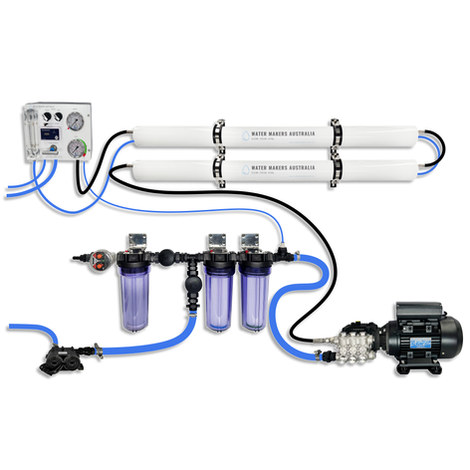
A two-membrane modular watermaker with 140 L/h nominal output, aimed at families and liveaboards that want more water per run.
Explore →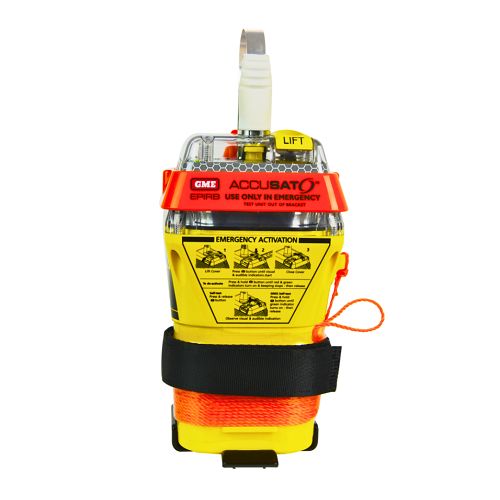
A 10‑year battery EPIRB with integrated GNSS (supports GPS and Galileo), infrared strobe and 121.5 MHz homing signal. Approved for worldwide COSPAS‑SARSAT operation.
Explore →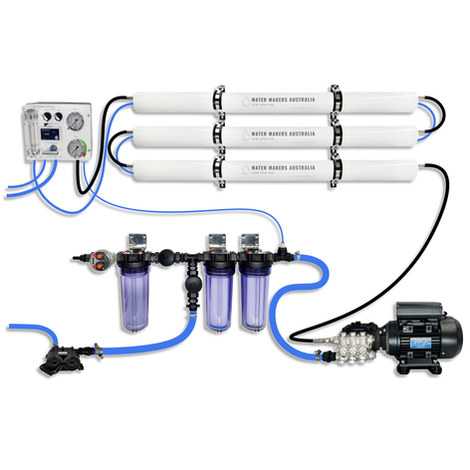
A three-membrane modular watermaker with 200 L/h nominal output and up to 240 L/h family-level marketing, for larger crews and heavy use.
Explore →