Loading this page…

Loading this page…
Sailing club
Port Macquarie Yacht Club (PMYC) is a keelboat-focused sailing club on the Mid North Coast of New South Wales. PMYC runs year‑round inshore racing on the Hastings River and an active offshore programme into the Tasman Sea, with Sunday races every week and twilight pointscore racing during daylight saving. The club operates as a member club of Yachting NSW and meets at the Port Macquarie Sailing Club premises at Settlement Point.
About
Port Macquarie Yacht Club (PMYC) is a keelboat-focused sailing club on the Mid North Coast of New South Wales. PMYC runs year‑round inshore racing on the Hastings River and an active offshore programme into the Tasman Sea, with Sunday races every week and twilight pointscore racing during daylight saving. The club operates as a member club of Yachting NSW and meets at the Port Macquarie Sailing Club premises at Settlement Point.
Service area: Hastings River and adjacent Tasman Sea (Port Macquarie, NSW)
Keep exploring
Port Macquarie Yacht Club is a community yacht club in Port Macquarie, NSW, that organises regular sailing and racing programs. The club runs weekly river and offshore races (including inshore, offshore and twilight point-score series), several regattas and trophy offshore events, Australia Day activities, and occasional social sails and BBQs. The fleet ranges from deep-keel offshore yachts to trailer yachts; the club requires annual equipment audits for racing entries and is a member club of Yachting NSW. Contact email listed on the site: contact-us@pmyc.com.au.
Rather than courses, this club teaches through a safety culture that doubles as seamanship training. Every yacht on the racing register must pass an annual Category 4 or Category 7 equipment audit, and the club treats situational training — man overboard practice above all — as desirable preparation. The point was proved when one crew earned audit exemptions after performing a real man-overboard recovery: competence demonstrated in earnest counts for more than a checklist.
For newcomers, the entry point is the free annual Discover Sailing Day on the Hastings River, co-hosted with the Port Macquarie Sailing Club and Sailability, where the Yacht Club's sessions — open to participants from fifteen up — offer short sails with experienced sailors and an introduction to further courses.
From there, racing itself is the development pathway, and the handicapping is built to encourage it. Both the annual river series and the ocean series are scored on performance handicapping rather than ratings, so improvement is rewarded directly: sail better this month than last and the system notices. With more than seventy races across the calendar — Sunday racing year-round, Thursday twilight pointscores in daylight saving, a one-day inshore regatta and a two-day offshore regatta, plus two weekend offshore trophy events that run south to Laurieton on the Camden Haven River, overnighting there — a committed novice can accumulate experience faster here than almost anywhere.
The variety of the fleet helps too: twenty-foot trailer yachts and forty-foot deep-keelers race in the same divisions, so skills transfer across boat types. There is no club-run sailing school, no Tackers and no Discover Sailing Centre accreditation — PMYC is a keelboat owners' club and says so plainly. What it offers is an apprenticeship in real conditions, river and Tasman Sea alike, underpinned by audits, handicaps that reward progress, and crews who plainly enjoy bringing sailors on.
Two very different arenas share the club's calendar. Inshore racing unfolds on the Hastings River, with courses starting from Settlement Point and running variously between the Settlement Point and Hibbard ferries, to a turning mark at Dennis Bridge, or upriver to the Maria River. These river races are scheduled around the tides, and even then they can be ordeals: the club describes its river "C" races as among the most problematic on the annual calendar, citing unreliable and inconsistent breezes, unhelpful tides and groundings among the hazards. A minimum breeze of about four and a half knots is required before a race can start at all — a rule born of long experience with river doldrums.
Offshore, the fleet heads out onto the Tasman Sea, where conditions can be genuinely testing. One recent offshore start was debated at length by skippers facing a forecast twenty-five-knot southerly with seas to three metres — the kind of conversation that separates a real ocean-racing culture from a fair-weather one. The offshore program includes two weekend trophy events south to Laurieton on the Camden Haven River, sleeping over before the run home, plus a two-day offshore regatta staged later in the year, balanced by a one-day inshore regatta in the first half and a special Australia Day event.
Port Macquarie's bar and coastal weather demand respect, and the annual Category 4 or 7 audits keep boats and crews honest. Ashore, the club borrows its infrastructure: monthly meetings are held on the third Monday from six o'clock at the Port Macquarie Sailing Club premises at Settlement Point, an arrangement that has anchored the two clubs' close relationship for decades. Between a tidal river that punishes inattention and an ocean that punishes overconfidence, PMYC sailors earn their seamanship in full.
The founding date is precise — 3 August 1981 — and the founding fleet was not what you might expect: 18-foot catamarans sailing without electronics, campaigned by a passionate group of sailors who wanted organised yachting competition in Port Macquarie. From that beach-cat beginning the club evolved steadily into a modern yacht fleet of trailer yachts and deep-keel offshore vessels, while never acquiring a clubhouse of its own.
The lack of a building became, if anything, a point of pride, because the club's real asset was its unbroken competition record — offshore and inshore racing staged continuously for forty-three years, interrupted only by the pandemic. A club history celebration honoured long-term members with life membership, and three sailors active since the early 1980s were inducted into the club's own invention, the Royal Order of the Bath & Tiller.
The traditions that have accumulated along the way give the club its distinctive voice. The Katiward Broken Oar recognises hard luck; the Order of the Pike Sword and Grappling Hook, long dormant, was brought back for Basia Dworak aboard Kookaburra 2; the Charles Nichol trophy, sailed in pursuit format, honours Charlie Nichol; and handicapper Ken McDonald has been saluted as the glue keeping the whole show together.
The club's race reports, published on its website, have become minor literature in their own right — witty, self-deprecating and quoted with relish. Active racing yachts in recent seasons include Cool Change, Third Man, Razzamatazz 2, Kookaburra 2, Larissa Trapeznikova's Ninja and Andrew Walmsley's Enticer. Membership of Yachting NSW ties the club to the state body, while the monthly meeting at the Sailing Club's Settlement Point clubhouse keeps it rooted in the town's wider sailing community — a nomad club with a permanent home in everything but title deeds.

Expect the usual IALA-B lateral system (red and green), cardinal and isolated-danger marks, safe-water and special marks, plus harbour-specific fairway buoys, leading/transit marks and exclusion or speed‑limit buoys. Check local harbour charts and Notices to Mariners for exact positions and light characteristics before entry.
Explore →
Plan to transit Sydney Heads and northern NSW estuary entrances to take advantage of favourable tidal streams or slack water; account for local acceleration over shoals, eddies, wind-on-current effects and river discharge, and always check the latest local observations and tide/stream products before departure.
Explore →
Plan as a chain of conservative daily legs tied to your boat’s real-world fuel and speed in the expected sea state, with confirmed primary and alternate anchorages/berths, fuel legs and back-up fuel options, and a documented emergency/diversion plan (comms, tow and med-evac). Build tidal and weather gates into each leg and carry chart and comms redundancy.
Explore →
Legal requirements can change — check Transport for NSW for the current rules. As a practical baseline for coastal day sailing from NSW shores: keep the right number and type of lifejackets for everyone, have a means of calling for help, show navigation lights if you’ll be out after dusk, and carry basic items to manage a man‑overboard or abandon‑ship situation. Add anchor, bilge/bailer, sun/protection and basic repair kit as recommended items.
Explore →A practical guide to preparing, planning and executing a recreational offshore passage along the New South Wales coast. Covers route selection, weather and tidal considerations, vessel and crew checks, safety equipment, communication, watchkeeping and common mistakes, with clear pre‑departure and underway checklists.
Explore →A practical guide for recreational sailors planning short trips or multi-day cruises around Port Stephens, the Myall Coast and nearby offshore waters. Covers local geography, common conditions, navigation considerations, anchoring and mooring tips, and safety checklists tailored to Australian conditions.
Explore →Practical guide for recreational sailors planning passage on the Hawkesbury River: how to plan around tides, choose anchorages, read local conditions and prepare the boat and crew for a safe, comfortable trip.
Explore →
A practical guide for new sailors on picking the right Australian sailing club: training, boat access, racing, social fit, costs and the key questions to ask before joining.
Explore →
The entry-level Poclink push-to-talk radio: 4G mobile network only, three years of service included, sold as a two-pack for half the price of the Pro and Ultra.
Explore →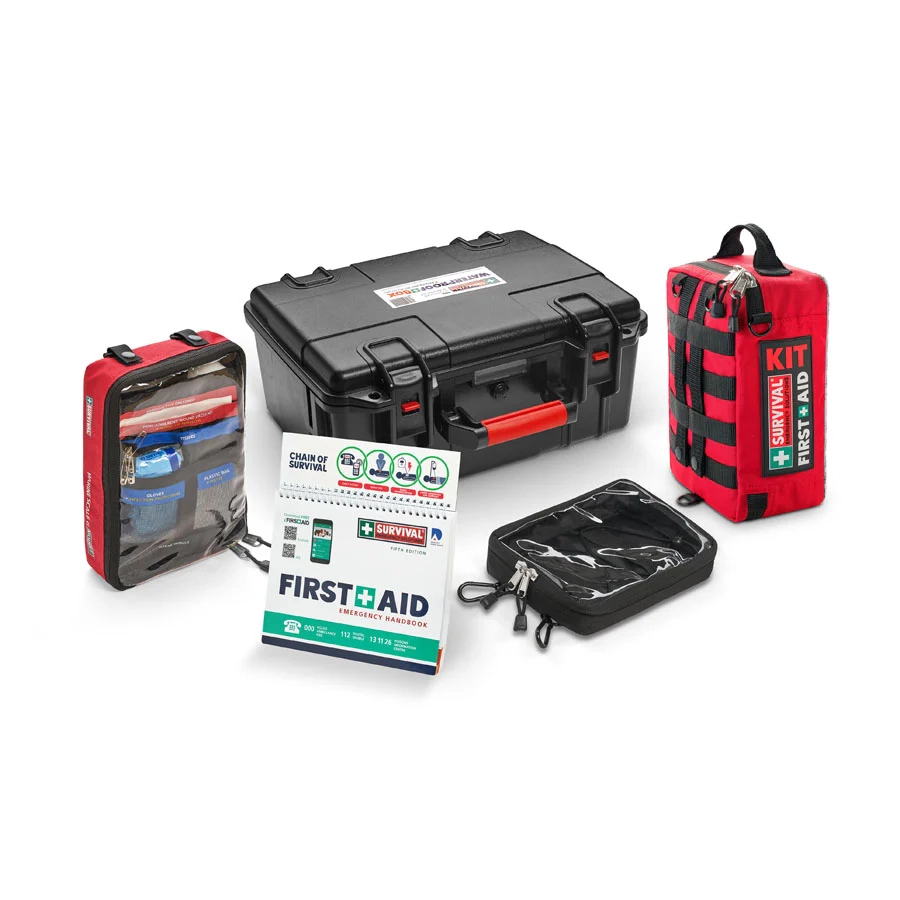
A 142-item marine first aid kit built around the Australian Scale G requirement, with a workplace kit, a Scale G module and a handbook packed in a large waterproof box.
Explore →
Push-to-talk radio that works over 4G mobile networks and Wi-Fi, including a Starlink router, with GPS tracking and an SOS button. Sold as a two-pack.
Explore →
Push-to-talk radio that uses 4G mobile networks where there is coverage and a built-in 16-channel analog radio where there is none, with GPS and SOS. Sold as a two-pack.
Explore →