Loading this page…

Loading this page…
Sailing club
Taree Aquatic Club (trading as Sailos) is a licensed community club and active dinghy/trailer-yacht sailing club on the Manning River at 1 Macquarie Street, Taree, NSW. The club combines hospitality and functions with a long-established sailing section that races dinghies and trailer yachts on a river course that starts and finishes at the clubhouse.
About
Taree Aquatic Club (trading as Sailos) is a licensed community club and active dinghy/trailer-yacht sailing club on the Manning River at 1 Macquarie Street, Taree, NSW. The club combines hospitality and functions with a long-established sailing section that races dinghies and trailer yachts on a river course that starts and finishes at the clubhouse.
Service area: Taree / Manning Valley, Mid North Coast, New South Wales
Keep exploring
Few sailing clubs in New South Wales live two lives quite as openly as Taree Aquatic Club. Walk in off Macquarie Street and you are in Sailos, a licensed club with a restaurant, gaming, functions and live entertainment marketed on dining beside the Manning River. Step out the back on a summer weekend and you are at the start line of a dinghy club whose roots run to 1946, with race signals flown from the balcony and a finish line that stretches from an outer pink buoy back to the club wall. The two identities are not at war — the hospitality business has, for decades, paid for the sailing — but together they make this one of the more distinctive institutions on the Mid North Coast.
The sailing section carries a heritage fleet of classes that tells the story of post-war Australian dinghy racing: Vee-Esses and MGs, NS14s, Flying 11s, Manly Juniors and Sabots, with trailer yachts filling out the divisions. Racing is organised under the club's own sailing instructions across Divisions One, Two and Three plus a trailer yacht division, with trophies for any constituted class that puts five or more boats on the water. It is competitive but unpretentious club racing on the river, the kind where senior sailors double as junior coaches and everyone takes a turn on duty crew.
The club's story is also the river's story. Organised aquatic sport on the Manning stretches back to at least 1889, when the Manning River Rowing and Sailing Club was running events, and the Croki Boxing Day regattas drew crowds until 1934; the Manning River Aquatic Association's Australia Day carnival ran for more than 40 years from 1950. Taree Aquatic Club sits squarely in that tradition — a community institution that happens to race sailboats, and a sailing club that happens to serve a very good lunch.
The most striking feature of the sailing program at Taree is how thoroughly junior training is woven into race day itself. There is no separate sailing school; instead, every senior crew is rostered for junior training duty. On race days the juniors gather for onshore tuition with senior members from 12.15 to 12.45, then take to the water for coached sailing and course racing between 12.45 and 1.45 — finishing just as the senior scratch races begin their starting sequence from one o'clock.
It is an apprenticeship model from an earlier era of club sailing, and it has the great virtue that young sailors learn on the same water, on the same afternoon, from the people they will soon be racing against. Australian Sailing Discover Sailing Centre accreditation and a formal Tackers program are not part of the picture; the club's own system does the work.
The class structure supports that ladder. Sabots and Manly Juniors give young sailors their first boats, the NS14s and Flying 11s offer two-handed development, and the historic VS and MG fleets — the classes the club was literally founded on — connect new members to the Manning's sailing lineage. Trailer yachts broaden the pathway for adults, and class trophies — awarded once a fleet fields five or more starters — give every division something to race for.
The inclusive side of the sport is covered by a close neighbour: Sailability Manning River Taree, a branch of Sailability NSW, operates in the town with the support of the Manning River sailing community, using purpose-built, uncapsizable one- and two-seater dinghies to put people of all ages and abilities on the water. Between the rostered junior tuition, the class racing and the Sailability presence, sailing in Taree reaches further than the club's own membership list might suggest — a community program wearing race-day clothes.
The clubhouse occupies 1 Macquarie Street, Taree, with absolute frontage to the Manning River at the foot of the town's main street grid. It is a genuinely rare arrangement for a sailing club: the course begins and ends at the front door. The finish line stretches from an outer pink buoy back to the clubhouse wall, course numbers are displayed from the balcony, and race signals are made ashore from the same vantage point — spectators can watch an entire race unfold from the club with a meal and a cold drink in hand.
The Manning River at Taree is serious racing water. Broad, straight and sheltered, it has long hosted a 2000-metre, six-lane rowing course that ends at the Manning River Rowing Club's boatshed — a course that exists precisely because this reach of the river offers the flat, protected water that competitive boat sport demands. For dinghies and trailer yachts the river gives steady, shifty-in-places breezes shaped by the valley, tidal flow to keep tacticians honest, and enough room for proper course racing directly in front of town.
The club's earliest home, the North Coast Steam Navigation Company's wharf shed beside Martin Bridge, stood only a short distance upstream, so the sailing waters have barely changed in three-quarters of a century.
Taree itself is the service centre of the Manning Valley, roughly three and a half hours north of Sydney on the Mid North Coast, and the river is its spine — the town famously straddles both banks, joined by the Martin Bridge. The club leans into the setting: the brick clubhouse, rebuilt and extended over the decades, opens to river views from the dining room and balconies, and the club markets those views proudly. For visiting sailors, the combination is easy to grasp — country-town hospitality, sheltered championship-quality water, and a regatta course you can watch from the balcony.
The club was officially formed in 1946 as the Manning River Vee-Ess Sailing Club, affiliated with the Vaucluse Amateur Sailing Association, and its first home was a wharf shed belonging to the North Coast Steam Navigation Company beside the Martin Bridge. A Vee-Jay club followed in January 1947, sharing the same shed. These were the great years of the VS and VJ classes in Australia, and the Manning sailors were part of the wave from the start.
Self-reliance defined the early decades. In 1950 members resolved to erect their own shed at the Macquarie Street end of the riverbank; a $600 bank advance got things started and voluntary labour did the rest. Eight years later, with fleets and membership outgrowing the shed, the club secured a Conditional Club Licence, sold debentures and borrowed from the bank, completing the first section of today's brick clubhouse in December 1958.
Mr Bill Northam did the honours at the official opening of extensions on 8 November 1968 — the club records do not confirm whether this was Sir William Northam, Australia's 1964 Olympic 5.5 Metre sailing gold medallist. The club's own history honours the founders of 1945–46, and the early Ladies Auxiliary recalled as "a tower of strength".
A property across Macquarie Street, on its western side, was bought in 1976, sold off late in the 1980s and bought back in the mid-1990s for future expansion. Then, at the 1988–89 annual general meeting, came the defining modern change: the club renamed itself Taree Aquatic Club to cover a wider membership. Major works followed — a new entrance, foyer and offices in 1999, then a two-stage redevelopment completed in 2007 and 2010 that delivered a refurbished gaming room, lounges and dining areas, balconies overlooking the river and a new kitchen.
The early 2000s had seen profits driven by a Saturday-night nightclub; in 2003 management pivoted back to service, food and membership, a decision the club calls a turning point. Today, trading as Sailos, it stands as a licensed club with nearly eighty years of sailing in its foundations — and a race fleet still finishing at the balcony each season.
Ballina sits at the mouth of the Richmond River on NSW’s far‑north coast. It’s a working river entrance with a compact boat harbour, exposed ocean beaches and a changeable, sand‑dominated bar. For coastal cruisers it offers a useful stop between Tweed Heads and Yamba, sheltered estuary cruising upriver and easy access to open ocean passages — but the river entrance is highly condition‑dependent and demands respectful planning and local knowledge.

Pick a protected bay, estuary or river reach where you can rig, launch and arrive on calm water within a short, sheltered transit; choose a site with a good ramp or jetty, clear recovery options and a nearby sailing club, marina or commercial operator for local knowledge and help.
Explore →
Plan to transit Sydney Heads and northern NSW estuary entrances to take advantage of favourable tidal streams or slack water; account for local acceleration over shoals, eddies, wind-on-current effects and river discharge, and always check the latest local observations and tide/stream products before departure.
Explore →
Late spring to summer is usually the best time for beginners to start learning to sail in Tasmania because the weather is generally warmer, days are longer and conditions are often more settled. Expect lighter to moderate winds with regular afternoon sea breees in summer, while spring and autumn bring more changeable and sometimes stronger conditions; winter is colder, wetter and typically windier with more fronts and swell.
Explore →
Watch for shallow entrance bars, shifting sandbanks and channels, tidal streams that accelerate through narrow channels or around headlands, drying mudflats and sills that expose at low water, and localised eddies or overfalls — and always confirm conditions for the specific estuary before you enter.
Explore →Practical guide for recreational sailors planning passage on the Hawkesbury River: how to plan around tides, choose anchorages, read local conditions and prepare the boat and crew for a safe, comfortable trip.
Explore →
A practical guide for new sailors on picking the right Australian sailing club: training, boat access, racing, social fit, costs and the key questions to ask before joining.
Explore →A practical guide for recreational sailors planning visits to Albany and King George Sound. Covers the main anchorage areas, typical local weather patterns, tidal and current considerations, navigational hazards, on-the-water etiquette and a pre-departure checklist to help you plan a safe passage and enjoyable stopover
Explore →A practical guide for recreational sailors planning day sails or short cruises around Batemans Bay, Broulee and the Clyde River. Covers local conditions, safe approaches, anchorages, launching, tides, common hazards, and checklists for trip planning and on-water decisions.
Explore →Burke Yachtsman Gear Bag 40L - Shop Now Zip Pay | Tamar Marine Skip to content 59 – 63 Holbrook Street, Invermay Online Shop Open 24/7 Products search Contact us 1300 MARINE $ 0.00 0 Cart Burke Yachtsman Gear Bag 40L $ 79.90 Colour Choose an option Black Blue Black Blue Clear - Burke Yachtsman Gear Bag 40L quantity + Add to cart Enquire about this product SKU BAGB-Y24/BLACK* Category Bags - Sail & Gear A Burke classic and customer favourite, the Yachtsman’s Gear Bag is built tough to handle wet, salty conditions while keeping your gear dry and protected. Made from double coated waterproof…
Explore →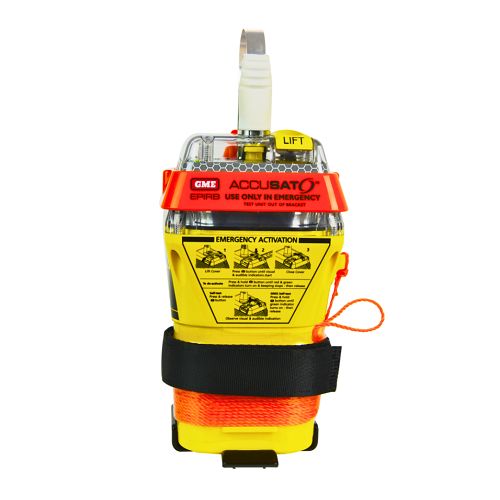
A 10‑year battery EPIRB with integrated GNSS (supports GPS and Galileo), infrared strobe and 121.5 MHz homing signal. Approved for worldwide COSPAS‑SARSAT operation.
Explore →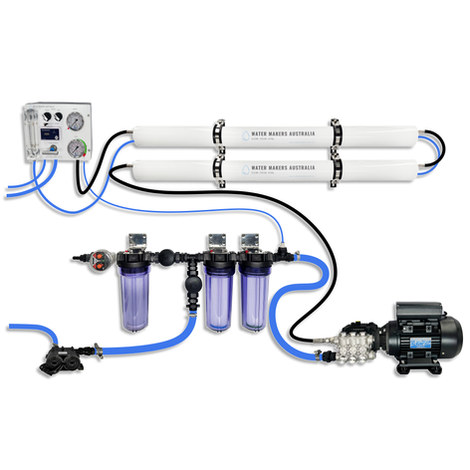
A two-membrane modular watermaker with 140 L/h nominal output, aimed at families and liveaboards that want more water per run.
Explore →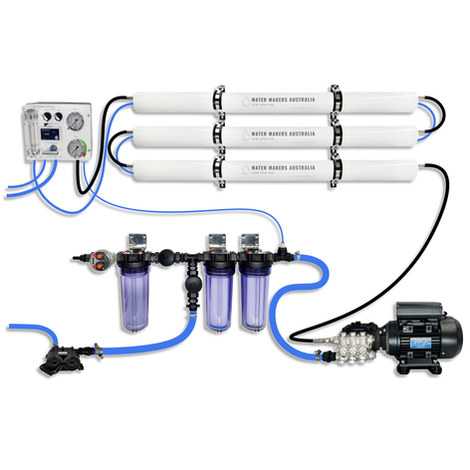
A three-membrane modular watermaker with 200 L/h nominal output and up to 240 L/h family-level marketing, for larger crews and heavy use.
Explore →