Loading this page…

Loading this page…
Sailing club
Barwon Heads Sailing Association (BHSA) is a community sailing club on the Barwon River that runs social sailing, learn-to-sail programs for juniors, teens and adults, and organised racing (including class racing and events such as the Barwon Safari and Australia Day Aggregate). The club offers limited equipment storage, a small shed, and moorings for members on a first-come, first-served basis, and operates a rescue boat to support safe racing and events.
About
Barwon Heads Sailing Association (BHSA) is a community sailing club on the Barwon River that runs social sailing, learn-to-sail programs for juniors, teens and adults, and organised racing (including class racing and events such as the Barwon Safari and Australia Day Aggregate). The club offers limited equipment storage, a small shed, and moorings for members on a first-come, first-served basis, and operates a rescue boat to support safe racing and events.
Service area: Barwon Heads, VIC
Keep exploring
River sailing has a flavour all its own, and the Barwon Heads Sailing Association has been distilling it on the Barwon River estuary since 1968. This small community association on the Bellarine Peninsula carries the jaunty tagline "beginner to Olympic gold!", and the claim behind it is a genuine breadth of membership: first-time sailors in club courses share the water with hardened estuary racers who have read this river for decades, and everyone in between.
The association's soul belongs to the Mirror dinghy. It was founded specifically to organise Mirror class and combined racing on the river, and the little red-sailed gaff-rigged boats shaped the club's early character — fleets of father-and-child crews were the norm in the founding years. The Mirror connection also produced the club's signature event, the Barwon Safari, an annual January expedition up-river towards Tait's Point in the Connewarre Lakes that has run since the mid-1960s in spirit and since 1973 with medallions for every finisher.
The Easter Sheepwash Race, commemorating a founder's hull being spiked by a ti-tree stake on an early Safari, adds a second fixture with genuine folklore behind it.
The association's history is unusually well told, written by founding member and first secretary Frank Steuart, whose garage housed the rescue boat and buoys through the years when the club had no home of its own. Today the club operates from converted space near the Ozone Road Jetty, offers Single Race Sail Passes for visiting sailors, and maintains moorings and a members' buy-and-sell page — small-club sailing, thoughtfully run.
Barwon Heads does something smart that many small clubs can't: it outsources its learn-to-sail delivery to a professional operator while keeping the pathway pointed firmly at club membership. The Smooth Sailing School, run by Tom and Oscar, delivers courses on the river with accredited Australian Sailing instructors, including a January holiday block priced at $435 per course. The full national pathway is on offer locally — Tackers 1 to 3 for seven- to twelve-year-olds, OutThere Sailing for teenagers aged thirteen to seventeen, and Start Sailing and Better Sailing for adults — all taught on calm, protected estuary water that the school promotes as ideal for building first-time confidence.
The handover to the club is the point of the exercise. Early Tackers graduates are actively encouraged into club membership and river racing, and the racing program is deliberately structured to develop new racers' skills and confidence while still giving experienced sailors a proper test. The season opens with the Iceberg Races from October to December, then rolls into the Summer Series, the Barwon Safari and the Easter Races through to April. For teenagers and adults the website carries dedicated program pages, and a "Finding a Boat" guide helps newcomers over the ownership hurdle.
Current fleet photos show the Laser/ILCA strongly represented on the river, and the Mirror heritage still colours the club's character, but the structure matters more than any single class: professional instruction at the front end, welcoming racing at the back, and a river in between that is gentle enough for a seven-year-old's first capsize and tactical enough to keep a veteran reading the tide for decades.
The Barwon River estuary at Barwon Heads is the whole show. The association sails the tidal river from near the Ozone Road Jetty, with courses that historically ran six miles up-river and beyond, towards Tait's Point and the Connewarre Lakes. The club describes the estuary with evident affection as safe and enjoyable yet genuinely challenging for learners and racers alike, and its tortuous courses — winding reaches, bends and tide-affected legs — demand a different skill set from open-bay sailing. Conditions on the river range, in the club's own words, from a quiet glide across sunlit ripples to muscle-wrecking howling gales, sometimes within the same afternoon.
For learners the appeal is obvious: protected water, no ocean swell, and plenty of room to make mistakes safely. For racers the river's subtleties — tidal flow, shifting pressure off the banks, the long fetch up toward the lakes — provide endless tactical variation. There is history written into the geography too: keelboats once raced on the Connewarre Lakes upstream until they silted up, and the annual Safari still retraces the route of those early up-river picnic expeditions.
The clubhouse story is part of the location's charm. After decades of failed attempts to secure a foreshore site, the association at last took possession of its own home in early 2002, converting space left over in the public amenities block by the Ozone Road Jetty, with members doing the refurbishment and painting and rent paid to Barwon Coast. It is an unpretentious base, but it sits exactly where it needs to be — a short trolley run from the river, at the heart of a holiday town that fills with sailing families every summer.
Sailing on the Barwon estuary long predates the association. From the mid-1800s, working fishing boats under sail had moored near Ocean Grove, and informal family racing on the river ran for years before anyone thought to organise it. The catalyst was the Mirror dinghy: from 1967, Scotch College master Rex Fettell promoted the class locally, sparking a crop of father-and-child crews — the Robinsons, Orchards, Lees, Lewins, Scotts, Aitkins, Swans and Morrisons among the early owners.
Around 1966, two of those owners, Hector Bourne and James Campbell, cruised up-river to Tait's Point for a picnic; on that trip a ti-tree stake spiked Campbell's hull, an incident Serena Steuart later immortalised in her trophy for the Easter Sheepwash Race.
The association was formally founded on 14 January 1968, its stated purpose being to run Mirror class and combined racing, with a first subscription of one dollar per boat. Hector Bourne took the presidency, Frank Steuart the secretary's pen, Sylvia Aitken the treasurer's book, James Campbell the vice-presidency and Oscar Meyer the patronage. The first formal race meeting followed on 29 January, a six-mile course from the Ozone Road Jetty up the river and back.
In April 1970 the forty members adopted a constitution and agreed to erect a clubhouse then costed at $3,000 — but repeated approaches to the foreshore authorities from February 1969 onward all failed, and Steuart's garage became the club's de facto boatshed.
The traditions accumulated regardless. The 1972 AGM adopted the Safari Medallion for every finisher and a club burgee; the first medals were awarded at the January 1973 Safari, which drew 31 entries including 21 Mirrors. Incorporation under the Associations Act came on 27 December 1984, and in early 2002 the association at last gained a clubhouse of its own in the converted toilet block by the jetty. Steuart's written history preserves it all — a small club's story, told with a founding member's care.
American River (Kangaroo Island, SA) is a small, sheltered inlet and township on the north‑eastern side of Kangaroo Island that acts as a calm staging point for cruising the eastern part of the island and for short hops through Backstairs Passage. It’s distinctive for its protected anchorage inside Eastern Cove and the adjacency of Pelican Lagoon — a shallow, ecologically important lagoon with sanctuary zoning — which shapes how and where boats can move. The area suits sheltered day sailing, weekend cruising and short coastal passages; it’s appropriate for trailer sailors, small cruisers and a

Look for a friendly club with beginner-focused training, accessible facilities and boats, a supportive community, clear safety practices, and opportunities to progress at your own pace.
Explore →
Late spring to summer is usually the best time for beginners to start learning to sail in Tasmania because the weather is generally warmer, days are longer and conditions are often more settled. Expect lighter to moderate winds with regular afternoon sea breees in summer, while spring and autumn bring more changeable and sometimes stronger conditions; winter is colder, wetter and typically windier with more fronts and swell.
Explore →
Expect very different seasonal systems across Western Australia: the south‑west (Perth to Albany) has a strong summer afternoon sea breeze (the “Fremantle Doctor”) and winter westerly fronts, while northern WA follows a wet/dry monsoonal cycle with strong seasonal onshore winds, thunderstorms and cyclone risk in the wet season. Local headlands, estuaries and tidal flows often change what you actually feel on the water, so learn the local timing and sheltered venues first.
Explore →
Pick a stable, simple, forgiving dinghy with a single sail or basic sloop rig, affordable handling and easy maintenance—ideally one with a local class or school nearby so you can access coaching and spare parts.
Explore →
A practical guide for new sailors on picking the right Australian sailing club: training, boat access, racing, social fit, costs and the key questions to ask before joining.
Explore →
A concise, practical guide to the points of sail and how to trim sails effectively for common Australian conditions. Learn the basics of wind angles, sail shape, telltales, reefing considerations and simple steps to improve boat speed and balance.
Explore →Practical guide for recreational sailors planning passage on the Hawkesbury River: how to plan around tides, choose anchorages, read local conditions and prepare the boat and crew for a safe, comfortable trip.
Explore →A practical guide for recreational sailors planning visits to Albany and King George Sound. Covers the main anchorage areas, typical local weather patterns, tidal and current considerations, navigational hazards, on-the-water etiquette and a pre-departure checklist to help you plan a safe passage and enjoyable stopover
Explore →Burke Yachtsman Gear Bag 40L - Shop Now Zip Pay | Tamar Marine Skip to content 59 – 63 Holbrook Street, Invermay Online Shop Open 24/7 Products search Contact us 1300 MARINE $ 0.00 0 Cart Burke Yachtsman Gear Bag 40L $ 79.90 Colour Choose an option Black Blue Black Blue Clear - Burke Yachtsman Gear Bag 40L quantity + Add to cart Enquire about this product SKU BAGB-Y24/BLACK* Category Bags - Sail & Gear A Burke classic and customer favourite, the Yachtsman’s Gear Bag is built tough to handle wet, salty conditions while keeping your gear dry and protected. Made from double coated waterproof…
Explore →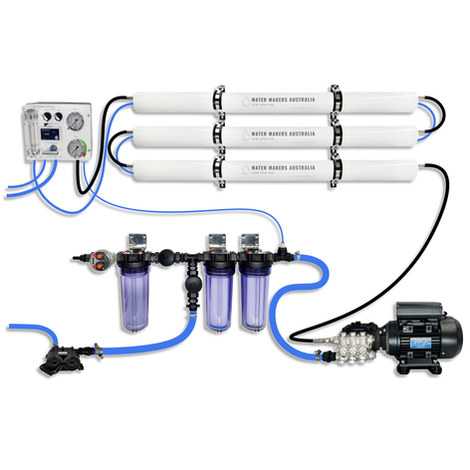
A three-membrane modular watermaker with 200 L/h nominal output and up to 240 L/h family-level marketing, for larger crews and heavy use.
Explore →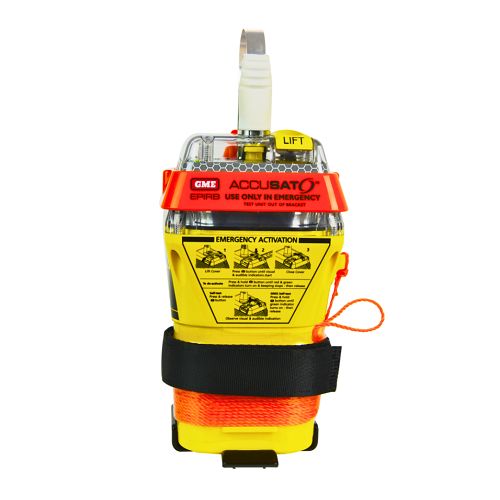
A 10‑year battery EPIRB with integrated GNSS (supports GPS and Galileo), infrared strobe and 121.5 MHz homing signal. Approved for worldwide COSPAS‑SARSAT operation.
Explore →
Self-contained, battery-powered plug‑and‑play autopilot designed for standard hydraulic steering systems.
Explore →