Loading this page…

Loading this page…
Sailing club
Carrum Sailing and Motor Boat Club (CSMBC) is a community sailing and motorboating club on the eastern shores of Port Phillip Bay at Carrum, VIC. The club runs regular sailing for trailerable yachts and off‑the‑beach dinghies (typically Sunday afternoons), welcomes people of all ages and experience, and notes experienced skippers who help novice sailors. The site also mentions paddling and motorboating activities and an on‑site café (The Galley) that operates in summer.
About
Carrum Sailing and Motor Boat Club (CSMBC) is a community sailing and motorboating club on the eastern shores of Port Phillip Bay at Carrum, VIC. The club runs regular sailing for trailerable yachts and off‑the‑beach dinghies (typically Sunday afternoons), welcomes people of all ages and experience, and notes experienced skippers who help novice sailors. The site also mentions paddling and motorboating activities and an on‑site café (The Galley) that operates in summer.
Service area: Carrum, VIC
Keep exploring
Ask the members and they will tell you, tongue only partly in cheek, that their club is "truly the best kept secret on the bay". Carrum Sailing and Motor Boat Club sits on the sandy south-eastern shoreline of Port Phillip, just below the mouth of the Patterson River, and it makes no apology for being three clubs in one: a home for sailors, motor boaters and paddlers alike, representing, in its own words, boating enthusiasts "whether they be powered by wind, motor or paddle". That breadth gives the place a relaxed, uncliquey atmosphere rare in bay clubs.
The sailing side is deliberately low-pressure — the club itself describes its racing as "always friendly and casual" — and Sunday afternoons in season end not with protest hearings but with drinks and conversation at the Galley, the club's cafe, which opens seven days a week through summer. The fleet tells the same story: Lasers, Sabres and Pacers form the backbone, with the occasional NS14 and Ultimate 18 turning up to keep things interesting.
Nineteen life members are listed on the club's honour roll, among them Ian and Kathryn Blencowe, Ray Cole, Doug and Heather Kentish and Peter and Jan Pitcher — names that speak to decades of continuity in a club that has split, reunited and reinvented itself across nearly eighty years. For sailors who want their racing social rather than cut-throat, and for families who want a beachside base where a kayak or a tinny is as welcome as a Laser, Carrum offers something genuinely uncommon on this stretch of the bay: a club without pretension.
Carrum's pathway into sailing runs not through a formal academy but through the cockpit of a member's boat. There is no evidence of a structured Tackers program or accredited learn-to-sail school here; instead, the club leans on Australian Sailing's SailPass system, offering free come-and-try sails with an experienced skipper so a newcomer can feel the boat heel and the sheet load up before committing to anything.
Learn-to-sail enquiries are welcomed directly — prospective sailors are simply invited to raise them with the club — and the informal culture does the rest, pairing novices with members who have sailed these waters for years. It is an old-fashioned arrangement, and it suits the place. The weekly engine of the club is Sunday afternoon sailing, running through a season that stretches from October to April and begins with an Opening Day in early October.
Trailerable yachts and off-the-beach dinghies share the afternoon, and because the racing is consciously casual, a first-timer on a borrowed Pacer is not out of their depth; the fleet's mix of Lasers, Sabres and Pacers keeps the pace honest without turning the afternoon into an arms race. What the club lacks in course infrastructure it makes up in repetition and welcome — sail most Sundays, learn by doing, debrief at the Galley afterwards, where the conversation over a coffee or something colder is half the point.
For many sailors on this part of the bay, that is precisely the product they want: competence acquired socially, in good company, on home water, without a syllabus in sight. Those chasing formal tuition or a junior squad program will find larger centres nearby; Carrum's offer is the club itself as teacher.
The club occupies a spot on the Carrum foreshore on Port Phillip's south-eastern shore, immediately south of the Patterson River mouth — a stretch of coast where the beach is wide, the sand is pale and the bay opens out toward the shipping lanes and the far You Yangs horizon. Boats launch straight off the sand into the shallow, protected water typical of this side of the bay, where depths shelve gently and the sea breeze arrives with welcome regularity on summer afternoons, usually from the south or south-west, flattening the morning's chop into sailable lines.
It is forgiving water for small dinghies and trailer sailors: no bar to cross, no current of consequence, and plenty of room to set a course without threading moored fleets. The neighbouring Patterson River deserves mention — it has been described as one of the busiest recreational boating lanes in the Southern Hemisphere, and its constant traffic of runabouts, jet skis and fishing boats is part of the scenery, if not the race course.
The club's listed address is 7/13 Johnson Avenue, Carrum, and its facilities centre on the clubhouse and the Galley, the cafe that operates daily through the warmer months and doubles as the social heart of the place. A public webcam streams the view so members can check conditions before leaving home — a small but telling touch for a club whose sailing happens within sight of its own deck.
Melbourne's south-eastern suburbs wrap around the hinterland, making this an after-work proposition in daylight saving months for locals, while the long beach and foreshore reserve give families room to spread out while the racing runs its short course offshore.
The club's story starts with motors, not sails. In 1946, in the years when the Patterson River mouth was becoming a hub for post-war boating, the Patterson River Motor Yacht Club was formed — the ancestor of everything that followed. That original club ran for about two decades before its members' interests pulled in different directions: in the 1960s it split in two, producing a Patterson River Motor Boat Club on one side and a Carrum Sailing Club on the other, and the pair then went their separate ways for roughly half a century, each building its own traditions on the same stretch of foreshore.
Reunification came in stages. The decision to join forces again was made during the 2012 season under the combined banner of Carrum Sailing and Motor Boat Club, but the paperwork took time — the merger was only formalised in 2019 with the approval of a new constitution for the reunited body. The result is a club whose unusual double name is not branding but biography: a sailing club and a motor boat club that grew apart and thought better of it.
The culture of continuity shows in the honours list — nineteen life members, including couples like Ian and Kathryn Blencowe and Doug and Heather Kentish, whose recognition reflects family-scale involvement across generations — and life memberships continue to be awarded, one being conferred at the 2025/26 annual general meeting. Through all the structural change, the constants have been the Sunday afternoon sailing rhythm, the October-to-April season, and the Galley as the place where the club actually lives.
Paddlers have since found a home under the same roof, rounding out a membership drawn from every corner of the Carrum boating community. For a club approaching eighty years from its first formation, the appetite for reinvention appears undiminished.
A practical cruising guide for the Moyne River port at the mouth of the Moyne River on Victoria’s south-west coast. It explains harbour geometry, seasonal conditions, principal sailing zones, anchorages, visitor facilities, known local hazards (bar, reefs, strong currents, surf and commercial traffic), regulatory controls and realistic experiences for day sailors, trailer-sailors and coastal cruisers. The guide draws on local port plans, state boating authorities, the yacht club’s visiting-boat practice and regional marine management documents.

Look for a friendly club with beginner-focused training, accessible facilities and boats, a supportive community, clear safety practices, and opportunities to progress at your own pace.
Explore →
Use ramps and beaches with respect for local conditions: check ramp layout, tide and swell, wind direction, vehicle access and crowding; prepare boat and crew before you launch or retrieve; and follow local signage, courtesy and safety practices. Specifics vary by ramp and beach, so confirm details for the exact site before you go.
Explore →
Plan passages across Spencer Gulf or to Kangaroo Island by basing fuel on your boat’s actual consumption plus a generous reserve, choosing sensible staging/stop options that match your boat and crew, and prioritising shelter and weather windows (gale fronts, strong winds and tidal streams can make the gulf uncomfortable or unsafe). Confirm fuel availability, safe anchorages or marinas on your route, and check up-to-date local weather, tide and navigation information before you go.
Explore →
Maybe — it depends. In NSW you often need registration and a boat operator licence for motorised vessels, but many small trailerable sailing dinghies without engines don’t require boat registration or a licence. Check the specific rules for your craft, trailer and engine.
Explore →
A practical guide for new sailors on picking the right Australian sailing club: training, boat access, racing, social fit, costs and the key questions to ask before joining.
Explore →A concise, practical introduction to the essential parts of a recreational sailing boat for beginners in Australia. Covers hull, deck, rigging, sails, steering, below-decks spaces and safety equipment, with simple explanations, common mistakes and a pre-decast checklist to help new sailors communicate and get underway.
Explore →Practical guide for recreational sailors planning passage on the Hawkesbury River: how to plan around tides, choose anchorages, read local conditions and prepare the boat and crew for a safe, comfortable trip.
Explore →A practical guide for recreational sailors planning day sails or short cruises around Batemans Bay, Broulee and the Clyde River. Covers local conditions, safe approaches, anchorages, launching, tides, common hazards, and checklists for trip planning and on-water decisions.
Explore →Burke Yachtsman Gear Bag 40L - Shop Now Zip Pay | Tamar Marine Skip to content 59 – 63 Holbrook Street, Invermay Online Shop Open 24/7 Products search Contact us 1300 MARINE $ 0.00 0 Cart Burke Yachtsman Gear Bag 40L $ 79.90 Colour Choose an option Black Blue Black Blue Clear - Burke Yachtsman Gear Bag 40L quantity + Add to cart Enquire about this product SKU BAGB-Y24/BLACK* Category Bags - Sail & Gear A Burke classic and customer favourite, the Yachtsman’s Gear Bag is built tough to handle wet, salty conditions while keeping your gear dry and protected. Made from double coated waterproof…
Explore →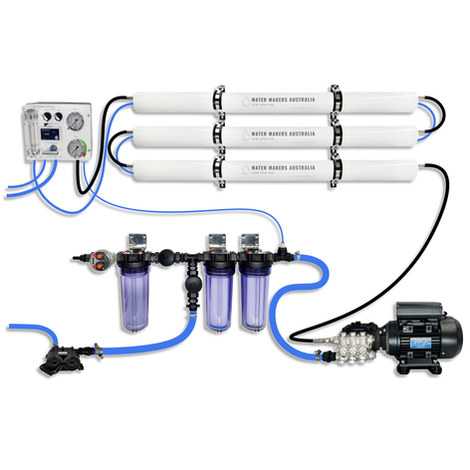
A three-membrane modular watermaker with 200 L/h nominal output and up to 240 L/h family-level marketing, for larger crews and heavy use.
Explore →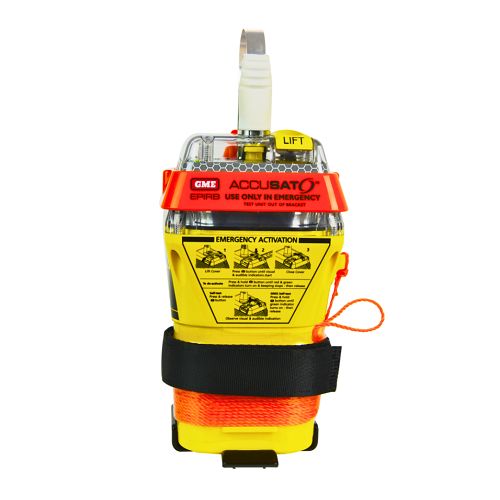
A 10‑year battery EPIRB with integrated GNSS (supports GPS and Galileo), infrared strobe and 121.5 MHz homing signal. Approved for worldwide COSPAS‑SARSAT operation.
Explore →
Self-contained, battery-powered plug‑and‑play autopilot designed for standard hydraulic steering systems.
Explore →