Loading this page…

Loading this page…
Sailing club
Elwood Sailing Club is a competitive and social sailing club based in Elwood, Victoria, near the head of Melbourne. The club describes itself as a thriving venue for sailing activities and member social programs and maintains a website at elwoodsc.com.
About
Elwood Sailing Club is a competitive and social sailing club based in Elwood, Victoria, near the head of Melbourne. The club describes itself as a thriving venue for sailing activities and member social programs and maintains a website at elwoodsc.com.
Service area: Elwood, VIC
Keep exploring
A seahorse appears on the sails, the burgee and the clubhouse wall at Elwood Sailing Club, and that little emblem carries the club's whole personality: improvised, seaworthy and a touch eccentric. The club grew out of a canoe club on the Elwood foreshore, roughly eight kilometres south-east of central Melbourne, and it still has the feel of a place where sailors make their own fun.
Racing here covers monohulls and catamarans, run on Saturdays from October through to Easter with patrol boats on the water, and the club regularly hosts state, national and international championship events on Port Phillip Bay. Alongside the dinghy fleet sits one of the bay's more committed boardsailing crews: Elwood counts up to fifty dedicated windsurfer members, and twenty or more rigs can be seen launching off the beach when the afternoon breeze fills in.
Kites, notably, are banned from this stretch of foreshore, which keeps the water for wind-powered craft of the older kind. The mood is competitive without being exclusive — the club caters to sailors of every skill level, and basic windsurfing gear and stand-up paddleboards are available for members to borrow, with lessons on offer. In 2024 the club marked its centenary, publishing a history written by Barbara Lloyd, and Commodore Ross Lloyd found himself acknowledged in the Victorian Parliament for the milestone.
The blue burgee with its white cross and seahorse has flown here since the canoe days. For a bayside club with a century behind it, Elwood wears its years lightly, and the mix of championship racing and beach-level boardsailing keeps the membership unusually broad.
What sets Elwood apart from most bayside dinghy clubs is its parallel life as a windsurfing centre. The club keeps a rack of basic boardsailing gear and stand-up paddleboards for members, and lessons are offered for those starting out on a rig — a rare thing among Port Phillip sailing clubs, where windsurfers usually organise themselves. On a good summer afternoon the launch area fills with sails of both kinds, dinghy sailors and boardsailors sharing the same protected water off the foreshore.
Structured activity runs on Saturdays from October through to Easter, when racing and sailing training share the calendar, backed by race and rescue patrols. The club says it supports all skill levels, so a first-timer can learn the basics in the relatively sheltered water beside the Elwood Life Saving Club while experienced crews tune for championship racing further off the beach.
Because the bay here is moderately protected, it suits beginners and improvers in lighter breezes, though the fifteen-to-twenty-knot afternoon sea breeze gives confident sailors plenty to work with. The club's formal accreditation status for national junior programs isn't confirmed, so prospective families are best advised to ask directly about junior pathways; what is clear is that the Saturday rhythm — rig on the foreshore, sail under patrol cover, wash down and debrief upstairs — has served generations.
The upstairs bar opens on race days, and the clubhouse is available for function hire, so training days tend to roll naturally into social ones. For anyone weighing up where to start on Melbourne's bay, the combination of patrol-covered training water, borrowable boards and a hundred years of small-boat know-how is a persuasive one.
The club stands at 5 Elwood Foreshore on Ormond Esplanade, with the Elwood Life Saving Club for a neighbour and the whole arc of Port Phillip Bay in front. The beach here is one of Melbourne's most dependable summer sailing spots. Through the best months, October to April, the afternoon sea breeze typically sets in around two o'clock at fifteen to twenty knots, and the sweet spot for direction runs from south-south-west through to north-east.
Northerlies blow offshore: the water stays flat but the wind arrives in gusts and holes, rewarding crews who can read the shifts. South-westerlies come onshore and build a chop. The water itself is mild by Victorian standards — around twenty-two degrees in summer, dropping near twelve in winter — and the area off the club is relatively protected, which makes it friendly territory for beginners and improvers when the breeze is moderate.
There are local quirks to learn. Swimmers are kept inside yellow markers, jellyfish drift through seasonally, and at low tide a small rocky reef lurks to the north of the rocky groin — the sort of local knowledge that gets passed down with rigging tips. Back on shore the facilities are practical rather than plush: men's and women's changing rooms with hot showers, toilets, a gear wash-down area, storage for boats and boards, and a barbecue. On Saturday race days the upstairs bar opens, and the clubhouse doubles as a function venue for hire.
It is a foreshore club in the classic Melbourne mould — everything within a few steps of the sand, and the city skyline close enough to remind you how central this patch of bay really is.
Elwood began on 20 May 1924, when a group of foreshore canoeists formed the Elwood Sea Canoe Club — the first club of its kind in Australia. Within a few years the members began doing what restless paddlers do: they fitted sails to their canoes, and by the late 1920s hybrid sailing canoes were racing off the beach. Out of that experimentation came something more ambitious. Designed at the club as an evolution of those hybrids, the Seahorse was an eighteen-footer with a four-foot beam and watertight bulkheads fore and aft.
The first was built at Elwood in 1934 and launched that November for trials; five more followed the next year, and by 1939 twenty-two had been completed, all but one of them by amateur builders. The Seahorse Class was established in 1934, and the club took its present name, Elwood Sailing Club, at the same time. A second one-design, the Elwood Junior catamaran, later carried the seahorse as its sail insignia from 1972 — the same emblem the canoe club had adopted in its earliest years and that still sits on the blue burgee with its white cross.
The early club ran with a rugged streak. By the 1930s it had a large beachfront shed with canoe racks stacked three high, and membership came with tests: sailors were required to swim, in full kit, from the clubhouse out to a diving platform and back before they could race, and every boat faced an annual 'bottling test', deliberately capsized to demonstrate its buoyancy. A century on from that first meeting, the club marked its hundredth year in 2024 with a centenary history written by Barbara Lloyd.
Batemans Bay and the Clyde River form a classic NSW South Coast cruising region where a sheltered, tidal estuary meets a short, island‑dotted entrance to the Tasman Sea. It’s distinctive for easy access from Canberra, a mix of river and bay sailing, a compact marina and mooring network, and a river entrance (the Clyde River bar) that can change rapidly. The area suits day sails, weekend cruising, trailer‑boat exploration and sheltered coastal passages; offshore or long‑passage plans require careful timing and local knowledge. Preparation for tidal flow, variable southerly swells and shallow, s

Look for a friendly club with beginner-focused training, accessible facilities and boats, a supportive community, clear safety practices, and opportunities to progress at your own pace.
Explore →
Before your first sail in South Australian waters check the weather and tide, make sure the boat and safety equipment are fit for the trip, confirm local rules and any area-specific hazards, and tell someone your plan.
Explore →
Write a one‑page plan with the who/what/when/where/how of your trip, keep a copy on board and leave the main copy with a responsible person ashore (and optionally with your club, marina office or local volunteer rescue service).
Explore →
Plan to transit Sydney Heads and northern NSW estuary entrances to take advantage of favourable tidal streams or slack water; account for local acceleration over shoals, eddies, wind-on-current effects and river discharge, and always check the latest local observations and tide/stream products before departure.
Explore →
A practical guide for new sailors on picking the right Australian sailing club: training, boat access, racing, social fit, costs and the key questions to ask before joining.
Explore →A concise, practical introduction to the essential parts of a recreational sailing boat for beginners in Australia. Covers hull, deck, rigging, sails, steering, below-decks spaces and safety equipment, with simple explanations, common mistakes and a pre-decast checklist to help new sailors communicate and get underway.
Explore →A practical guide for recreational sailors planning voyages to Esperance and the Recherche Archipelago: what to expect, key planning considerations, common anchorages, safety and communications, equipment recommendations and sensible steps for a successful trip in this remote southern WA cruising area.
Explore →
A practical, Australia-focused guide for planning and sailing around the Whitsunday Islands: weather and seasons, navigation and anchoring, moorings and parks, provisioning and charters, safety and common mistakes, plus checklists and next steps.
Explore →Burke Yachtsman Gear Bag 40L - Shop Now Zip Pay | Tamar Marine Skip to content 59 – 63 Holbrook Street, Invermay Online Shop Open 24/7 Products search Contact us 1300 MARINE $ 0.00 0 Cart Burke Yachtsman Gear Bag 40L $ 79.90 Colour Choose an option Black Blue Black Blue Clear - Burke Yachtsman Gear Bag 40L quantity + Add to cart Enquire about this product SKU BAGB-Y24/BLACK* Category Bags - Sail & Gear A Burke classic and customer favourite, the Yachtsman’s Gear Bag is built tough to handle wet, salty conditions while keeping your gear dry and protected. Made from double coated waterproof…
Explore →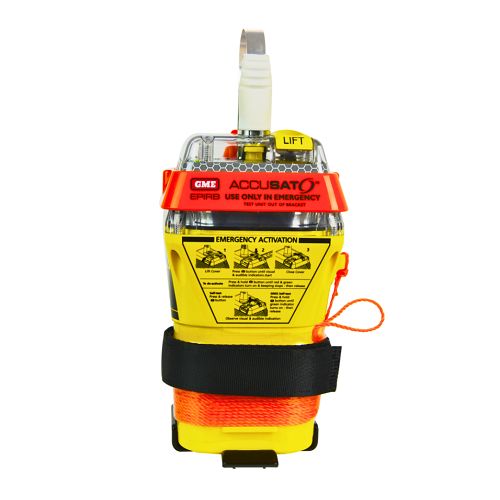
A 10‑year battery EPIRB with integrated GNSS (supports GPS and Galileo), infrared strobe and 121.5 MHz homing signal. Approved for worldwide COSPAS‑SARSAT operation.
Explore →
Self-contained, battery-powered plug‑and‑play autopilot designed for standard hydraulic steering systems.
Explore →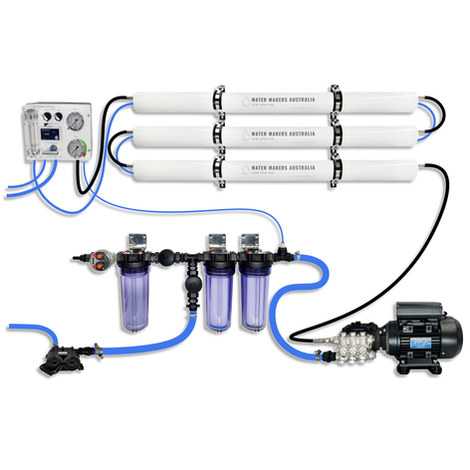
A three-membrane modular watermaker with 200 L/h nominal output and up to 240 L/h family-level marketing, for larger crews and heavy use.
Explore →