Loading this page…

Loading this page…
Sailing club
Lake Boga Yacht Club is a community sailing club on the foreshore of Lake Boga in north‑west Victoria. The club runs regular sailing on most Sundays (mid‑September to end of April), holds events such as an Easter Regatta, participates in Try Sailing Days for the public, and offers secure shed storage for member yachts for a yearly fee.
About
Lake Boga Yacht Club is a community sailing club on the foreshore of Lake Boga in north‑west Victoria. The club runs regular sailing on most Sundays (mid‑September to end of April), holds events such as an Easter Regatta, participates in Try Sailing Days for the public, and offers secure shed storage for member yachts for a yearly fee.
Service area: Lake Boga, North West Victoria (approx. 16 km south of Swan Hill)
Keep exploring
Every Easter, a small town sixteen kilometres south of Swan Hill turns into one of Victorian sailing's busiest addresses. Caravans and tents fill the grassed parklands around Lake Boga Yacht Club, catamarans rig along the shoreline, and for four days the lake hosts a regatta that Australian Sailing has described as one of the largest and best-run in the state. Competitors mostly camp beside their boats, wandering the park with a beer or a coffee before and after sailing — the social fabric of the event is as much a drawcard as the racing.
The rest of the year, Lake Boga is a classic inland off-the-beach club, sailing dinghies and catamarans most Sundays from mid-September to the end of April. The regular classes tell the story of Australian small-boat sailing across the decades: Micron, Mirror, Paper Tiger, Fireball, Impulse, Sabre, Pacer, Arrow and Mosquito all appear on the club's list. The membership travels well, too — the club records that its sailors compete Australia-wide with plenty of success, and it has hosted numerous National and State titles for various classes over the years.
Positioned roughly 300 kilometres north of Melbourne in the state's North West, the club draws from Swan Hill and the surrounding irrigation country, and it carries a particularly rich thread of catamaran history, including a strong Australian Sailfish fleet in the late 1970s and 1980s built on member Ray Hale's energetic advocacy for the class. Affiliated with Australian Sailing as a Victorian inland club, it remains volunteer-run and unmistakably a country club: relaxed on shore, sharp on the water.
The most useful boat at Lake Boga might be one you don't own. The club keeps several yachts available so that prospective sailors can have a proper go before committing to a purchase of their own — a try-before-you-buy approach that removes the biggest barrier facing newcomers to inland sailing, where there is no chandlery around the corner and buying blind is a real risk. Once they do take the plunge, secure boat storage sheds on site cost members only a token annual amount.
Each year the club also joins in Yachting Victoria's Try Sailing Days, when the public is invited down to go out with a member and sample the sport in the least intimidating format possible. It is a straightforward, club-driven model of recruitment rather than a formal accredited training pathway, and it suits a small rural membership whose strength lies in personal invitation and mentoring across the fleet.
Sunday club sailing from mid-September through April gives those new sailors somewhere to land, with the mixed fleet of cats and monohulls offering plenty of variety in handicap company. Then there is the Easter Regatta itself, which functions as an unofficial masterclass: four days of racing on separate catamaran and monohull courses set at opposite ends of the lake, with divisions in recent editions have ranged across catamarans such as the Mosquito, Nacra 5.0, Cobra, Hobie 16, Maricat and Arrow, and monohulls including the Pacer, Sabre, NS14, Tasar, Impulse, Fireball, FD and Sailfish.
The 2026 regatta drew 98 entries and was noted for strong female representation — six of the seven Sabre skippers in one division were women. For a developing sailor, sharing a start line with interstate travellers across fourteen classes teaches more than any single course could.
Lake Boga is a broad, oval freshwater lake — roughly five kilometres long by four wide in the club's telling, closer to three by three-and-a-half in Australian Sailing's — and crucially it is free of obstructions. No islands, no reefs, no tree-lined points to bend the breeze: just open water where a race officer can set a clean course in any direction. That same quality is why the RAAF chose it as a flying boat base during the Second World War; Catalinas needed room to take off and land wherever the wind dictated, and today's sailors benefit from the identical geography.
The foreshore is made for off-the-beach sailing. A grassed shoreline of around a hundred metres serves for rigging and launching, and a grassy camping area beside the clubhouse lets regatta visitors sleep within steps of their boats. The two-storey clubhouse, erected in the mid-1970s and renovated several times since, anchors the site, with boat storage sheds and an extended shower and toilet block serving the camping crowd.
Easter conditions are typically kind: light-to-moderate breezes, often a ten-to-fifteen-knot south-easter with some chop that can shift north-east and ease as the day wears on, though calm mornings have been known to cost a race or two. The lake is shared with water-skiers and anglers, and water levels are the one variable no one controls — during the Millennium drought the lake dried out completely for almost four years, refilling only in mid-2010. Levels have been more consistent since. Overlooking it all is the heritage-listed Flying Boat Museum, where a restored Catalina and the original communications bunker recall the lake's wartime chapter.
Lake Boga Yacht Club formed in 1936, and the first clubhouse was a humble tin shed down at the southern end of the caravan park. That shed led a wandering life — shifted to the north end of the park in 1950, then moved again in 1962 to the site the club still occupies — before the current two-storey clubhouse went up in the mid-1970s, with storage sheds and an enlarged amenities block added across the following years.
The Easter Regatta's starting year is genuinely contested, and the club wears the discrepancy openly: the club itself and the Sabre association record the first running in 1937, Australian Sailing has reported 1935, and the Gannawarra Times has it running since 1936. Whichever date you take, the regatta belongs to the 1930s and has been interrupted only by catastrophe. World War II shut it down when the lake became a RAAF Catalina flying boat repair base from 1942 to 1947 — the base site is now the heritage-listed museum on the foreshore. Decades later the Millennium drought emptied the lake entirely for nearly four years, halting the regatta again until the water returned in mid-2010.
In between, the event grew into a giant. Historical regattas regularly drew well over 250 competing yachts, and the club accumulated a deep record of hosting National and State titles across many classes. The late 1970s and 1980s brought a golden patch for the Australian Sailfish, with member Ray Hale championing the class and building a fleet that gave the club a name in catamaran circles well beyond the Murray. Through drought, war and everything since, the pattern has held: the water comes back, and so does Lake Boga.
American River (Kangaroo Island, SA) is a small, sheltered inlet and township on the north‑eastern side of Kangaroo Island that acts as a calm staging point for cruising the eastern part of the island and for short hops through Backstairs Passage. It’s distinctive for its protected anchorage inside Eastern Cove and the adjacency of Pelican Lagoon — a shallow, ecologically important lagoon with sanctuary zoning — which shapes how and where boats can move. The area suits sheltered day sailing, weekend cruising and short coastal passages; it’s appropriate for trailer sailors, small cruisers and a

Use ramps and beaches with respect for local conditions: check ramp layout, tide and swell, wind direction, vehicle access and crowding; prepare boat and crew before you launch or retrieve; and follow local signage, courtesy and safety practices. Specifics vary by ramp and beach, so confirm details for the exact site before you go.
Explore →
Expect very different seasonal systems across Western Australia: the south‑west (Perth to Albany) has a strong summer afternoon sea breeze (the “Fremantle Doctor”) and winter westerly fronts, while northern WA follows a wet/dry monsoonal cycle with strong seasonal onshore winds, thunderstorms and cyclone risk in the wet season. Local headlands, estuaries and tidal flows often change what you actually feel on the water, so learn the local timing and sheltered venues first.
Explore →
Write a one‑page plan with the who/what/when/where/how of your trip, keep a copy on board and leave the main copy with a responsible person ashore (and optionally with your club, marina office or local volunteer rescue service).
Explore →
Expect the usual IALA-B lateral system (red and green), cardinal and isolated-danger marks, safe-water and special marks, plus harbour-specific fairway buoys, leading/transit marks and exclusion or speed‑limit buoys. Check local harbour charts and Notices to Mariners for exact positions and light characteristics before entry.
Explore →
A practical guide for new sailors on picking the right Australian sailing club: training, boat access, racing, social fit, costs and the key questions to ask before joining.
Explore →A concise, practical introduction to the essential parts of a recreational sailing boat for beginners in Australia. Covers hull, deck, rigging, sails, steering, below-decks spaces and safety equipment, with simple explanations, common mistakes and a pre-decast checklist to help new sailors communicate and get underway.
Explore →Practical guide for recreational sailors planning a coastal cruise from Sydney north to the Queensland border. Covers route options, weather and tidal considerations, planning checklists, common hazards, anchorages and practical examples for a safe, enjoyable trip.
Explore →
A practical step‑by‑step guide to planning a safe, realistic coastal sailing passage in Australian waters: choosing a route, estimating distance and time, checking weather and tides, fuel and daylight planning, identifying safe harbours and anchorages, and preparing backup plans.
Explore →Burke Yachtsman Gear Bag 40L - Shop Now Zip Pay | Tamar Marine Skip to content 59 – 63 Holbrook Street, Invermay Online Shop Open 24/7 Products search Contact us 1300 MARINE $ 0.00 0 Cart Burke Yachtsman Gear Bag 40L $ 79.90 Colour Choose an option Black Blue Black Blue Clear - Burke Yachtsman Gear Bag 40L quantity + Add to cart Enquire about this product SKU BAGB-Y24/BLACK* Category Bags - Sail & Gear A Burke classic and customer favourite, the Yachtsman’s Gear Bag is built tough to handle wet, salty conditions while keeping your gear dry and protected. Made from double coated waterproof…
Explore →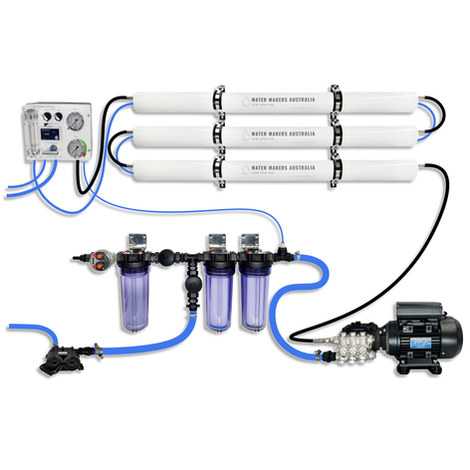
A three-membrane modular watermaker with 200 L/h nominal output and up to 240 L/h family-level marketing, for larger crews and heavy use.
Explore →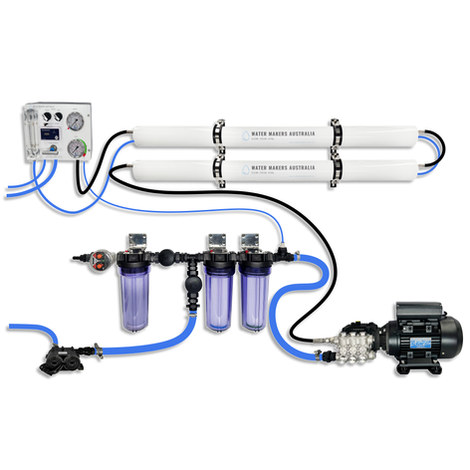
A two-membrane modular watermaker with 140 L/h nominal output, aimed at families and liveaboards that want more water per run.
Explore →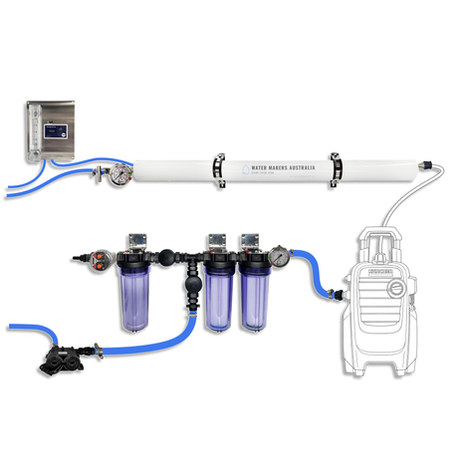
A one-membrane modular marine watermaker with 80 L/h nominal output, remote stainless control panel, standard consumables and direct Australian support.
Explore →