Loading this page…

Loading this page…
Sailing club
Mandurah Offshore Fishing & Sailing Club (MOFSC) is a large, mixed water‑based club based at 115 Breakwater Parade inside the Mandurah Ocean Marina, Mandurah, WA. The club supports dinghy and keelboat racing, junior sailing, accessible sailing, powerboat events and recreational and offshore fishing. Facilities include a modern 220‑berth floating marina with a 200 m collector jetty, multiple launching ramps, hardstand storage and a sizeable clubhouse with dining, bars and event spaces.
About
Mandurah Offshore Fishing & Sailing Club (MOFSC) is a large, mixed water‑based club based at 115 Breakwater Parade inside the Mandurah Ocean Marina, Mandurah, WA. The club supports dinghy and keelboat racing, junior sailing, accessible sailing, powerboat events and recreational and offshore fishing. Facilities include a modern 220‑berth floating marina with a 200 m collector jetty, multiple launching ramps, hardstand storage and a sizeable clubhouse with dining, bars and event spaces.
Service area: Mandurah, Peel Region, Western Australia
Keep exploring
Junior sailing is where Mandurah's training effort concentrates, and the club backs it with resources most volunteer organisations can only envy: a large junior section directed by a full-time professional coach. The class structure supports that ambition, with a pathway running from Optimists and Open BICs through Lasers, Pacers, RS Fevas and 29ers to Tasars, so young sailors can progress from their first hull to fast skiff-style racing without leaving the club. Regular twilight cruises round out the on-water offering for those after a gentler introduction.
The club's most distinctive program, though, belongs to accessible sailing. Mandurah offers sailing opportunities for people of all abilities using specially designed accessible single and double sailboats — one of them electronically operated — opening the sport to participants whom conventional dinghies exclude. It is the kind of provision that very few Australian clubs attempt, and it sits naturally beside the junior program as evidence of a club that treats access to the water as its core business.
As an Australian Sailing training centre, the club also appears in the national course finder delivering Safety Boat Operator courses, the qualification that underpins safe race management and training support everywhere. Power boaters are catered for with well-organised events, and the club boat gives members without their own vessel a route onto the water for fishing.
Underpinning all of it is infrastructure that training programs elsewhere would covet: four boat-launching ramps, a 220-bay floating marina and a two-hundred-metre jetty for visiting boats. Add the keelboat divisions and their regular racing, and the pathway from a child's first Optimist lesson to ocean racing off Comet Bay can be travelled entirely within one membership.
Few clubs anywhere enjoy a setting with this many options. The Mandurah Ocean Marina, home to the club, sits between the Indian Ocean on one flank and the vast Peel-Harvey Estuary system on the other, with the Harvey Estuary, Peel Inlet and the Serpentine and Murray Rivers all within reach. Offshore, the waters of Comet Bay directly off the club provide, by Australian Sailing's account, excellent sailing with reliable breezes and rolling swells — proper ocean racing terrain, as the national Laser fleet discovered when it contested the 2014/15 championships a ten-minute reach from the marina.
The marina itself is a serious piece of infrastructure: a modern 220-bay floating installation with a two-hundred-metre Collector Jetty for visiting boats, four launching ramps, wash-down bays and 123 hardstand bays leasable by members. The Marina Industries Association awarded it 4.5 stars, a rating that reflects how far the facility sits beyond the average club compound. For members, the practical consequence is simple: whatever the weather and whatever the craft — dinghy, keelboat, power boat or fishing vessel — there is water to match it.
The clubhouse matches the scale of the operation. Inside, members find the Marina Bar, the Sundowner Lounge and the Dolphin View Room overlooking the marina, plus an a la carte restaurant with a large outdoor alfresco area. The complex functions as a wedding and events venue with reception spaces accommodating up to roughly 400 guests, making the club a social anchor for the wider Mandurah community as well as a sporting one. Sitting at 115 Breakwater Parade on the marina's edge, with the estuary behind and the ocean in front, the club occupies one of the most complete boating addresses in Western Australia.
The modern club is a marriage, and both partners brought solid histories to it. In 2000, the Mandurah Yacht Club — established in 1969 — merged with the Mandurah Offshore Fishing Club — established in 1972 — to form the organisation that carries both pursuits in its name today. The union created something larger than the sum of its parts: a club that could cater for ocean racing sailors, estuary cruisers, power boaters and anglers under one constitution and one clubhouse roof. In August 2021 members gathered to celebrate the merged club's twentieth birthday, an occasion Australian Sailing marked with a club-in-focus feature.
That note of deliberate detail runs through the club's story. Consider its role in the Mandurah artificial reef: before the structure was deployed off the coast in April 2016, club volunteers consulted with Recfishwest on its placement, even lowering cameras to the seafloor to inspect candidate sites. It was a practical, skilful contribution from a membership that knows these waters intimately — the fishing arm of the club acting on behalf of the whole recreational boating community.
The sailing arm brought its own lineage. The Mandurah Yacht Club's three decades before the merger laid down the racing tradition that the combined club inherited, culminating in events such as the 2014/15 Australian Laser Open and Masters Nationals, and in the enduring offshore partnership with Fremantle Sailing Club behind the Halls Head Race and Point Robert Return. The Finistere Cup, introduced by the two clubs to honour members lost to both, gives that rivalry a solemn heart. From two modest clubs founded within three years of each other, Mandurah has built a single institution now counted — by membership at least — among the biggest boating organisations in the nation.
Deen Maar (the island and adjacent coastal region off south‑west Victoria) is a small but significant offshore island and coastal protected area offering dramatic cliffs, important seabird and seal habitat, cultural values for Gunditjmara and Eastern Maar Traditional Owners, and a clear contrast between exposed Bass Strait seascape and the comparatively sheltered waters inside the Moyne/Port Fairy approaches. From the water it is best treated as an ecological and cultural landmark rather than a place for casual landings: recreational boating activity is concentrated at Port Fairy, Killarney, Y

Pick a protected bay, estuary or river reach where you can rig, launch and arrive on calm water within a short, sheltered transit; choose a site with a good ramp or jetty, clear recovery options and a nearby sailing club, marina or commercial operator for local knowledge and help.
Explore →
Write a one‑page plan with the who/what/when/where/how of your trip, keep a copy on board and leave the main copy with a responsible person ashore (and optionally with your club, marina office or local volunteer rescue service).
Explore →
Increase inspection and cleaning frequency, use correctly sized and positioned sacrificial anodes or maintain impressed-current systems, select antifouling and application timing for local WA fouling pressure, and treat stainless and electrical connections proactively to break the corrosion chain.
Explore →
A regular, layered maintenance routine combining hull cleaning, targeted anti-fouling management, cathodic protection and systems checks will substantially reduce marine growth and corrosion for boats kept year‑round in South Australian waters. Focus on preventing attachment and electrochemical attack, then inspect and act more often if you’re in warm, nutrient-rich or high‑traffic sheltered waters.
Explore →A practical guide for recreational sailors planning visits to Albany and King George Sound. Covers the main anchorage areas, typical local weather patterns, tidal and current considerations, navigational hazards, on-the-water etiquette and a pre-departure checklist to help you plan a safe passage and enjoyable stopover
Explore →
A practical, Australia-focused guide for planning and sailing around the Whitsunday Islands: weather and seasons, navigation and anchoring, moorings and parks, provisioning and charters, safety and common mistakes, plus checklists and next steps.
Explore →A practical guide to preparing, planning and executing a recreational offshore passage along the New South Wales coast. Covers route selection, weather and tidal considerations, vessel and crew checks, safety equipment, communication, watchkeeping and common mistakes, with clear pre‑departure and underway checklists.
Explore →
A practical guide for new sailors on picking the right Australian sailing club: training, boat access, racing, social fit, costs and the key questions to ask before joining.
Explore →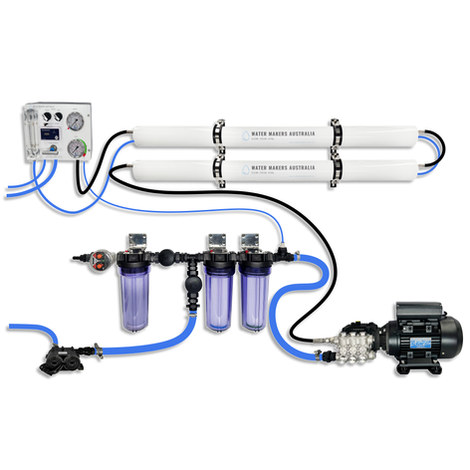
A two-membrane modular watermaker with 140 L/h nominal output, aimed at families and liveaboards that want more water per run.
Explore →Burke Yachtsman Gear Bag 40L - Shop Now Zip Pay | Tamar Marine Skip to content 59 – 63 Holbrook Street, Invermay Online Shop Open 24/7 Products search Contact us 1300 MARINE $ 0.00 0 Cart Burke Yachtsman Gear Bag 40L $ 79.90 Colour Choose an option Black Blue Black Blue Clear - Burke Yachtsman Gear Bag 40L quantity + Add to cart Enquire about this product SKU BAGB-Y24/BLACK* Category Bags - Sail & Gear A Burke classic and customer favourite, the Yachtsman’s Gear Bag is built tough to handle wet, salty conditions while keeping your gear dry and protected. Made from double coated waterproof…
Explore →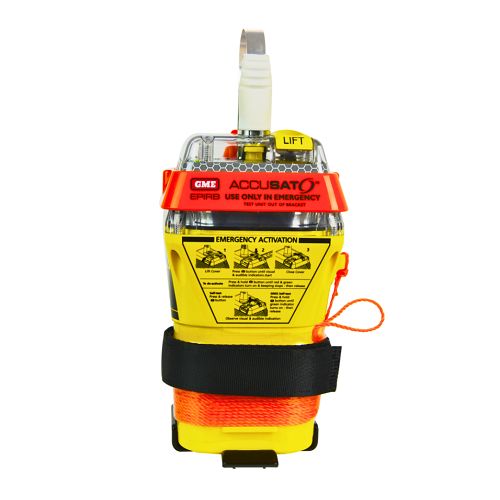
A 10‑year battery EPIRB with integrated GNSS (supports GPS and Galileo), infrared strobe and 121.5 MHz homing signal. Approved for worldwide COSPAS‑SARSAT operation.
Explore →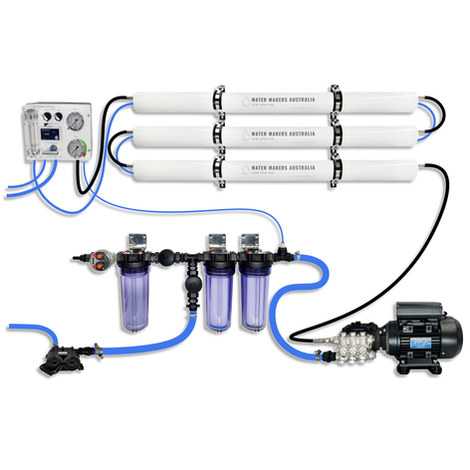
A three-membrane modular watermaker with 200 L/h nominal output and up to 240 L/h family-level marketing, for larger crews and heavy use.
Explore →