Loading this page…

Loading this page…
Sailing club
Maryborough Sailing Club is a volunteer-run, family-orientated dinghy club that has sailed from Scarness beach on Hervey Bay since 1929. The club focuses on beach-launched small-boat sailing, club racing and junior learn-to-sail activities, and operates in partnership with the Fraser Coast Sailing Academy to deliver structured training for juniors and adults.
About
Maryborough Sailing Club is a volunteer-run, family-orientated dinghy club that has sailed from Scarness beach on Hervey Bay since 1929. The club focuses on beach-launched small-boat sailing, club racing and junior learn-to-sail activities, and operates in partnership with the Fraser Coast Sailing Academy to deliver structured training for juniors and adults.
Service area: Scarness / Hervey Bay, Fraser Coast, Queensland
Keep exploring
Volunteer-run, family-oriented dinghy sailing club based in Maryborough that has sailed on the waters of Hervey Bay from Scarness Beach since 1929.
The club runs a Junior Learn to Sail program on Saturdays (9:00am) and maintains a fleet of club-owned boats (BICs, Sabots, Lasers and 125s) for members. Maryborough Sailing Club collaborates with the Fraser Coast Sailing Academy, which provides Introduction to Sailing, Tackers (junior programs) and Adult Learn to Sail courses.
For a small volunteer club, the training arrangement is unusually well organised: instruction is delivered in partnership with the Fraser Coast Sailing Academy rather than carried entirely in-house. The academy supplies the structured courses — an Introduction to Sailing for newcomers, the national Tackers program for juniors, and adult learn-to-sail classes — while the club provides the setting, the members and much of the hardware.
Its own fleet of club-owned boats is available to members and covers the classic small-boat progression: O'pen Bics for the youngest sailors, then Sabots, Lasers and 125s as skills grow. The junior learn-to-sail session runs on Saturday mornings from nine o'clock, a fixed weekly anchor that suits the club's family character. Whether the club itself holds Discover Sailing Centre accreditation isn't stated; what is clear is that an equivalent pathway operates on its beach through the academy partnership, which achieves much the same result for prospective members.
Coaching beginners is hardly a recent invention here, either — club records from the 1950s show a trainee championship contested within the membership, so structured development of new sailors has deep roots. Members who catch the racing bug can graduate from the training boats into the club's dinghy and catamaran sailing, and because the fleet is trailerable, travelling to other Fraser Coast and Queensland events is straightforward.
For families weighing up where to start sailing around Hervey Bay, the combined offer — academy instruction, club boats to borrow and a social membership behind it — removes most of the usual barriers to getting afloat.
The club sails from Scarness, a beachfront suburb of Hervey Bay on Queensland's Fraser Coast — not from Maryborough, despite the name above the door. Hervey Bay is a broad embayment sheltered from the open Pacific by K'gari (Fraser Island), the great sand island lying across its eastern side, and that protection gives the bay the manageable conditions that suit dinghies and trailerable multihulls so well.
Launching happens from the beach beside the club's patch of foreshore, and a public boat ramp — catalogued as HB26 in Queensland's marine parks legislation — sits adjacent near Frank Street. The sailing ground between Scarness and neighbouring Torquay is shared with the Hervey Bay Sailing Club, and the two together anchor small-boat sailing along this stretch of coast; the region also stages the Bay to Bay race for trailer sailers, organised by the neighbouring club, an event that draws entries from well beyond the Fraser Coast.
It is a stretch of coast that rewards exactly the kind of sailing this club has always done. An older directory listing places the club at 2 Walker Street in Maryborough, but that address reads as a leftover from an earlier era rather than a guide to finding the sailing — members and visitors should point themselves at the Scarness foreshore. The practical pattern follows the bay's geography: protected inshore water for training and club racing, with longer passages available up the strait between the mainland and K'gari for sailors chasing distance.
Warm water and beach launching, rather than marina infrastructure, define the experience, which suits a club whose fleet lives on trailers and trolleys.
The club dates itself to 1929, when organised dinghy sailing began on the Hervey Bay foreshore at Scarness under the Maryborough name. Its first shelter was a surplus Second World War Navy boatshed, and in 1950 members put up a clubhouse beside it, mixing new and recycled materials. The Queensland Heritage Register later counted that building among eleven Queensland sailing clubhouses raised with donated materials and volunteer labour during the 1940s and 1950s — a whole generation of sailing infrastructure built by members' own hands.
Newspaper records from 1954, preserved through the Maryborough Chronicle, show a club in good health: Commodore Arnie McCracken reported the original debt on the clubhouse cleared, an awning added over the verandah and a telephone installed. That same year the club skiff Edna Too took out the club championship decided on the bay, earning the right to carry Queensland's colours to the national championship in Perth in January 1955, and also won the state skiff title on home water at Easter inside a fleet of thirty.
The trainee ranks were just as active: Heather won the club's trainee championship, Cygnet raced the corresponding event at Sandgate, and four of the club's skiffs travelled to Brisbane for the South Queensland championship. In those years the season closed at Easter, and the Easter weekend carnival became the fixture around which the sailing year turned — a tradition still going when the 84th Easter regatta was staged in 2015.
The hardest chapter arrived much later: flooding in early 2022 so damaged the old clubhouse that it was demolished, a loss noted by the Australian Register of Historic Vessels. The club itself, however, never stopped sailing, and continues from the same beach it has used since 1929.
Apollo Bay is a small working harbour on Victoria’s Great Ocean Road where sheltered inshore sailing meets the Southern Ocean. The character is a mix of protected harbour berths and an exposed open coast: pleasant day-sails and sheltered weekend cruising inside the bay, with demanding coastal passages immediately offshore where south‑westerly swell and strong winds from the Southern Ocean dominate. It suits coastal cruisers, trailer sailors who launch at the ramp, and experienced coastal sailors who understand bar and swell behaviour; it is not a casual open‑ocean anchorage for unprepared or

Use ramps and beaches with respect for local conditions: check ramp layout, tide and swell, wind direction, vehicle access and crowding; prepare boat and crew before you launch or retrieve; and follow local signage, courtesy and safety practices. Specifics vary by ramp and beach, so confirm details for the exact site before you go.
Explore →
Maybe — it depends. In NSW you often need registration and a boat operator licence for motorised vessels, but many small trailerable sailing dinghies without engines don’t require boat registration or a licence. Check the specific rules for your craft, trailer and engine.
Explore →
Look for a friendly club with beginner-focused training, accessible facilities and boats, a supportive community, clear safety practices, and opportunities to progress at your own pace.
Explore →
Rig and de-rig a small dinghy by following a consistent, step-by-step sequence: prepare the boat on shore, fit spars and foils in a stable order, control sails and running rigging so lines don’t tangle, check fittings and safety gear, and reverse the process when coming ashore—always working with a partner when possible and staying aware of wind and tide.
Explore →
A practical guide for new sailors on picking the right Australian sailing club: training, boat access, racing, social fit, costs and the key questions to ask before joining.
Explore →
Buying a Sailing Boat
Explore →A practical guide to the coastal weather systems that affect sailing along Western Australia's coast, focusing on the Fremantle Doctor, local sea breezes, and linked coastal phenomena. Explains how these systems form, when they tend to occur, how they influence boat handling and passage planning, common mistakes, and a
Explore →A practical guide for recreational sailors planning visits to Albany and King George Sound. Covers the main anchorage areas, typical local weather patterns, tidal and current considerations, navigational hazards, on-the-water etiquette and a pre-departure checklist to help you plan a safe passage and enjoyable stopover
Explore →Burke Yachtsman Gear Bag 40L - Shop Now Zip Pay | Tamar Marine Skip to content 59 – 63 Holbrook Street, Invermay Online Shop Open 24/7 Products search Contact us 1300 MARINE $ 0.00 0 Cart Burke Yachtsman Gear Bag 40L $ 79.90 Colour Choose an option Black Blue Black Blue Clear - Burke Yachtsman Gear Bag 40L quantity + Add to cart Enquire about this product SKU BAGB-Y24/BLACK* Category Bags - Sail & Gear A Burke classic and customer favourite, the Yachtsman’s Gear Bag is built tough to handle wet, salty conditions while keeping your gear dry and protected. Made from double coated waterproof…
Explore →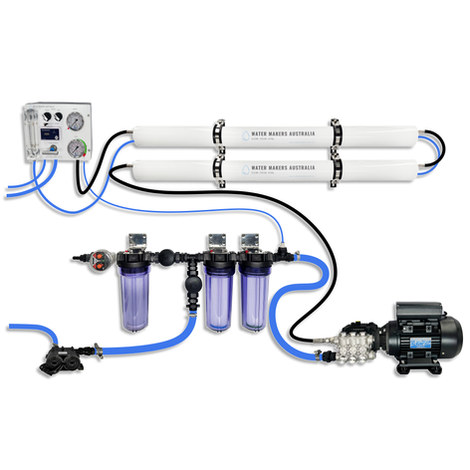
A two-membrane modular watermaker with 140 L/h nominal output, aimed at families and liveaboards that want more water per run.
Explore →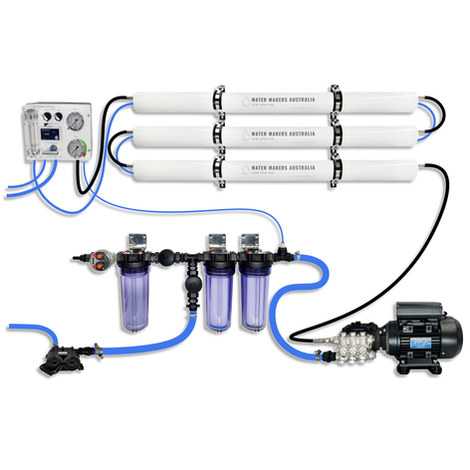
A three-membrane modular watermaker with 200 L/h nominal output and up to 240 L/h family-level marketing, for larger crews and heavy use.
Explore →Imported from Tamar Marine. This draft has no editorial summary yet.
Explore →