Loading this page…

Loading this page…
Sailing club
McCrae Yacht Club is a sailing club based at 690 Point Nepean Road, McCrae (VIC). The club runs organised sailing programs and events (including regattas and class championships), operates a Training Centre offering adult sail training, Tackers/green fleet development and courses such as powerboat handling and first aid, and provides member services, online membership and event booking facilities. Contact details listed: phone (03) 5986 1361 and email admin@mccraeyc.com.au.
About
McCrae Yacht Club is a sailing club based at 690 Point Nepean Road, McCrae (VIC). The club runs organised sailing programs and events (including regattas and class championships), operates a Training Centre offering adult sail training, Tackers/green fleet development and courses such as powerboat handling and first aid, and provides member services, online membership and event booking facilities. Contact details listed: phone (03) 5986 1361 and email admin@mccraeyc.com.au.
Service area: McCrae, VIC
Keep exploring
Speed is written into McCrae Yacht Club's DNA. This is the Mornington Peninsula club that hosted four challenges for the Little America's Cup, that produced the world sailing speed record holder Yellow Pages Endeavour, and whose members were aboard the first sailing vessel ever to sustain more than fifty knots. Yet walk the hard on a Saturday in season and the scene is less exotic than that pedigree suggests: an off-the-beach club for dinghies and catamarans on the southern shore of Port Phillip, with no marina pens or keelboat moorings, where around 600 members put fleets of seventy or more boats on the water each weekend.
The scale sits comfortably alongside the family brief set at the founding in 1961 — the club's stated objective was to encourage sailing in all its forms in a way that involved the whole family, with gender and age expressly irrelevant. That principle shows up in the membership model: every member shares a duty-roster obligation, and more than a thousand duty slots are filled across a season, so the racing machine genuinely runs on its own people. The clubhouse on Point Nepean Road fronts a broad sandy beach between Rosebud and Dromana, with a lawn and deck overlooking the bay.
Class culture runs deep and wide — A-Class catamarans, Hobies, B14s, Contenders, Lasers, Tasars, Paper Tigers and Sabres all race here — and the club's championship hosting record stretches back almost unbroken to the 1962/63 season. McCrae is, in short, a big volunteer club with an international résumé, where a seven-year-old in an Optimist and a world champion in a Contender can rig within metres of each other.
The sharpest expression of McCrae's development philosophy is its Learning & Development pathway, which deliberately draws on the international and national athletes and coaches within the club's own ranks — an advantage very few Victorian clubs can match. Above the learn-to-sail tiers sit a Green Fleet Sailing program, where freshly graduated juniors make the transition into coached club racing, and a Performance Squad for sailors pushing toward state, national and international competition. The results validate the structure: McCrae member Mark Bulka took out the 2025 Contender world title against a fleet of 170 boats, and Stephen Brayshaw contested the 2017 A-Class Catamaran Worlds in Poland flying McCrae colours.
Beneath that high-performance layer runs the standard accredited pathway — the club holds Australian Yachting Federation approval as a Sail Training Establishment, offering Tackers for children from around age seven, then teenager and adult courses — alongside powerboat handling, first aid and RSA certificates offered through the Training Centre. The weekly rhythm across the October-to-April season is structured and predictable: junior training occupies Saturday mornings, racing fills Saturday afternoons, and further training runs on Sunday mornings.
The junior pathway itself climbs through the classic Victorian ladder of Optimist, Minnow and Pacer before sailors branch into the club's senior classes. Supporting all of it is a rescue powerboat fleet described as one of the most modern in the state — a serious asset when seventy boats hit the water at once. The depth of coaching talent flowing back into the program is what distinguishes McCrae: sailors developed here, from speed-sailing pioneers to current world champions, feed knowledge directly into the squads that follow them, keeping the pathway from first tack to podium unusually short.
The club occupies a wide sandy beach at McCrae, near the southern end of Port Phillip on the Mornington Peninsula, with Blairgowrie Yacht Squadron its near neighbour along the coast. Boats rig on the hard and launch straight off the sand into the bay — there is no marina, and none is needed. Local observers rate the site among the finest off-the-beach sailing venues in the country, and the practical ingredients are all present: safe beach launching, generous car parking, boat storage, and a clubhouse whose front lawn and deck look directly over the course area.
A live beach webcam lets sailors check the state of the bay before leaving home, and the heritage-listed McCrae Eastern Lighthouse of 1883 stands as the district's landmark.
The water deserves respect. Port Phillip off McCrae is broad and comparatively shallow, which means a rising breeze builds a short, steep chop with surprising speed — testing conditions for off-the-beach fleets, and a genuine workout for crews when a southerly or south-westerly change pushes through with pressure. On lighter days the same stretch of bay turns benign; locals describe McCrae's waters as smooth and tranquil in soft conditions, sheltered by the bay's geography. That duality — kind to beginners one weekend, demanding the next — is part of why the club has been entrusted with so many class championships over six decades.
For visiting sailors the venue is straightforward to enjoy: the beach is the boat park, the sailing water starts at the sand, and the post-race debrief happens on a lawn overlooking the course. The club also opens its doors socially, running Sunset Social evenings and hiring out the clubroom for private functions, so the building works for the wider McCrae community as well as the racing membership.
McCrae Yacht Club was founded on 29 December 1961, in the middle of a summer holiday crowd on the Peninsula, and was admitted to full membership of the Victorian Yachting Council in 1966. Barely a season has passed since 1962/63 without the club staging a major class championship — international, national or state — or another prestige event — a hosting record few Australian clubs can match.
The club's place in sailing history was sealed by the International C-Class Catamaran Trophy, better known as the Little America's Cup. McCrae hosted four defence challenges, including the match of 21–29 January 1989, and the January 1996 contest in which the American challenger Cogito defeated Australian defender Yellow Pages Edge four races to nil, ending Australia's eleven-year hold on the trophy.
The same stretch of water carried an even faster story: Simon McKeon and Tim Daddo set a world sailing speed record at 46.52 knots in Yellow Pages Endeavour, a mark that stood from 1993 to 2004, and in 2009 Macquarie Innovation recorded sailing's first sustained run above fifty knots. McKeon served as McCrae's Club Captain from 2004 to 2006.
One member ties those eras together. Lindsay Cunningham AM — who designed and campaigned wing-sailed C-Class cats to Little America's Cup victory alongside his father Charlie — also contributed to both the Yellow Pages Endeavour and Macquarie Innovation campaigns. He was made a Member of the Order of Australia in 1999 and entered the Australian Sailing Hall of Fame during 2024.
Members have given heavily to the sport's administration too, serving as Yachting Victoria executives, honorary solicitor to the state and national bodies, committee chairs and judges at national and international level. The club marked its fiftieth anniversary in 2011 with By the Light on the Bay, a compiled history by Lyn Johannessen — and the silverware keeps coming, most recently Mark Bulka's 2025 Contender world title.
Deen Maar (the island and adjacent coastal region off south‑west Victoria) is a small but significant offshore island and coastal protected area offering dramatic cliffs, important seabird and seal habitat, cultural values for Gunditjmara and Eastern Maar Traditional Owners, and a clear contrast between exposed Bass Strait seascape and the comparatively sheltered waters inside the Moyne/Port Fairy approaches. From the water it is best treated as an ecological and cultural landmark rather than a place for casual landings: recreational boating activity is concentrated at Port Fairy, Killarney, Y

Pick a stable, simple, forgiving dinghy with a single sail or basic sloop rig, affordable handling and easy maintenance—ideally one with a local class or school nearby so you can access coaching and spare parts.
Explore →
Maybe — it depends. In NSW you often need registration and a boat operator licence for motorised vessels, but many small trailerable sailing dinghies without engines don’t require boat registration or a licence. Check the specific rules for your craft, trailer and engine.
Explore →
Use ramps and beaches with respect for local conditions: check ramp layout, tide and swell, wind direction, vehicle access and crowding; prepare boat and crew before you launch or retrieve; and follow local signage, courtesy and safety practices. Specifics vary by ramp and beach, so confirm details for the exact site before you go.
Explore →
Write a one‑page plan with the who/what/when/where/how of your trip, keep a copy on board and leave the main copy with a responsible person ashore (and optionally with your club, marina office or local volunteer rescue service).
Explore →
A practical guide for new sailors on picking the right Australian sailing club: training, boat access, racing, social fit, costs and the key questions to ask before joining.
Explore →
A practical, Australia-focused guide for planning and sailing around the Whitsunday Islands: weather and seasons, navigation and anchoring, moorings and parks, provisioning and charters, safety and common mistakes, plus checklists and next steps.
Explore →A practical guide for recreational sailors planning visits to Albany and King George Sound. Covers the main anchorage areas, typical local weather patterns, tidal and current considerations, navigational hazards, on-the-water etiquette and a pre-departure checklist to help you plan a safe passage and enjoyable stopover
Explore →Practical guide for recreational sailors planning passage on the Hawkesbury River: how to plan around tides, choose anchorages, read local conditions and prepare the boat and crew for a safe, comfortable trip.
Explore →Burke Yachtsman Gear Bag 40L - Shop Now Zip Pay | Tamar Marine Skip to content 59 – 63 Holbrook Street, Invermay Online Shop Open 24/7 Products search Contact us 1300 MARINE $ 0.00 0 Cart Burke Yachtsman Gear Bag 40L $ 79.90 Colour Choose an option Black Blue Black Blue Clear - Burke Yachtsman Gear Bag 40L quantity + Add to cart Enquire about this product SKU BAGB-Y24/BLACK* Category Bags - Sail & Gear A Burke classic and customer favourite, the Yachtsman’s Gear Bag is built tough to handle wet, salty conditions while keeping your gear dry and protected. Made from double coated waterproof…
Explore →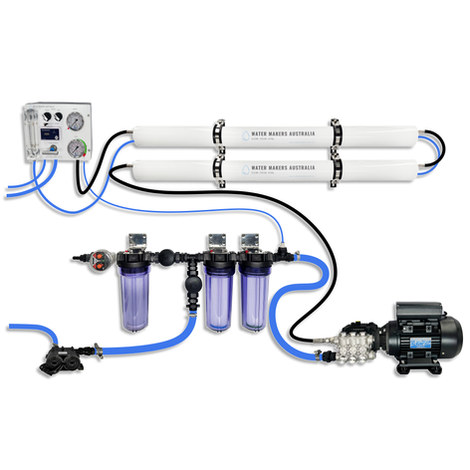
A two-membrane modular watermaker with 140 L/h nominal output, aimed at families and liveaboards that want more water per run.
Explore →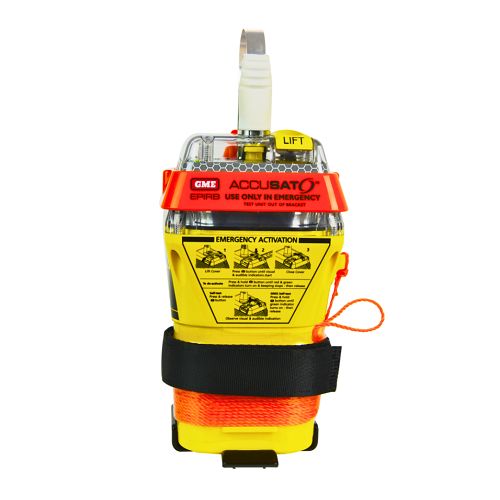
A 10‑year battery EPIRB with integrated GNSS (supports GPS and Galileo), infrared strobe and 121.5 MHz homing signal. Approved for worldwide COSPAS‑SARSAT operation.
Explore →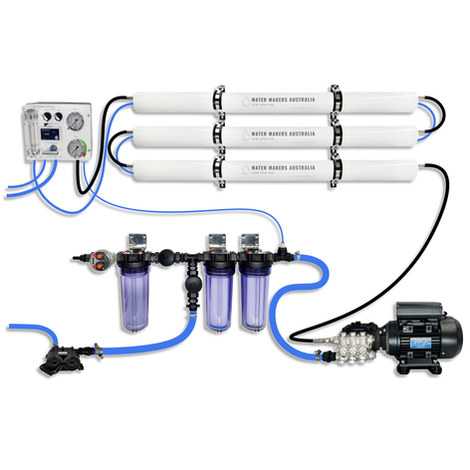
A three-membrane modular watermaker with 200 L/h nominal output and up to 240 L/h family-level marketing, for larger crews and heavy use.
Explore →