Loading this page…

Loading this page…
Sailing club
Port Bouvard Yacht Club (PBYC) is a local sailing and outrigger-canoe club based in Dawesville, WA, on the southeast corner of the Dawesville Cut overlooking the Harvey Estuary. The club runs a sailing season from October to April with sailing held every Saturday and club races usually in the afternoon. Fleet activity includes Topaz and Taz boats for juniors, 125s for youth sailors, Flying Fifteens, various catamarans and trailer-sailers for adults, and an outrigger-canoe cohort.
About
Port Bouvard Yacht Club (PBYC) is a local sailing and outrigger-canoe club based in Dawesville, WA, on the southeast corner of the Dawesville Cut overlooking the Harvey Estuary. The club runs a sailing season from October to April with sailing held every Saturday and club races usually in the afternoon. Fleet activity includes Topaz and Taz boats for juniors, 125s for youth sailors, Flying Fifteens, various catamarans and trailer-sailers for adults, and an outrigger-canoe cohort.
Service area: Dawesville, WA
Keep exploring
Where the Dawesville Cut meets the Harvey Estuary, on the waterway's southeast corner, a young club has built a sailing culture around two craft most organisations would never pair: racing yachts and outrigger canoes. Port Bouvard Yacht Club bills itself as a club "for Sail and Outrigger Canoe," and it operates not as a standalone body but as a division of the Port Bouvard Recreation and Sporting Club Incorporated, sharing the broader community facility at 1 Thisbe Drive, Dawesville.
The geography places it twenty kilometres south of Mandurah and about eighty kilometres south of Perth, on the foreshore of the Mandurah estuary system, with the clubhouse outlook sweeping down the Harvey Estuary — panoramic, in the club's own assessment. The Australian Flying Fifteen class association dates the club's establishment to the late 1990s, making it one of the younger sailing organisations in Western Australia, though the exact founding year does not appear in the public record.
Seven Flying Fifteens are registered at the club, giving it a meaningful stake in that classic keelboat class, and the fleet mix extends well beyond it. Office bearers listed by the club have included Commodore Kevin Spark, with Jason Brouwer serving as Vice Commodore, William Smith as Rear Commodore and Warren Keating as Treasurer, while the club's 2026 AGM news named Dave Darn as Commodore — evidence of the ordinary, healthy turnover of volunteer leadership.
Membership administration runs through the Majestri platform, race results go up on the club website, and the AGM has flagged a search for a sales and marketing person to promote the club and chase grants for growth.
Inclusion sits at the front of the program list here: Port Bouvard runs a Sailability program, with a dedicated contact listed among the club's officers, opening on-water participation to sailors who need supported access. Around that anchor, the club's class structure doubles as an informal training ladder. Juniors start in Topaz and Taz dinghies, youth sailors step up into 125s, and adults race Flying Fifteens alongside a mixed fleet of catamarans and trailer sailers — a progression that lets a family move through the sport without changing clubs.
The outrigger canoe contingent, complete with its own Outrigger Captain, adds another entry point entirely, and one that few yacht clubs anywhere in the country can match. The competitive framework is spelled out in unusual detail in the club's sailing instructions. Racing runs under the Racing Rules of Sailing, with fleets contesting a championship series scored on the Australian Sailing Yardstick plus a club-rated handicap series; each series comprises nine heats — eighteen races — with drop scores applied.
Entry costs ten dollars per boat per day or one hundred and twenty dollars for the season, fees the club directs to safety boat fuel and maintenance and to end-of-season prizes. Members who race are rostered at least once a season onto rescue or start boat duty, spreading the volunteer load that makes the racing possible. Formal rules also apply to eligibility: participants must hold financial membership of an Australian Sailing-affiliated club, as the sailing instructions note in citing Rules 46 and 75, and every boat, member or visitor, must carry its own insurance policy with racing cover.
Dedicated learn-to-sail courses are not detailed in the club's public material, so newcomers are best guided toward the junior classes and the Sailability contact.
The clubhouse occupies a foreshore position in the southeast corner of the Dawesville Cut, the engineered channel that links the Mandurah estuary system to the ocean, and racing takes place in the estuary waters directly off the club's eastern foreshore. From the grounds, the view runs down the Harvey Estuary — a wide, sheltered waterway that suits the dinghies, catamarans, trailer sailers and Flying Fifteens that make up the local fleet.
The Cut itself shapes the racing in a literal sense: the club's sailing instructions treat the Dawesville Channel as an obstacle that yachts may not enter during a race, with a specific exemption written in for outrigger canoes whether racing or training. It is a small detail that captures the club's dual identity better than any slogan. Dawesville sits roughly twenty kilometres below Mandurah and eighty kilometres below Perth, close enough to the metropolitan fringe to draw visiting boats yet far enough south to keep its own quiet character.
Launching is by ramp, which suits the off-the-beach and trailerable fleets, and shore facilities include a bar and function room within the wider Port Bouvard Recreation and Sporting Club complex. The estuary environment rewards regular local knowledge: shifting breezes off the surrounding land, shallow margins to respect, and a defined channel where sail gives way to powered traffic.
For the Flying Fifteen fraternity the venue is firmly on the map — the class association lists seven of the boats registered here, sailed on Saturdays through a season that opens in October and closes in April. Estuary sailing of this kind, sheltered and scenic, offers a genuine alternative to the open-coast venues that dominate Western Australian yachting.
According to the Australian Flying Fifteen class association, Port Bouvard Yacht Club came into being in the late 1990s, and that is honestly the most precise founding statement the public record offers. No exact year, no named founders and no detailed origin story have surfaced on the club's website or in the wider sources checked — a common gap for a young club formed as one arm of a larger community organisation.
The structural fact is clear enough: the club sails today as a division of the Port Bouvard Recreation and Sporting Club Incorporated, and its home at 1 Thisbe Drive sits within that broader sporting precinct on the Dawesville foreshore. Its emergence fits the region's timeline. The Dawesville Cut opened the Peel-Harvey system to ocean flushing in the mid-1990s, transforming the waterway's health and its appeal for recreation, and the canal and marina developments that followed drew a new population of boat owners to the area; a sailing club growing out of that community in the years after the Cut opened makes intuitive sense, though the club itself does not publish the connection.
What can be documented is the club's recent life. Its sailing instructions, updated for 2025, codify a mature racing operation with two series, defined fees, duty rosters and insurance requirements. Its officer list has rotated in the ordinary way of volunteer clubs — Commodore Kevin Spark's team giving way, by the 2026 AGM, to Dave Darn in the top job. That same AGM notice asked for a sales and marketing volunteer to promote the club and chase grant funding for growth, the kind of plain-spoken self-improvement typical of a club still writing its early chapters.
A quarter-century on from the late-1990s founding, those chapters are still being drafted.
Mud Islands is a group of low sand and saltmarsh islands in the southern part of Port Phillip, Victoria, north of Sorrento and Portsea. Part of the Port Phillip Heads Marine National Park, it is surrounded by shallows and important for seabirds.

Expect very different seasonal systems across Western Australia: the south‑west (Perth to Albany) has a strong summer afternoon sea breeze (the “Fremantle Doctor”) and winter westerly fronts, while northern WA follows a wet/dry monsoonal cycle with strong seasonal onshore winds, thunderstorms and cyclone risk in the wet season. Local headlands, estuaries and tidal flows often change what you actually feel on the water, so learn the local timing and sheltered venues first.
Explore →
Pick a protected bay, estuary or river reach where you can rig, launch and arrive on calm water within a short, sheltered transit; choose a site with a good ramp or jetty, clear recovery options and a nearby sailing club, marina or commercial operator for local knowledge and help.
Explore →
Increase inspection and cleaning frequency, use correctly sized and positioned sacrificial anodes or maintain impressed-current systems, select antifouling and application timing for local WA fouling pressure, and treat stainless and electrical connections proactively to break the corrosion chain.
Explore →
Before you head offshore from WA have a reliable primary VHF with DSC, a charged and registered 406 MHz EPIRB, at least one waterproof mobile phone and a separate handheld VHF as a backup; write and practise a clear escalation procedure so everyone knows which device to use and when.
Explore →
A practical guide for new sailors on picking the right Australian sailing club: training, boat access, racing, social fit, costs and the key questions to ask before joining.
Explore →A concise, practical introduction to the essential parts of a recreational sailing boat for beginners in Australia. Covers hull, deck, rigging, sails, steering, below-decks spaces and safety equipment, with simple explanations, common mistakes and a pre-sail checklist to help new sailors communicate and get underway.
Explore →A practical guide to the coastal weather systems that affect sailing along Western Australia's coast, focusing on the Fremantle Doctor, local sea breezes, and linked coastal phenomena. Explains how these systems form, when they tend to occur, how they influence boat handling and passage planning, common mistakes, and a
Explore →Practical guide for recreational sailors planning passage on the Hawkesbury River: how to plan around tides, choose anchorages, read local conditions and prepare the boat and crew for a safe, comfortable trip.
Explore →
Push-to-talk radio that uses 4G mobile networks where there is coverage and a built-in 16-channel analog radio where there is none, with GPS and SOS. Sold as a two-pack.
Explore →
Metal-bodied 4G push-to-talk radio with GPS and SOS in the GPS variant and a lifetime SIM plan included. Sold as a two-pack.
Explore →
The entry-level Poclink push-to-talk radio: 4G mobile network only, three years of service included, sold as a two-pack for half the price of the Pro and Ultra.
Explore →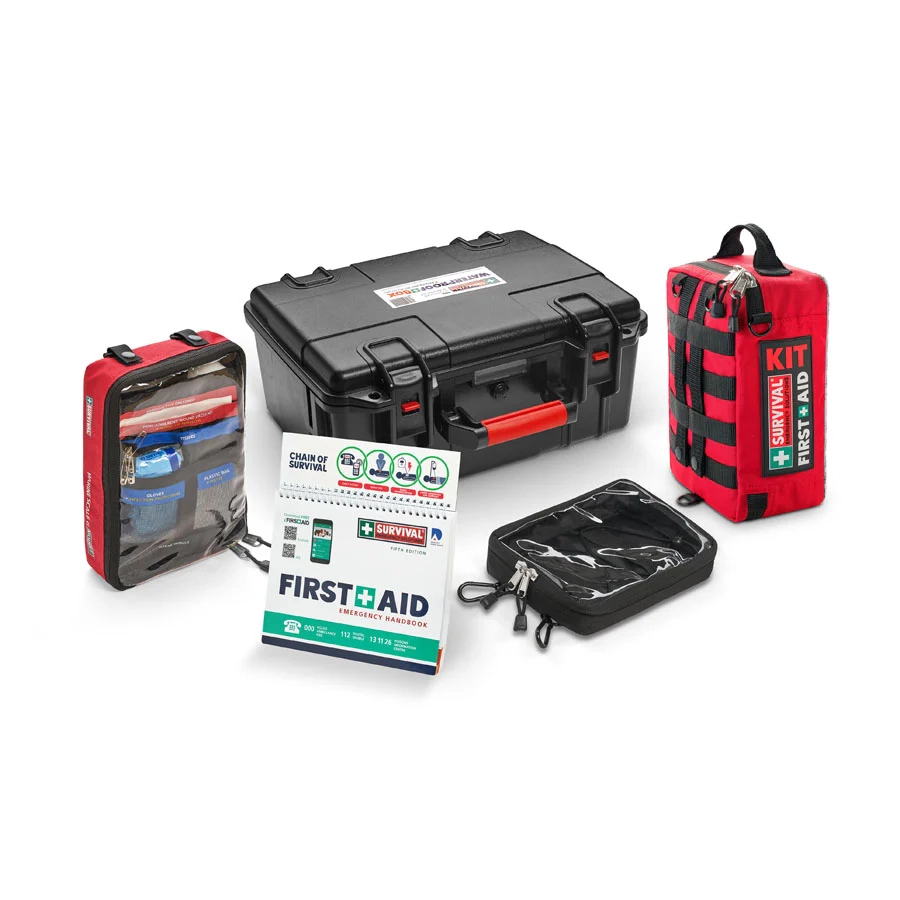
A 142-item marine first aid kit built around the Australian Scale G requirement, with a workplace kit, a Scale G module and a handbook packed in a large waterproof box.
Explore →