Loading this page…

Loading this page…
Sailing club
Port Douglas Yacht Club (PDYC) is a waterfront yacht club on Dickson Inlet in Port Douglas, Far North Queensland. The club combines social waterfront hospitality (The Yachty restaurant & bar) with volunteer-led community sailing, member-keelboat racing and an annual offshore regatta, Port Douglas Race Week, contested on the Coral Sea each May.
About
Port Douglas Yacht Club (PDYC) is a waterfront yacht club on Dickson Inlet in Port Douglas, Far North Queensland. The club combines social waterfront hospitality (The Yachty restaurant & bar) with volunteer-led community sailing, member-keelboat racing and an annual offshore regatta, Port Douglas Race Week, contested on the Coral Sea each May.
Service area: Port Douglas, Far North Queensland
Keep exploring
Port Douglas Yacht Club (PDYC) is a waterfront sailing club in Port Douglas, QLD with a character-filled clubhouse known as The Yachty (a restaurant & bar overlooking the marina).
The club runs organised sailing activities and events, publishes a sailing calendar and race week schedule, and operates J24 sailboats for member use. The site also mentions options for visitors including a free Wednesday sunset sail and a SailPASS program, plus membership information and event bookings.
Port Douglas Yacht Club does not operate a formal learn-to-sail school — no Tackers courses, junior training program or Discover Sailing Centre accreditation is advertised — and instead gets people on the water through two home-grown mechanisms that suit the club's character. The first is WAGS, the Wednesday-afternoon institution in which member volunteers take members of the public out for a free sunset sail.
Sign-on opens at 3:30pm, boats depart around 4:30pm and are back by about 6:30pm, and participants are expected to round out the evening with dinner and drinks at the clubhouse. It is, in effect, an informal sailing induction conducted at golden hour on one of the prettiest inlets in Queensland — and when strong wind warnings apply to Cairns Coastal Waters, the sailing is prudently restricted to the sheltered waters of Dickson Inlet or Packers Creek, or cancelled altogether.
The second mechanism is the club's own keelboat fleet. PDYC owns two J24 yachts, operated exclusively for the use of members and overseen by the club's Sailing Committee, which applies a Safety Management Plan and the J24 class rules. For members, that is a genuine development pathway: the J24 is a strict one-design keelboat with a deep racing heritage, and access to a matched club pair lets sailors build keelboat skills and race experience without owning a boat.
At the top of the program sits Port Douglas Race Week, the six-race series sailed each May on the Coral Sea off the town. The event gives club sailors an annual offshore-racing target and draws visiting yachts from far afield, with volunteer race officials — the club's honour roll includes Arthur and Val Hodge, Bob Brenac, John Graham, Greg Sinclair, Lister Hughes, Ross Chisholm and Gayleen Lowe — running a professional-standard series. Between free public sailing on Wednesdays, members' J24 racing, and a nationally recognised Race Week, PDYC's sailing program covers introduction, participation and competition without ever needing a classroom.
Port Douglas sits on a narrow peninsula in Far North Queensland, and the yacht club occupies the sheltered side of it, on the shores of Dickson Inlet. The clubhouse at 1 Spinnaker Close is reached off Wharf Street, directly opposite the Reef Marina and next door to Closehaven Marina — the nautical centre of a town that serves as a gateway to two World Heritage treasures, the Great Barrier Reef and the Daintree rainforest. Sailing here is framed by that geography: the calm waters of the inlet at your feet, and the open Coral Sea beyond the headlands.
Dickson Inlet itself is central to club life. Many members live aboard their boats, moored in the inlet or berthed in the marina next door, which gives the club an authentic working-waterfront atmosphere — this is not a clubhouse beside a car park but one at the middle of a floating community. The inlet and Packers Creek also serve as the club's sheltered-water fallback: when strong wind warnings are issued for the Cairns Coastal Waters, Wednesday afternoon sailing simply moves inside, keeping the tradition alive in safety.
The serious sailing water is the Coral Sea off Port Douglas, where Race Week's six-race series is contested each May. Tropical trade-wind conditions, reef-strewn approaches and a backdrop of rainforest-clad ranges make it one of the most spectacular regatta arenas in Australian yachting — a course area that has attracted offshore fleets since the Clipper Cup days of the 1990s.
Ashore, the clubhouse trades as The Yachty, open Wednesday to Friday from 2pm to 10pm and on weekends from midday to 10pm, and catering for functions and weddings — tourism listings suggest seating for around 150. Enquiries go to info@pdyc.org or (07) 4099 4386, and reciprocal privileges are recognised by clubs as far away as the Republic of Singapore Yacht Club. For visiting sailors, few Australian clubhouses combine this level of hospitality with a World Heritage sailing ground at the doorstep.
The club dates itself to 1985, when a group of friends and sailing enthusiasts gathered for the inaugural meeting and formed what became the Port Douglas Yacht Club Inc. The early years were modest in the extreme: the club opened just on race days and certain evenings, with volunteers staffing the kitchen and bar. A paid manager and weekend trading hours came later, as membership and ambition grew side by side.
The clubhouse story reached its first landmark on 4 December 1993, when the club's first dedicated premises were opened by Sir James Hardy after years of fundraising. A roof extension followed, funded by yacht donations, and further improvements were made in the wake of Cyclone Yasi in 2011. When the club marked forty years in 2025, it looked back on what it describes as numerous transformations along the road from race-day rooms to a full waterfront clubhouse.
The regatta history is richer still, and it begins offshore in every sense. The Clipper Cup trophy itself had a storied journey — carried home from Hawaii by Dick Gooch after Pan Am's closure and held in safekeeping at the Cruising Yacht Club of Australia — before the inaugural Mirage Resorts Clipper Cup was staged in Far North Queensland in September 1995: three races under Cairns Yacht Club's hosting, then a forty-nautical-mile passage race up to Port Douglas followed by three races organised by PDYC, attracting forty-four entries.
The roots went deeper still: Mike Burgess and Moss Hunt had originally proposed a Port Douglas to Lizard Island race for the town's Carnivale, and although that race never materialised, the Carnivale grew into a major annual event. By 1999 the Mirage Resorts Regatta had shifted to May to align with it, and from 2000 the PDYC-organised Clipper Cup ran alongside Carnivale.
The modern event took shape in 2012, when the regatta was revived with several divisions and a five-day racing format — twenty-three yachts contested that year's Exemplar Clipper Cup — before taking its present identity as Port Douglas Race Week in 2015. Sponsorship has carried the event through its eras: Exemplar Coaches and Limousines from 2010 to 2014, Mickey Ink Marine in 2015, the Quicksilver Group for six years from 2017, and then Riddoch Insurance Services. One small administrative footnote marks the digital age: the club's earlier website lapsed in 2025, with pdyc.org now the online home of a club whose next forty years look every bit as eventful as its first.

Look for a friendly club with beginner-focused training, accessible facilities and boats, a supportive community, clear safety practices, and opportunities to progress at your own pace.
Explore →
Write a one‑page plan with the who/what/when/where/how of your trip, keep a copy on board and leave the main copy with a responsible person ashore (and optionally with your club, marina office or local volunteer rescue service).
Explore →
Follow the basic COLREGs: keep a proper lookout, maintain safe speed and steering to avoid collisions, know which vessel ‘gives way’ and which ‘stands on’, use correct lights and sound signals, and keep clear of restricted waters and traffic lanes. Check local harbour rules and AMSA guidance for specifics.
Explore →
Pick a stable, simple, forgiving dinghy with a single sail or basic sloop rig, affordable handling and easy maintenance—ideally one with a local class or school nearby so you can access coaching and spare parts.
Explore →
A practical guide for new sailors on picking the right Australian sailing club: training, boat access, racing, social fit, costs and the key questions to ask before joining.
Explore →Practical guide for recreational sailors planning a coastal cruise from Sydney north to the Queensland border. Covers route options, weather and tidal considerations, planning checklists, common hazards, anchorages and practical examples for a safe, enjoyable trip.
Explore →
Practical guidance for recreational sailors in Australia on assessing swell, tide and wind, choosing the safest time to cross a coastal bar, preparing crew and gear, and making the decision to go or turn back.
Explore →
A practical guide to Queensland’s top sailing areas, what to expect from each region, seasonal and safety considerations, suggested itineraries and useful planning checklists for recreational sailors.
Explore →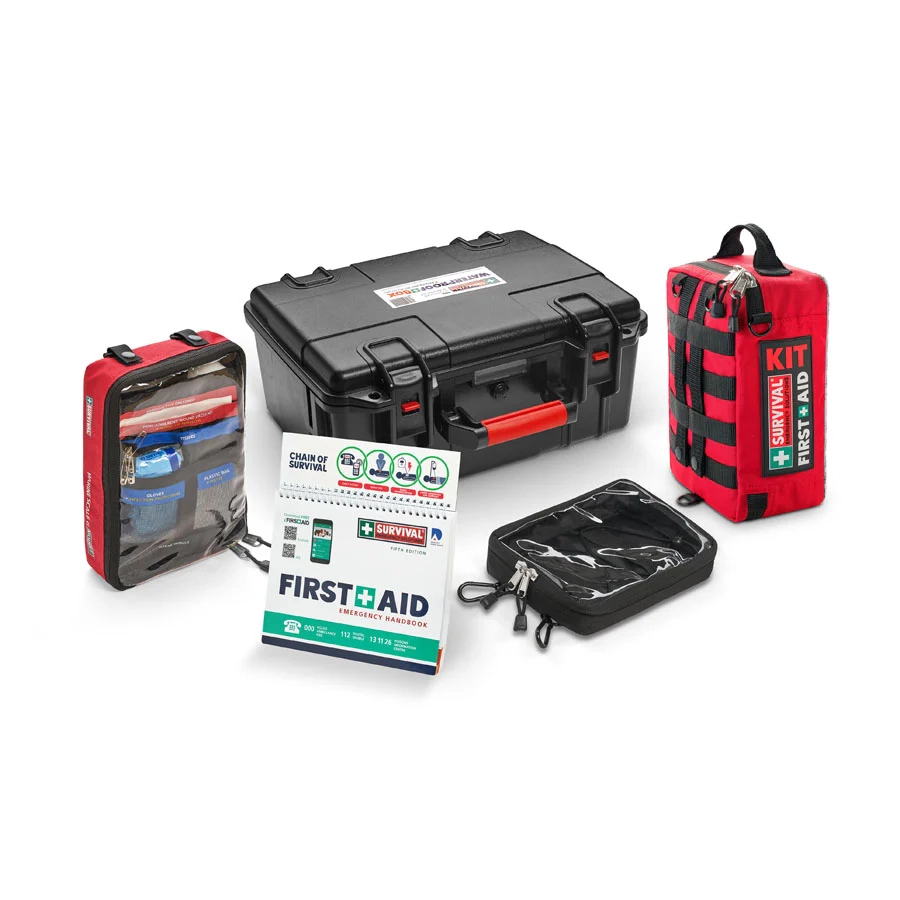
A 142-item marine first aid kit built around the Australian Scale G requirement, with a workplace kit, a Scale G module and a handbook packed in a large waterproof box.
Explore →
The original BoatEye360 full-colour low-light camera: the same 0.0001 lux sensor as the V2 in a larger 316L stainless housing, with HDMI and analog output, at a lower price.
Explore →
Push-to-talk radio that uses 4G mobile networks where there is coverage and a built-in 16-channel analog radio where there is none, with GPS and SOS. Sold as a two-pack.
Explore →
Metal-bodied 4G push-to-talk radio with GPS and SOS in the GPS variant and a lifetime SIM plan included. Sold as a two-pack.
Explore →