Loading this page…

Loading this page…
Sailing club
Portland Yacht Club is a community sailing club on the foreshore at Portland, Victoria. The club runs social sailing, learn-to-sail and competitive sailing programs for adults and juniors (including a junior sailing project and women’s courses), hosts regattas and welcomes cruising yachts. The club describes facilities and programs for members, and invites volunteer roles such as rescue-boat operators.
About
Portland Yacht Club is a community sailing club on the foreshore at Portland, Victoria. The club runs social sailing, learn-to-sail and competitive sailing programs for adults and juniors (including a junior sailing project and women’s courses), hosts regattas and welcomes cruising yachts. The club describes facilities and programs for members, and invites volunteer roles such as rescue-boat operators.
Service area: Portland, VIC
Keep exploring
Portland wears its age lightly. The club promotes its home as Victoria's second-oldest town, and Portland Yacht Club carries that maritime inheritance onto the water every week — a family-centred, mixed-fleet sailing club on the Portland harbour foreshore, where beginners share the ramp with hardened offshore sailors. The club states its values plainly — "confidence, independence, excellence, participation, community spirit and respect" — and its program is built to deliver each of them, from seven-year-olds in club Optimists to keelboat crews finishing twilight races as the sun drops over the bay.
The club credits its home conditions with sharpening its sailors. Portland's turbulent weather and strong southern oceans, the club says, have produced "many successful ocean racers and Australian championship holders" — and the regional record backs the claim's substance. Yachting Western Victoria, the association founded in Portland on 31 October 1959, counts Olympian Paul McKenzie and multiple world champions, including in the A Class catamaran, among the region's products, with national and state titles spread across Fireball, Taipan, RL24, Minnow and Flying Ant classes. Portland YC is a member of that association and one of its anchor clubs.
Current leadership keeps the operation personal: Commodore Les Thomas heads a committee that also includes Luke Donovan as vice commodore, Donna Hendy as rear commodore, Debb Oakley as secretary and Amanda Macdonald as treasurer. The club sails under the Po prefix and is affiliated with Australian Sailing. Local businesses — from the Port of Portland to the Harbour Lights Snack Bar — back the club's events, a sign of how tightly the club is woven into this deep-sea port town on the state's far south-west coast.
The Mentor Program is where Portland diverges from the textbook. New members are paired as buddies with experienced sailors and their boats, joining monthly Better Sailing sessions together — a model that solves the sport's oldest dropout problem by giving every newcomer a person, not just a course. It sits beside a SheSails program for female participation at all skill levels, which carries its own dedicated representative on the sailing committee, and a Portland South West Junior Sailing Project, a fundraising effort run through the Australian Sports Foundation to bring primary-school-aged children across the wider region into sailing.
Around those distinctive structures sits the full Australian Sailing pathway: free Discover Sailing Days with all equipment provided, Tackers 1 to 3 for kids aged seven to twelve in club Optimists over the summer holidays, OutThere Sailing for thirteen-to-seventeen-year-olds, a six-week adult Learn to Sail course on club Pacers, then Green Fleet, Intermediate Racing and Sunday pennant racing. Holiday programs are delivered with outside providers The Boatshed and Smooth Sailing School, and a Junior Summer Sailing Program ran across four days in January 2025. The training fleet comprises Optimists, Pacers and Lasers, with even Remote Control Laser sailing on the list for something different.
Adults are not left to the formal courses alone. Twilight Social Sailing runs on Friday nights through daylight saving for keel and trailable yachts, finishing with dinner and drinks at the club — for many members, the real retention program. The club has also signed on, with Warrnambool Yacht Club, to the Western Region's Discover Sailing Participation program backed by the Victorian Government's regional community sport funding, signalling that participation growth here is strategy, not accident. For a regional club, the breadth is striking: a child can arrive at a Discover Sailing Day and be mentored into club racing without a single gap in the ladder.
Two kinds of water lie at the club's doorstep, and the fleet uses both. Inside, Portland Harbour offers genuinely sheltered sailing — protected water where training fleets and junior sailors can operate in conditions that stay manageable when the ocean misbehaves. Outside, Portland Bay and the south-west coast deliver exactly what the club advertises: strong oceans and turbulent weather that test boat and crew properly. That pairing explains much about the club's character — nurturing at one end of the week, demanding at the other.
The clubhouse stands on the foreshore on Lee Breakwater Road, beside the harbour, with the Portland Marina a short walk away. The marina — floating berths in the sheltered harbour, managed by Glenelg Shire rather than the club — serves visiting yachts, and a boat ramp in the marina precinct can handle vessels up to eight tonnes. Portland is a working deep-sea port, and the club promotes it as a secure, welcoming port of call — or home base — for cruising yachts working their way along the coast between Melbourne and Adelaide; for keelboat owners, the combination of all-weather harbour, marina berths and a welcoming club is a genuine cruising asset on a coast that offers few of them.
Shoreside, the clubhouse hall doubles as a community asset, available for hire when the sailors aren't using it. The foreshore setting keeps everything compact: rigging areas, harbour, marina and clubrooms within a short walk of one another. For visiting racers arriving for the Portland Regatta or the Admella Cup, logistics are simple — launch, berth, sail and sleep all within the same harbour precinct, with a town behind it that has been provisioning seafarers for the better part of two centuries.
The precise year Portland Yacht Club was founded is not recorded in any source currently available — the club's own materials carry no history page, and the documentary trail runs thin. What can be said with confidence is that the club sails in one of Australia's oldest maritime communities and locates itself deliberately within that inheritance, crediting Portland's tough southern ocean conditions with forging generations of successful ocean racers and Australian champions. The club's history is best told, for now, through the institutions and events around it.
The strongest of those is Yachting Western Victoria, founded in Portland on 31 October 1959 as the regional association for western Victorian and south-east South Australian clubs — Portland, Port Fairy, Warrnambool, Port MacDonnell, Colac, Stawell and Derrinallum among them. Its Easter Regatta has been going since 1961, peaking at a record 230 boats in 1978; the region it serves produced Olympian Paul McKenzie, world champions in the A Class catamaran and national or state titleholders across Fireball, Taipan, RL24, Minnow and Flying Ant. The Portland Regatta ranks among the association's most durable fixtures, in company with the Port MacDonnell and Warrnambool regattas and Derrinallum's classic boat gathering — fixtures that have kept the region's clubs racing against each other for over six decades.
The club's own signature is the Admella Cup, an annual match-racing event run in recent years each autumn — March 2023 and April 2024 among them — and named with a nod to the coast's most famous shipwreck story. Event sponsorship drawn from across the town — Portland Signworks, the Port of Portland, Glenelg Shire, AWA Alliance Bank and local traders — shows how the club's calendar is underwritten by its community. A founding date may still be waiting in a minute book somewhere, but the visible record is of a club embedded in its town, its region and its harbour, and still adding chapters.
Bathurst Harbour (Port Davey system), in south‑west Tasmania, is a vast, almost land‑locked estuarine harbour inside the Southwest National Park and World Heritage Area. It offers a remote, sheltered anchoring environment protected from the Roaring Forties, but demands careful planning, an awareness of marine‑reserve rules, and a willingness to operate in shallow, tannin‑stained waters. Best suited to experienced coastal cruisers and small expedition yachts prepared for self‑sufficiency, Bathurst Harbour is more a place to linger and explore on foot and by tender than a port of call for busy,

Look for a friendly club with beginner-focused training, accessible facilities and boats, a supportive community, clear safety practices, and opportunities to progress at your own pace.
Explore →
Late spring to summer is usually the best time for beginners to start learning to sail in Tasmania because the weather is generally warmer, days are longer and conditions are often more settled. Expect lighter to moderate winds with regular afternoon sea breees in summer, while spring and autumn bring more changeable and sometimes stronger conditions; winter is colder, wetter and typically windier with more fronts and swell.
Explore →
Expect very different seasonal systems across Western Australia: the south‑west (Perth to Albany) has a strong summer afternoon sea breeze (the “Fremantle Doctor”) and winter westerly fronts, while northern WA follows a wet/dry monsoonal cycle with strong seasonal onshore winds, thunderstorms and cyclone risk in the wet season. Local headlands, estuaries and tidal flows often change what you actually feel on the water, so learn the local timing and sheltered venues first.
Explore →
Pick a stable, simple, forgiving dinghy with a single sail or basic sloop rig, affordable handling and easy maintenance—ideally one with a local class or school nearby so you can access coaching and spare parts.
Explore →
A concise, practical guide to the points of sail and how to trim sails effectively for common Australian conditions. Learn the basics of wind angles, sail shape, telltales, reefing considerations and simple steps to improve boat speed and balance.
Explore →
A practical guide for new sailors on picking the right Australian sailing club: training, boat access, racing, social fit, costs and the key questions to ask before joining.
Explore →A practical guide for recreational sailors planning visits to Albany and King George Sound. Covers the main anchorage areas, typical local weather patterns, tidal and current considerations, navigational hazards, on-the-water etiquette and a pre-departure checklist to help you plan a safe passage and enjoyable stopover
Explore →A practical guide for recreational sailors planning voyages to Esperance and the Recherche Archipelago: what to expect, key planning considerations, common anchorages, safety and communications, equipment recommendations and sensible steps for a successful trip in this remote southern WA cruising area.
Explore →Burke Yachtsman Gear Bag 40L - Shop Now Zip Pay | Tamar Marine Skip to content 59 – 63 Holbrook Street, Invermay Online Shop Open 24/7 Products search Contact us 1300 MARINE $ 0.00 0 Cart Burke Yachtsman Gear Bag 40L $ 79.90 Colour Choose an option Black Blue Black Blue Clear - Burke Yachtsman Gear Bag 40L quantity + Add to cart Enquire about this product SKU BAGB-Y24/BLACK* Category Bags - Sail & Gear A Burke classic and customer favourite, the Yachtsman’s Gear Bag is built tough to handle wet, salty conditions while keeping your gear dry and protected. Made from double coated waterproof…
Explore →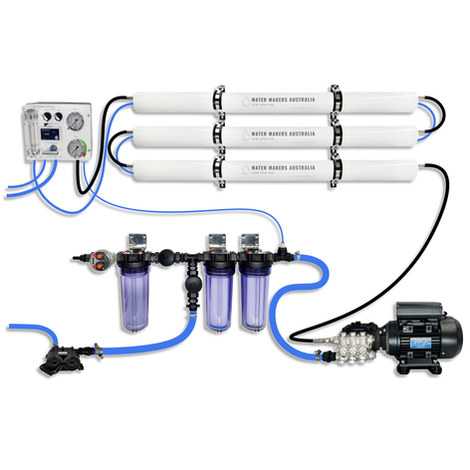
A three-membrane modular watermaker with 200 L/h nominal output and up to 240 L/h family-level marketing, for larger crews and heavy use.
Explore →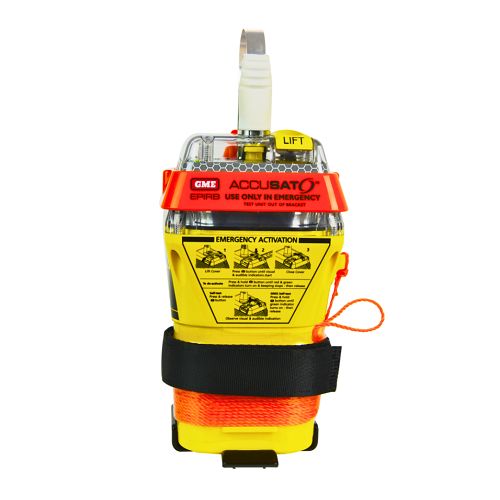
A 10‑year battery EPIRB with integrated GNSS (supports GPS and Galileo), infrared strobe and 121.5 MHz homing signal. Approved for worldwide COSPAS‑SARSAT operation.
Explore →
Self-contained, battery-powered plug‑and‑play autopilot designed for standard hydraulic steering systems.
Explore →