Loading this page…

Loading this page…
Sailing club
Queenscliff Lonsdale Yacht Club (QLYC) is a community sailing and boating club in Queenscliff, Victoria. The club runs organised on-water activities including keelboat and Couta boat racing on Port Phillip Bay, dinghy sailing, and paddling (kayaks, canoes and stand-up paddleboards) on Swan Bay. QLYC operates a clubhouse that hosts social events, offers a live clubhouse weather station, and provides bookings for vessel storage and venue hire. Membership and day-by-day SailPass options are offered for participation.
About
Queenscliff Lonsdale Yacht Club (QLYC) is a community sailing and boating club in Queenscliff, Victoria. The club runs organised on-water activities including keelboat and Couta boat racing on Port Phillip Bay, dinghy sailing, and paddling (kayaks, canoes and stand-up paddleboards) on Swan Bay. QLYC operates a clubhouse that hosts social events, offers a live clubhouse weather station, and provides bookings for vessel storage and venue hire. Membership and day-by-day SailPass options are offered for participation.
Service area: Queenscliff, VIC
Keep exploring
Friday evening at King Street, and the deck above Swan Bay fills with members watching the sun drop over the water — a weekly institution that says as much about Queenscliff Lonsdale Yacht Club as any trophy cabinet. This is a family club with an unusually wide sailing remit: dinghies and catamarans on the bay's shallows, keelboats racing every Saturday out on Port Phillip, trailer sailers in the pens, and a couta boat fleet that keeps Queenscliff's fishing-boat heritage under sail. The club believes it is probably among the oldest sailing organisations in Victoria, with more than a century on the shores of Swan Bay behind it — a claim explored in its history below, where two founding dates both deserve their place.
Affiliated with Australian Sailing and sailing under the Q prefix, the club has ridden a recent wave of growth. Membership jumped dramatically after the Covid years, the club secretary reported in 2023, as young families moved into the district and discovered the sailing on their doorstep. The clubhouse, boatshed and grounds along King Street were put up by the founding members with help from their families and friends, and volunteer labour still keeps them up — the sort of place where working on the club is part of belonging to it.
Visitors should note the local geography of clubs: Queenscliff has two. Queenscliff Lonsdale is the older, Swan Bay-based racing club with dinghies, cats, keelboats and couta boats; its younger neighbour, Queenscliff Cruising Yacht Club on Sand Island, is a keelboat destination club founded in 1963. Between them they cover nearly every kind of sailing the lower bay offers, but QLYC is where the town's sailing story began — and where, on a still evening, the sunset over the bay closes the argument.
Rather than buying in the standard national junior pathway, Queenscliff Lonsdale teaches sailing its own way — through in-house clinics run on club dinghies, priced to remove excuses. A three-day express clinic, such as the April 2024 edition at sixty dollars for members, covers rigging, points of sailing, capsize drills and the rudiments of racing, explicitly designed to feed new sailors into the club's teams racing.
The Sailing Clinic A series runs a slower burn: six fortnightly two-hour evening sessions for beginners through spring, culminating in Novices Trophy races — a first regatta experience built into the course itself. Intermediate clinics then step sailors up to a day of racing alongside the club's catamaran fleet on Swan Bay.
The club's school-holiday and summer face is equally distinctive. Discover Sailing and Paddling Days welcome the public on chosen Sundays across December and January, timed to the tide because Swan Bay is shallow, and put visitors into dinghies, canoes and kayaks alike. A partnership with the surf lifesavers at Point Lonsdale works to bring more of the district's youngsters across to sailing, continuing a schools connection that goes back to 1959, when Queenscliff High School introduced sailing as a sport with the club at its centre.
Racing opportunities complete the development loop. Dinghy and catamaran racing runs on Swan Bay, where the shallow water rewards local knowledge; keelboats race every Saturday on Port Phillip; and the couta boat fleet races in celebration of the town's fishing heritage. Club-owned boats historically played a role here — the one-design Pup, a twelve-foot plywood yacht built by members, was freely available to members, especially youngsters — and that tradition of club boats lowering the entry cost persists in the clinic model. No Tackers program is documented, but the club's own system demonstrably works: post-Covid membership growth, driven by young families, is its own endorsement.
Swan Bay is shallow, and the club makes a virtue of it. The bay carries enough water for dinghies, cats and paddle craft chiefly around the top of the tide, which is why the club's sailing and public days are scheduled tide-dependently — a constraint that doubles as a safety feature, keeping small-boat sailing in protected, forgiving water. When the keelboats want room, they head out to lower Port Phillip for Saturday racing, so the club genuinely sails two different waters in the same weekend.
Swan Bay's shallows are also ecologically precious: the bay is a Marine National Park and a RAMSAR-listed wetland, and the club promotes kayaking and canoeing as ways to enjoy it — one reason its public days pair paddling with sailing.
The King Street site holds everything within a few steps. The club rooms and deck look straight over Swan Bay, backed by a well-equipped kitchen and the Gaff & Oar Bar, the social engine of the Friday-night tradition. Practical shore facilities include launching ramps, a grassed rigging area, plenty of parking, secure storage in the boatshed and outdoor pens for trailer sailers, cats and dinghies. It is a working waterfront, built and kept up by volunteer hands, and it wears that care visibly.
Queenscliff itself completes the setting. The town sits at the lower end of Port Phillip near the Heads, with a fishing heritage that the club's couta boat fleet keeps alive under sail each week. For families, the appeal is the combination: sheltered bay sailing for the small boats, open-water keelboat racing a short sail away, a historic town around the corner, and a deck that catches the evening sun. Clubs on the open coast offer drama; Swan Bay offers frequency — more days on the water, for more members of the family, across more kinds of craft.
The club counts its age two ways, and both dates are honest. The first beginning came in 1913, when a sailing group formed on Swan Bay below the primary school under the name Swan Bay Boat Club — the origin of the club's belief that it is "probably one of the oldest sailing organisations in Victoria". The second beginning came at Easter 1947, when the club was revived after the war years under commodore J.
R. (Jack) Golightly senior, keeping the Swan Bay Boat Club name and — in the most Queenscliff detail imaginable — floating the original clubhouse down the bay to its present King Street site. Between 1947 and 1949 members built the boatshed, constructed a pier and raised new club rooms around it.
The post-war decades were inventive ones. Members turned out their own Swan Bay class dinghies and created a one-design they called the Pup — a twelve-foot plywood yacht built by club hands and lent freely to members, especially the young. In 1959, principal Jack Bishop brought sailing into the sports program at Queenscliff High School — regarded as the first school in Australia, possibly anywhere, to do so — with the club central to making it work. In 1972 the club took its current name, Queenscliff Lonsdale Yacht Club, extending and improving the clubhouse to match.
Recent years have been about recording and renewing. The club marked seventy-five years since the 1947 revival by holding an open day on 5 March 2023 while also releasing an updated oral history of the club. That project, built from interviews conducted by Ian Campbell in February 2023, captured the voices of life members and champions including Bill Reynolds, boat builder Alan Cayzer, Brian Golland, Chris Laker, David Golightly, Colin Bishop and Bob Mayne.
Meanwhile the membership surged after Covid with an influx of young families, and the partnership with Point Lonsdale's surf lifesavers points the next chapter. A club with two birthdays, it turns out, can still be growing at a hundred and ten.
Metung is a village on a peninsula between Lake King and Bancroft Bay in Victoria’s Gippsland Lakes. It is a well-used boating base on the lakes, with jetties and sheltered water all around.

Look for a friendly club with beginner-focused training, accessible facilities and boats, a supportive community, clear safety practices, and opportunities to progress at your own pace.
Explore →
Pick a stable, simple, forgiving dinghy with a single sail or basic sloop rig, affordable handling and easy maintenance—ideally one with a local class or school nearby so you can access coaching and spare parts.
Explore →
Many pets can enjoy sailing but suitability comes down to temperament, physical fitness and how you introduce them. Do a calm, staged assessment and get a vet check before you take them offshore.
Explore →
Rig and de-rig a small dinghy by following a consistent, step-by-step sequence: prepare the boat on shore, fit spars and foils in a stable order, control sails and running rigging so lines don’t tangle, check fittings and safety gear, and reverse the process when coming ashore—always working with a partner when possible and staying aware of wind and tide.
Explore →
A practical guide for new sailors on picking the right Australian sailing club: training, boat access, racing, social fit, costs and the key questions to ask before joining.
Explore →A practical guide for recreational sailors planning day sails or short cruises around Batemans Bay, Broulee and the Clyde River. Covers local conditions, safe approaches, anchorages, launching, tides, common hazards, and checklists for trip planning and on-water decisions.
Explore →A concise, practical introduction to the essential parts of a recreational sailing boat for beginners in Australia. Covers hull, deck, rigging, sails, steering, below-decks spaces and safety equipment, with simple explanations, common mistakes and a pre-sail checklist to help new sailors communicate and get underway.
Explore →Practical guide for recreational sailors planning passage on the Hawkesbury River: how to plan around tides, choose anchorages, read local conditions and prepare the boat and crew for a safe, comfortable trip.
Explore →
Push-to-talk radio that uses 4G mobile networks where there is coverage and a built-in 16-channel analog radio where there is none, with GPS and SOS. Sold as a two-pack.
Explore →
Standard 10 x 2.5 inch activated coconut carbon block cartridge, 5 micron nominal. It sits in the freshwater flush line and helps remove chlorine before the flush water reaches the membrane.
Explore →
Metal-bodied 4G push-to-talk radio with GPS and SOS in the GPS variant and a lifetime SIM plan included. Sold as a two-pack.
Explore →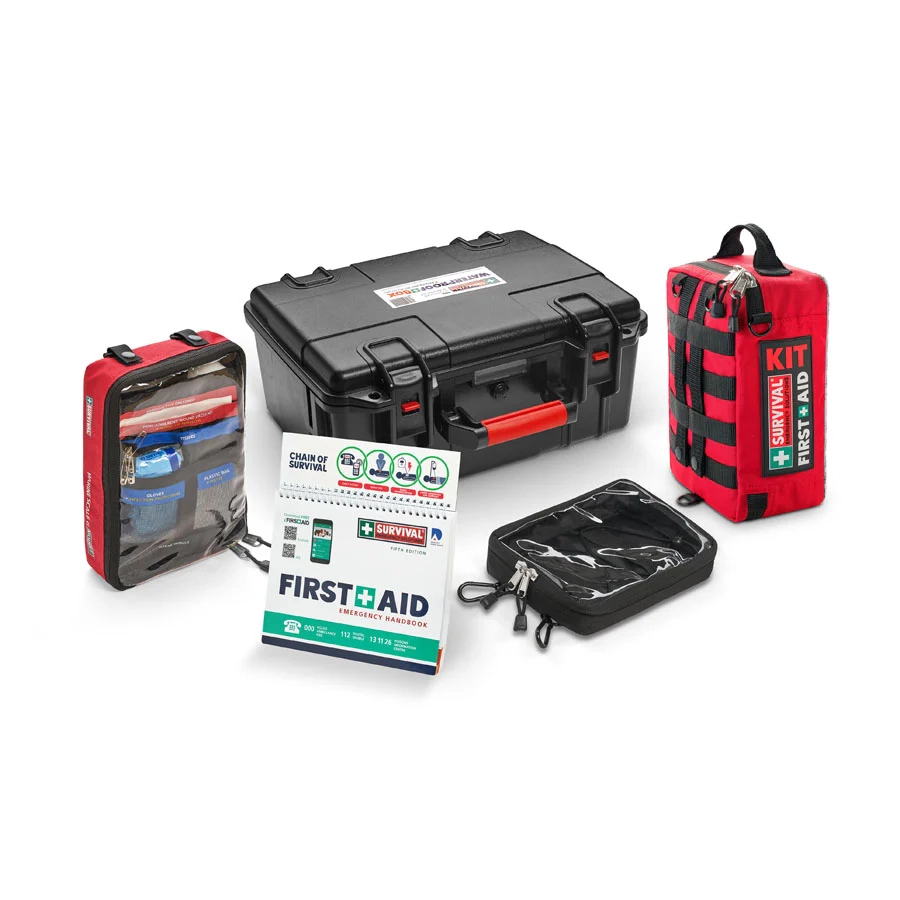
A 142-item marine first aid kit built around the Australian Scale G requirement, with a workplace kit, a Scale G module and a handbook packed in a large waterproof box.
Explore →