Loading this page…

Loading this page…
Sailing club
South Brisbane Sailing Club is a community-focused sailing club on the Brisbane River near Orleigh Park in West End (QLD). The club runs organised Saturday racing (September–April), social sailing events and regattas, offers Learn to Sail programs for juniors and adults delivered by instructors, provides club dinghy hire and an active volunteer and social program, and makes a community hall available for hire.
About
South Brisbane Sailing Club is a community-focused sailing club on the Brisbane River near Orleigh Park in West End (QLD). The club runs organised Saturday racing (September–April), social sailing events and regattas, offers Learn to Sail programs for juniors and adults delivered by instructors, provides club dinghy hire and an active volunteer and social program, and makes a community hall available for hire.
Service area: West End, QLD (Brisbane River near Orleigh Park)
Keep exploring
South Brisbane Sailing Club is a community-focused sailing club on the Brisbane River near Orleigh Park in West End (QLD). The club runs organised Saturday racing (September–April), social sailing events and regattas, offers Learn to Sail programs for juniors and adults delivered by instructors, provides club dinghy hire and an active volunteer and social program, and makes a community hall available for hire.
Saturday is the engine room of South Brisbane's sailing development. From early September until the end of March, training classes run on Saturday mornings and races follow in the afternoon, with a lighter schedule through winter, and the club states plainly that it welcomes every age and level of skill, from people with no prior experience to, in its own phrase, budding Olympians.
Instruction uses the club's Pacers and Herons, stable dinghies well suited to first-time sailors, and learn-to-sail classes are backed by a fleet of 17 hire dinghies, so a newcomer does not need to own a boat to get started. The pathway then leads into one of the club's racing fleets: Lasers in standard, radial and 4.7 rigs, Herons, Tasars, and NS14s, a development class the club describes as highly competitive.
No Discover Sailing Centre or Tackers listing is advertised, so the club's training is best understood as a club-run program rather than an accredited sailing school; as general context, many Australian dinghy clubs operate exactly this way, with volunteer instructors, club-owned training boats and a direct bridge from lessons into weekend racing. The results suggest the model works.
The club has produced a string of national champions across the decades, including Cathy and Neil Hackett in 125s during 1977-78; David Miers, Ian Kennedy, Craig Taylor, Brad Taylor and three-time winner Robbie Lea in Sabots through the 1970s; and a Heron lineage stretching from Peter Bailey in 2007 through John Nobbs, David Johnson and Justin Carey in 2017. Historical fleets, from Sharpies and 16ft skiffs to 125s and Trainees, show how the club has repeatedly rebuilt its junior pipeline around the classes of the day.
The address, 68 Hill End Terrace in West End, puts the club beside Orleigh Park on a sweeping bend of the Brisbane River, around three kilometres upstream from the CBD on the way toward the University of Queensland at St Lucia. Racing takes place on the St Lucia and Milton Reaches, the broad river sections either side of the clubhouse, which appear on the state waterways authority's aquatic event permits as the club's sailing waters; in the club's early years courses ranged far more widely, anywhere from Milton down to Hamilton.
River sailing here has its own character: shifting breezes bending around the city reaches, tidal flow to consider, and the constant backdrop of one of Brisbane's greenest inner suburbs. The clubhouse itself is a modest weatherboard building erected in 1956 on a site leased from the Brisbane City Council, and its position could hardly be closer to the action, with under 16 feet separating the back of the building from the water's edge.
That proximity is both charm and hazard: river floods in 1974, 2011 and 2022 have all put water through the building, the first of them six feet above the floorboards, and each restoration has been carried out by members. On calmer days the front lawn serves as the club's social deck, where sausage sizzles after racing look out over the same reach where the fleets have competed since 1903.
For a visiting dinghy sailor, it is an unusually accessible taste of metropolitan river sailing, minutes from the city yet with well over a century of continuity under its keel.
The club began life in 1903 under the name Victoria Sailing Club, whose members gathered in the basement of the Victoria Hotel in Stanley Street, South Brisbane, close by the Victoria Bridge. On 13 September 1906 it reformed under its present name with 222 senior members, headquartered at J.D. O'Connor's South Brisbane Hotel, and flew a navy blue pennant with white S.B.S.C. letters over fleets catering for boats from 10 to 21 feet.
An early milestone came on 9 December 1909, when the club accepted a challenge from Sydney's Port Jackson Sailing Skiff Club, which sent two skiffs north for a championship race intended to promote 16ft skiff racing; Minoru, skippered by H. Rodrick, won the £5 first prize. In 1913 the club declined an invitation to help form an Olympic Association, judging it of no benefit to water sports, and in 1915 Life Member K.H. Laidlaw and President A.F.
Reid convened a special meeting that resolved to cater for the 16ft skiff class alone; by 1918 twenty skiffs were racing. Membership hit 250 in 1920, electric lights arrived in 1921, and an interclub contest with Oxley was inaugurated in 1921-22. The 21st birthday dinner in 1924-25 was claimed as a privilege no other Queensland sailing club had enjoyed, and a history booklet sealed in a casket for Brisbane's centenary has since been lost.
The club moved to Fish Lane in 1925, was refused a site near Patrick Lane, Toowong, in 1953, then won approval for Orleigh Street in February 1954 with help from Vice Mayor Col Bennett; volunteers built the clubhouse for about £1,945 and it opened on 9 June 1956. Floods tested it in 1974, 2011 and 2022, members restoring it each time. Incorporation followed on 17 July 1986, the West End Sports Association affiliation and canoe club tenancy in 1993-94, and a centenary history by Helen Gregory, with archives now held at the John Oxley Library; the club marked 120 years of sailing in the 2023-24 season.
A practical, harbour-focused cruising guide to Trial Bay on the New South Wales Mid North Coast. The guide describes the bay’s sheltered and exposed zones, headlands and islands, local seasonal wind and swell patterns, principal sailing areas and recommended anchorages, shore facilities around South West Rocks and Arakoon, navigation and arrival considerations, specific hazards such as the Macleay River entrance, sand movement and reefs, local marine park and heritage restrictions, and three realistic sailing experiences ranging from sheltered family daysails to multi-day island circuits. It’s

Expect very different seasonal systems across Western Australia: the south‑west (Perth to Albany) has a strong summer afternoon sea breeze (the “Fremantle Doctor”) and winter westerly fronts, while northern WA follows a wet/dry monsoonal cycle with strong seasonal onshore winds, thunderstorms and cyclone risk in the wet season. Local headlands, estuaries and tidal flows often change what you actually feel on the water, so learn the local timing and sheltered venues first.
Explore →
Yes — South Australian coastal waters include marine parks, aquatic reserves, harbour bylaws and local council restrictions that can affect anchoring, fishing, mooring and access; check the relevant state agencies, local councils and Notices to Mariners for location-specific rules and permit requirements.
Explore →
Local rules, marine‑park zoning and permit needs vary by reserve around South Australia’s coast — check the relevant marine park zoning map and SA Department for Environment and Water (DEW) information for the exact area before you go.
Explore →
Pick a protected bay, estuary or river reach where you can rig, launch and arrive on calm water within a short, sheltered transit; choose a site with a good ramp or jetty, clear recovery options and a nearby sailing club, marina or commercial operator for local knowledge and help.
Explore →
A practical guide for new sailors on picking the right Australian sailing club: training, boat access, racing, social fit, costs and the key questions to ask before joining.
Explore →Practical guide for recreational sailors planning passage on the Hawkesbury River: how to plan around tides, choose anchorages, read local conditions and prepare the boat and crew for a safe, comfortable trip.
Explore →
A practical, Australia-focused guide for planning and sailing around the Whitsunday Islands: weather and seasons, navigation and anchoring, moorings and parks, provisioning and charters, safety and common mistakes, plus checklists and next steps.
Explore →A practical guide for recreational sailors planning day sails or short cruises around Batemans Bay, Broulee and the Clyde River. Covers local conditions, safe approaches, anchorages, launching, tides, common hazards, and checklists for trip planning and on-water decisions.
Explore →Burke Yachtsman Gear Bag 40L - Shop Now Zip Pay | Tamar Marine Skip to content 59 – 63 Holbrook Street, Invermay Online Shop Open 24/7 Products search Contact us 1300 MARINE $ 0.00 0 Cart Burke Yachtsman Gear Bag 40L $ 79.90 Colour Choose an option Black Blue Black Blue Clear - Burke Yachtsman Gear Bag 40L quantity + Add to cart Enquire about this product SKU BAGB-Y24/BLACK* Category Bags - Sail & Gear A Burke classic and customer favourite, the Yachtsman’s Gear Bag is built tough to handle wet, salty conditions while keeping your gear dry and protected. Made from double coated waterproof…
Explore →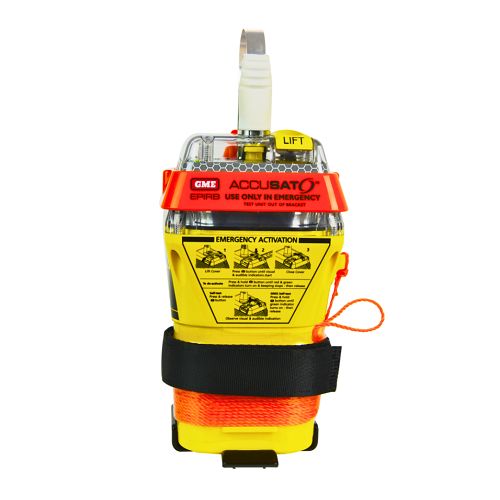
A 10‑year battery EPIRB with integrated GNSS (supports GPS and Galileo), infrared strobe and 121.5 MHz homing signal. Approved for worldwide COSPAS‑SARSAT operation.
Explore →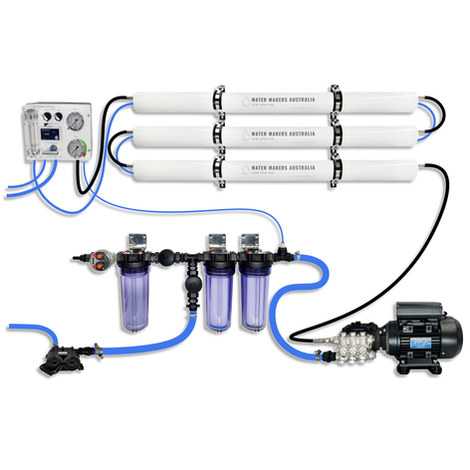
A three-membrane modular watermaker with 200 L/h nominal output and up to 240 L/h family-level marketing, for larger crews and heavy use.
Explore →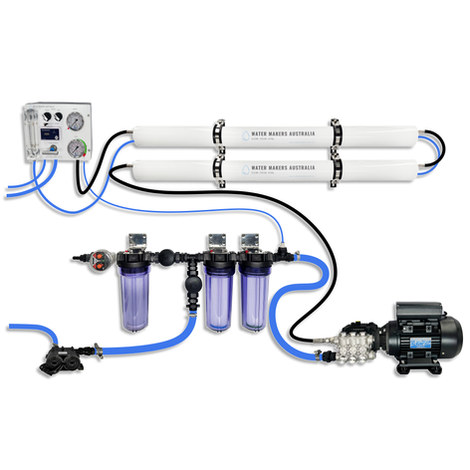
A two-membrane modular watermaker with 140 L/h nominal output, aimed at families and liveaboards that want more water per run.
Explore →