Loading this page…

Loading this page…
Sailing club
South Gippsland Yacht Club is a community sailing club in Inverloch, Victoria. The club runs organised sailing activities and regattas, offers comprehensive training programs and coaching for junior and senior sailors, and provides a storage facility used by local sailing enthusiasts. Visitors and prospective members are welcome.
About
South Gippsland Yacht Club is a community sailing club in Inverloch, Victoria. The club runs organised sailing activities and regattas, offers comprehensive training programs and coaching for junior and senior sailors, and provides a storage facility used by local sailing enthusiasts. Visitors and prospective members are welcome.
Service area: Inverloch, VIC
Keep exploring
Inverloch can fairly claim a place in world sailing history: the Moth class — the little scow that went on to circle the globe and eventually sprout foils — was born on Anderson Inlet in 1928. The South Gippsland Yacht Club sails that same water today, and it does so in a deliberately modest key. Southern Wooden Boat Sailing has called it an "archetypal community organisation", enthusiastically run by and for the locals, and the club's foreshore buildings have what the same observer affectionately termed a functional beach shack quality. Australian Sailing lists it as a Category B club.
The club's own stated priority is participation — fun for every member regardless of skill level or the class of boat they sail — and the fleet reflects that: Impulses, Lasers, RS Aeros and Sabres in the monohull divisions, Taipans and Mosquitos among the cats, all launched off the beach into a shallow tidal inlet that keeps keelboats out and the focus firmly on small boats. The season runs from November, with Sunday racing between eleven and two and regattas programmed on every public holiday weekend.
The event that has put the club on the national map is the Inverloch Classic Wooden Dinghy Regatta, which began around 2015 and which Southern Wooden Boat Sailing describes as the country's largest gathering of classic wooden dinghies. One honest caveat belongs in any account of this club: when the present organisation was founded is not stated in its own publications, a distinction explored in the History section. What the club may lack in documented pedigree it more than replaces with the pedigree of its water.
The entry point here is the club sailing school's Introduction to Off the Beach Sailing course — an intensive twelve hours spread over two days in the school holidays, priced around $250, mixing onshore demonstrations and theory with one-on-one coaching on the water. That concentrated format suits a holiday town: families can time a course to an Inverloch summer stay and come away genuinely started in the sport. It is equally important to state what the club does not offer.
Its courses page notes there is no official year-round training program and that Tackers is not currently available at SGYC, and no Discover Sailing Centre accreditation appears in published listings — even as the club's own homepage speaks of comprehensive programs for juniors and seniors alike, with professional coaching on offer. Prospective families should ask the club directly about the current season's arrangements.
What removes the financial sting is the club boat fleet, available free to sailing members: a Mirror, two Optimists, two RS Fevas, two Pacers, a Sabre, a Laser and a Corsair. A new sailor can finish the course and keep sailing all season without owning anything, then race from November onward in the Sunday program. Competition is structured but friendly — the Toyota Series, for instance, counts the best four results from five races across divisions — and the calendar adds regattas on every public holiday weekend plus the Eastern Regional Regatta, run in early February 2026.
Members also travel as a group each year to Port Albert, where they contest the annual South Gippsland Regatta. For coaching beyond the courses, professional help can be arranged through the club, and the racing fleet's mix of Impulse, ILCA, RS Aero, Sabre, Taipan and Mosquito means graduates graduate into real class racing rather than a cul-de-sac.
The club rooms stand at 22 The Esplanade, Inverloch, postcode 3996, directly on the foreshore of Anderson Inlet. Inverloch itself is a Bass Coast Shire seaside town 143 kilometres south-east of Melbourne, sitting at the inlet's mouth where it meets Bass Strait. The club's own description of its sailing water is worth quoting directly: "a varied seascape, often making racing fun and challenging". Anderson Inlet is a broad tidal estuary sheltered from the open ocean, and its racing waters shift character with the tide — wide and open at high water, threaded with channels and banks as the tide falls.
Those same traits impose hard limits. The water is shallow, the tides run hard, the sandbars shift, the entrance bar is treacherous, and keelboats cannot get in — which is precisely why this has always been, and remains, an off-the-beach club. For dinghy and cat sailors the constraints are features: protected water in almost any weather, tactical sandbank racing when the tide is low, and flat-water speed when it is high.
Ashore, the facilities are exactly what a beach club needs — club rooms on the foreshore, a launching ramp, and a substantial boat storage facility that local sailors rely on. The sponsor board reads like the town's business directory: Bass Coast Shire Council, Bendigo Bank Inverloch, Leongatha Toyota, Alex Scott & Staff, Mitre 10 Inverloch and the local Lions club — a fair measure of how woven into the town the club is.
Regatta coverage gets professional treatment too, with event videos shot by club member Oliver Hartas, who works professionally as a yachting-event videographer. It is a small-town sailing venue that knows exactly what it is.
Precision matters in this club's story, so here it is plainly: the year in which the present-day South Gippsland Yacht Club was founded appears nowhere on its website or in the public record consulted, and any account that quotes a date is guessing. What is documented is the lineage of sailing at Inverloch. An earlier Inverloch Yacht Club ran a race on 2 January 1893, when the town was a small, isolated seaside community, and regatta days followed — though the link between that body and today's club is unverified.
The inlet's second documented chapter is the famous one. In 1928 local man Len Morris designed an eleven-foot scow, the Inverloch Eleven Foot Class, and the first boat — Olive, named for his wife — survives on display at Albert Park Yacht Club. As sisters like Whoopee and Flutterby were built, an Inverloch yacht club organised around the class; Morris then renamed it the Moth after spotting the American Moth Boat in Rudder magazine, and Inverloch hosted the 1936 formation of the Victorian Moth Class Association.
The class went worldwide, and the Moth national championship trophy remains the Inverloch Silver Cup — an extraordinary legacy for one small inlet. The modern club's clearest milestone is the Inverloch Classic Wooden Dinghy Regatta, first run around 2015, reaching its eighth running in 2022 and tenth in 2024 and billed as the country's largest gathering of classic wooden dinghies.
Its trophies include the Ginn Cup for the overall winner and the Jack Carroll Memorial Trophy for Sailfish, and the February 2026 running marked seventy years since the Australian Sailfish appeared, with Brian Carroll — whose father Jack Carroll co-designed the class — out racing his own vintage boat. The 2015 regatta heard a speech from Jessica Watson OAM, introduced by Tom King OAM, a Mirror world champion and Olympic 470 gold medallist.
Gwen 12s, Mirrors, Herons, Flying Ants, Sabots, Rainbows, Finns, Cherubs and Minnows all turn up to race, keeping Inverloch's wooden-dinghy flame alight.
Batemans Bay and the Clyde River form a classic NSW South Coast cruising region where a sheltered, tidal estuary meets a short, island‑dotted entrance to the Tasman Sea. It’s distinctive for easy access from Canberra, a mix of river and bay sailing, a compact marina and mooring network, and a river entrance (the Clyde River bar) that can change rapidly. The area suits day sails, weekend cruising, trailer‑boat exploration and sheltered coastal passages; offshore or long‑passage plans require careful timing and local knowledge. Preparation for tidal flow, variable southerly swells and shallow, s

Use ramps and beaches with respect for local conditions: check ramp layout, tide and swell, wind direction, vehicle access and crowding; prepare boat and crew before you launch or retrieve; and follow local signage, courtesy and safety practices. Specifics vary by ramp and beach, so confirm details for the exact site before you go.
Explore →
Write a one‑page plan with the who/what/when/where/how of your trip, keep a copy on board and leave the main copy with a responsible person ashore (and optionally with your club, marina office or local volunteer rescue service).
Explore →
Before your first sail in South Australian waters check the weather and tide, make sure the boat and safety equipment are fit for the trip, confirm local rules and any area-specific hazards, and tell someone your plan.
Explore →
A good float plan and a well-stocked emergency kit significantly improve your chances of a safe outcome when cruising remote parts of South Australia’s coastline. The float plan should give someone ashore all the information they need to find you and raise help if you don’t return; the emergency kit should allow you to stabilise the boat, care for injuries, signal for rescue and survive until help arrives.
Explore →
A practical guide for new sailors on picking the right Australian sailing club: training, boat access, racing, social fit, costs and the key questions to ask before joining.
Explore →A practical guide for recreational sailors planning voyages to Esperance and the Recherche Archipelago: what to expect, key planning considerations, common anchorages, safety and communications, equipment recommendations and sensible steps for a successful trip in this remote southern WA cruising area.
Explore →Practical guide for recreational sailors planning passage on the Hawkesbury River: how to plan around tides, choose anchorages, read local conditions and prepare the boat and crew for a safe, comfortable trip.
Explore →
A practical, Australia-focused guide for planning and sailing around the Whitsunday Islands: weather and seasons, navigation and anchoring, moorings and parks, provisioning and charters, safety and common mistakes, plus checklists and next steps.
Explore →Burke Yachtsman Gear Bag 40L - Shop Now Zip Pay | Tamar Marine Skip to content 59 – 63 Holbrook Street, Invermay Online Shop Open 24/7 Products search Contact us 1300 MARINE $ 0.00 0 Cart Burke Yachtsman Gear Bag 40L $ 79.90 Colour Choose an option Black Blue Black Blue Clear - Burke Yachtsman Gear Bag 40L quantity + Add to cart Enquire about this product SKU BAGB-Y24/BLACK* Category Bags - Sail & Gear A Burke classic and customer favourite, the Yachtsman’s Gear Bag is built tough to handle wet, salty conditions while keeping your gear dry and protected. Made from double coated waterproof…
Explore →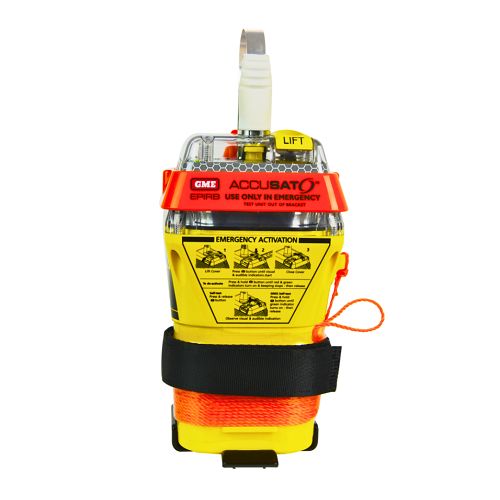
A 10‑year battery EPIRB with integrated GNSS (supports GPS and Galileo), infrared strobe and 121.5 MHz homing signal. Approved for worldwide COSPAS‑SARSAT operation.
Explore →
Self-contained, battery-powered plug‑and‑play autopilot designed for standard hydraulic steering systems.
Explore →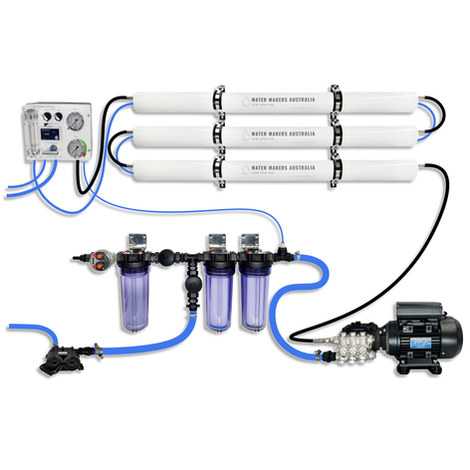
A three-membrane modular watermaker with 200 L/h nominal output and up to 240 L/h family-level marketing, for larger crews and heavy use.
Explore →