Loading this page…

Loading this page…
Sailing club
Warneet Motor Yacht Club (WMYC) is a long-established yacht club on Rutherford Inlet in Warneet, Westernport, Victoria. Founded in 1952, the club runs cruising, racing and social programs for the local boating and yachting community and hosts the long-running Warneet Around French Island Race (WAFIR). The club offers a renovated clubhouse (2019) with decking and community/venue hire functions and positions itself as a local hub for Warneet and the City of Casey.
About
Warneet Motor Yacht Club (WMYC) is a long-established yacht club on Rutherford Inlet in Warneet, Westernport, Victoria. Founded in 1952, the club runs cruising, racing and social programs for the local boating and yachting community and hosts the long-running Warneet Around French Island Race (WAFIR). The club offers a renovated clubhouse (2019) with decking and community/venue hire functions and positions itself as a local hub for Warneet and the City of Casey.
Service area: Warneet, Westernport, Victoria
Keep exploring
Some clubs have to earn seniority; Warneet Motor Yacht Club simply states it. "Proudly Westernport's Oldest Yacht Club" is the club's own banner, and by its account it was the first yacht club established on Western Port, the great tidal bay south-east of Melbourne, formed in February 1952. More than seventy years on — the club marked its seventieth anniversary in 2022 — it remains anchored in the same spot on Rutherford Inlet at Warneet, in the City of Casey.
The "Motor" in the name hints at the club's breadth. This is a cruising, racing and social club that opens its doors to non-sailing members too, and the Save the Warneet Jetties group describes it as "as much a community hub as a yacht club", offering a base for community groups across Warneet and the wider City of Casey. The club's self-bestowed nickname is "the jewel in the crown of Warneet" — an immodest phrase, but one backed by decades of local institution-building. It is an affiliated member of Australian Sailing, with Commodore Alex Stroud at the helm and mail directed to PO Box 315, Tooradin.
Its flagship occasion, the Warneet Around French Island Race, is a long-running fixture of Victorian distance sailing and has drawn fields exceeding two hundred yachts in its biggest years. Around that anchor sit trailable-yacht cruises, Friday raffles and barbecues, open-mic afternoons and movie nights — the program of a club that takes its social charter as seriously as its racing, and that has done so since the foreshore-pavilion meetings of 1952.
Formal learn-to-sail programs are not where Warneet's energy goes: no accredited training centre, Tackers course or sailing school appears in the club's published material, and it would be wrong to imply otherwise. What the club programs instead, with seven decades of practice, is events — and none looms larger than the Warneet Around French Island Race. WAFIR, as everyone calls it, circumnavigates French Island in Western Port and has, by the club's figures, attracted fields of well over two hundred competing yachts and more than ten thousand participants across forty-five years, as of 2018. The golden-anniversary edition is set down for 21 November 2026.
The race has rituals of its own: a Friday-night briefing, an 0500 breakfast, and a spit-roast presentation dinner. The 2018 edition drew thirty-nine entrants to a 7 am start in light airs before a sea-breeze spinnaker run carried the fleet home. The entry list is dominated by trailable yachts and multihulls — the 2025 race included Timpenny 670 and 770, Magic 25, Farr 6000, RL24, Careel 22, Southern Cross 23 and Noelex 25 designs, plus Couta boats and Haynes Hunter tris — drawn from Warneet, Hastings, Westernport and the Melbourne Trailable Yacht Club.
That trailable connection runs deep. The club hosts Melbourne Trailable Yacht Club fixtures including the Warneet–Hastings Cruise, the Tooradin Lunch Cruise and the Sandy Point Cruise, plus a joint Christmas party between the two clubs. Ashore, the social calendar fills in everything else: Friday raffles and barbecues, monthly Open Mic afternoons on the first Sunday, and Saturday movie nights — a rolling schedule that explains why the club counts non-sailing members among its own.
Warneet is a small coastal village of around five hundred people on Western Port, roughly fifty-six kilometres south-east of Melbourne near Tooradin. Once known as Crouch's Beach, it remains a place oriented toward fishing and boating, and the clubhouse sits on Rutherford Inlet with the bay spread out in front; the expansive decking added in the 2018 rebuild takes full advantage of the outlook.
The local boating infrastructure carries the club's fingerprints. Toward the close of the 1960s the club pushed through construction of a launching ramp and the six-hundred-foot Warneet South Jetty, with the Warneet South Slipway Club formed to run them; the Warneet North Jetty and boat club facilities serve the other side of the village. These jetties matter so much locally that a dedicated Save the Warneet Jetties campaign formed when closures loomed — and that campaign counts the yacht club among its partners in the fight to keep the town's water access alive.
The sailing water is Western Port itself: a large, shallow, tide-worked bay of channels, banks and islands. The club's signature racecourse makes full use of it, circumnavigating French Island, the bay's great central landmass, in a single day's racing. For cruisers, the bay offers destinations such as Hastings, Tooradin and Sandy Point, all of which appear on the trailable-yacht calendar the club hosts. It is genuine cruising territory — sheltered from ocean swell, threaded with channels that keep navigators honest, and quiet enough that a village of five hundred can sustain one of the state's older yacht clubs.
The founding of Warneet Motor Yacht Club is unusually well documented for a club of its size. In late January 1952, eleven locals gathered in Warneet's foreshore pavilion and agreed that Westernport needed a boating and angling club; the club was formally constituted on 8 February 1952, and on 8 March thirty-six people assembled to elect office-bearers. The pace never slackened: the first year alone saw at least thirty-seven meetings and twenty-five working bees, and building the clubhouse began immediately, with the Warneet Progress Association — formed in December 1945 and now the Warneet Association — overseeing the club's construction.
The 1950s made Warneet a water-sport centre: Victorian championship racing across several classes took place there, and the Westernport Challenge originated at the club. The following decades added infrastructure and responsibility — the launching ramp and South Jetty at the end of the 1960s, a place for the clubhouse in the Warneet Disaster Plan, and a radio room established in 1969 that grew into a twenty-four-hour watch by 1973 and was upgraded in 1974 to communicate with yachts out in Bass Strait. The radio facilities were housed in what became known as the Tamo house, after Bill and Alwyn Tamo, pillars of the club from its earliest days and now life members; Bill Tamo served as Commodore from 1956 to 1972.
Multihulls run through the club's mid-century story. Four Warneet multihulls contested the Queenscliff–Devonport Race, with Gary Bodworth's Shilo taking line honours in 1977, and the Multihull Yacht Club of Victoria folded into Warneet in 1979. The club incorporated as the Warneet Motor Yacht Club in 1984. In December 2018 a fully rebuilt clubhouse opened with expansive decking, and in November 2025 the Warneet Association celebrated its own eightieth anniversary beneath that roof — two institutions still sharing the same foreshore, as they have since 1952.
A practical cruising guide for the Moyne River port at the mouth of the Moyne River on Victoria’s south-west coast. It explains harbour geometry, seasonal conditions, principal sailing zones, anchorages, visitor facilities, known local hazards (bar, reefs, strong currents, surf and commercial traffic), regulatory controls and realistic experiences for day sailors, trailer-sailors and coastal cruisers. The guide draws on local port plans, state boating authorities, the yacht club’s visiting-boat practice and regional marine management documents.

Pick a protected bay, estuary or river reach where you can rig, launch and arrive on calm water within a short, sheltered transit; choose a site with a good ramp or jetty, clear recovery options and a nearby sailing club, marina or commercial operator for local knowledge and help.
Explore →
Write a one‑page plan with the who/what/when/where/how of your trip, keep a copy on board and leave the main copy with a responsible person ashore (and optionally with your club, marina office or local volunteer rescue service).
Explore →
Before your first sail in South Australian waters check the weather and tide, make sure the boat and safety equipment are fit for the trip, confirm local rules and any area-specific hazards, and tell someone your plan.
Explore →
Use ramps and beaches with respect for local conditions: check ramp layout, tide and swell, wind direction, vehicle access and crowding; prepare boat and crew before you launch or retrieve; and follow local signage, courtesy and safety practices. Specifics vary by ramp and beach, so confirm details for the exact site before you go.
Explore →
A practical guide for new sailors on picking the right Australian sailing club: training, boat access, racing, social fit, costs and the key questions to ask before joining.
Explore →A practical guide for recreational sailors planning visits to Albany and King George Sound. Covers the main anchorage areas, typical local weather patterns, tidal and current considerations, navigational hazards, on-the-water etiquette and a pre-departure checklist to help you plan a safe passage and enjoyable stopover
Explore →Practical guide for recreational sailors planning passage on the Hawkesbury River: how to plan around tides, choose anchorages, read local conditions and prepare the boat and crew for a safe, comfortable trip.
Explore →A practical guide for recreational sailors planning voyages to Esperance and the Recherche Archipelago: what to expect, key planning considerations, common anchorages, safety and communications, equipment recommendations and sensible steps for a successful trip in this remote southern WA cruising area.
Explore →Burke Yachtsman Gear Bag 40L - Shop Now Zip Pay | Tamar Marine Skip to content 59 – 63 Holbrook Street, Invermay Online Shop Open 24/7 Products search Contact us 1300 MARINE $ 0.00 0 Cart Burke Yachtsman Gear Bag 40L $ 79.90 Colour Choose an option Black Blue Black Blue Clear - Burke Yachtsman Gear Bag 40L quantity + Add to cart Enquire about this product SKU BAGB-Y24/BLACK* Category Bags - Sail & Gear A Burke classic and customer favourite, the Yachtsman’s Gear Bag is built tough to handle wet, salty conditions while keeping your gear dry and protected. Made from double coated waterproof…
Explore →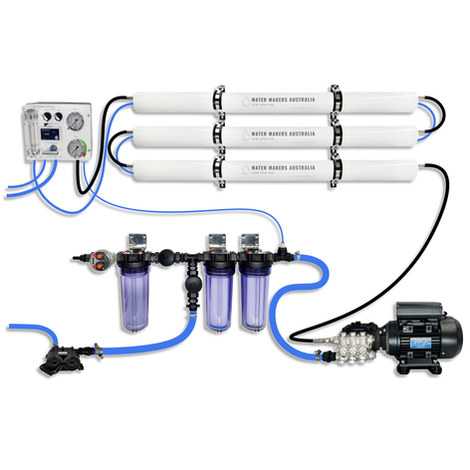
A three-membrane modular watermaker with 200 L/h nominal output and up to 240 L/h family-level marketing, for larger crews and heavy use.
Explore →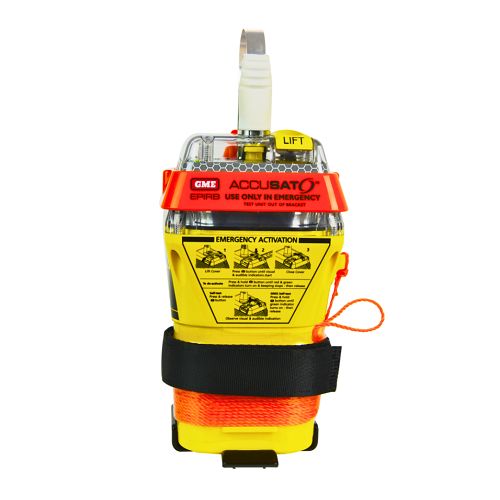
A 10‑year battery EPIRB with integrated GNSS (supports GPS and Galileo), infrared strobe and 121.5 MHz homing signal. Approved for worldwide COSPAS‑SARSAT operation.
Explore →
Self-contained, battery-powered plug‑and‑play autopilot designed for standard hydraulic steering systems.
Explore →