A watermaker pushes seawater through a reverse osmosis membrane at high pressure. Fresh water comes out one side, and the salt goes back over the side as brine. With one on board you stop planning passages around taps, and you stop carrying hundreds of kilos of water you may not need.
It is also the upgrade people most often regret buying too small, or leaving unused until the membrane dies. Both are avoidable.
Do you need one
- Yes, if you cruise for more than a week at a time, sail with more than two people, or visit places where water is scarce, dirty or expensive.
- Probably not, if you day sail and weekend from a marina berth. Bigger tanks or a few jerry cans are cheaper and have nothing to maintain.
How much output you need
Work it out from how you live aboard, then add a margin.
- A careful couple uses roughly 10 to 20 litres each per day. Add a daily freshwater shower each and that can double.
- Divide your daily use by the hours you are willing to run the unit. Most people want to run it for one to two hours a day, not six.
- A unit that makes 30 litres an hour suits a frugal couple. A family, or anyone who washes the boat down in fresh water, should look at 60 litres an hour and up.
The main types
| Type | Powered by | Suits | Watch for |
|---|---|---|---|
| 12 or 24 volt DC | House batteries | Small and mid sized cruising boats that run it off solar | Lower output, so longer run times |
| Energy recovery DC | House batteries | Boats that want the least power used per litre | Higher price, more parts in the pump |
| AC driven | Generator or large inverter | Bigger boats with a generator already | Needs the generator running |
| Engine driven | Belt off the main engine | Boats that motor often and want high output | Mounting the pump on the engine takes care |
| Portable | Batteries or a small generator | Small boats and those who do not want a permanent install | Setting up and stowing each time |
Power and space
- A conventional small DC unit uses a lot of amps for each litre it makes. Energy recovery units use far less. Check the amps per litre figure, not only litres per hour.
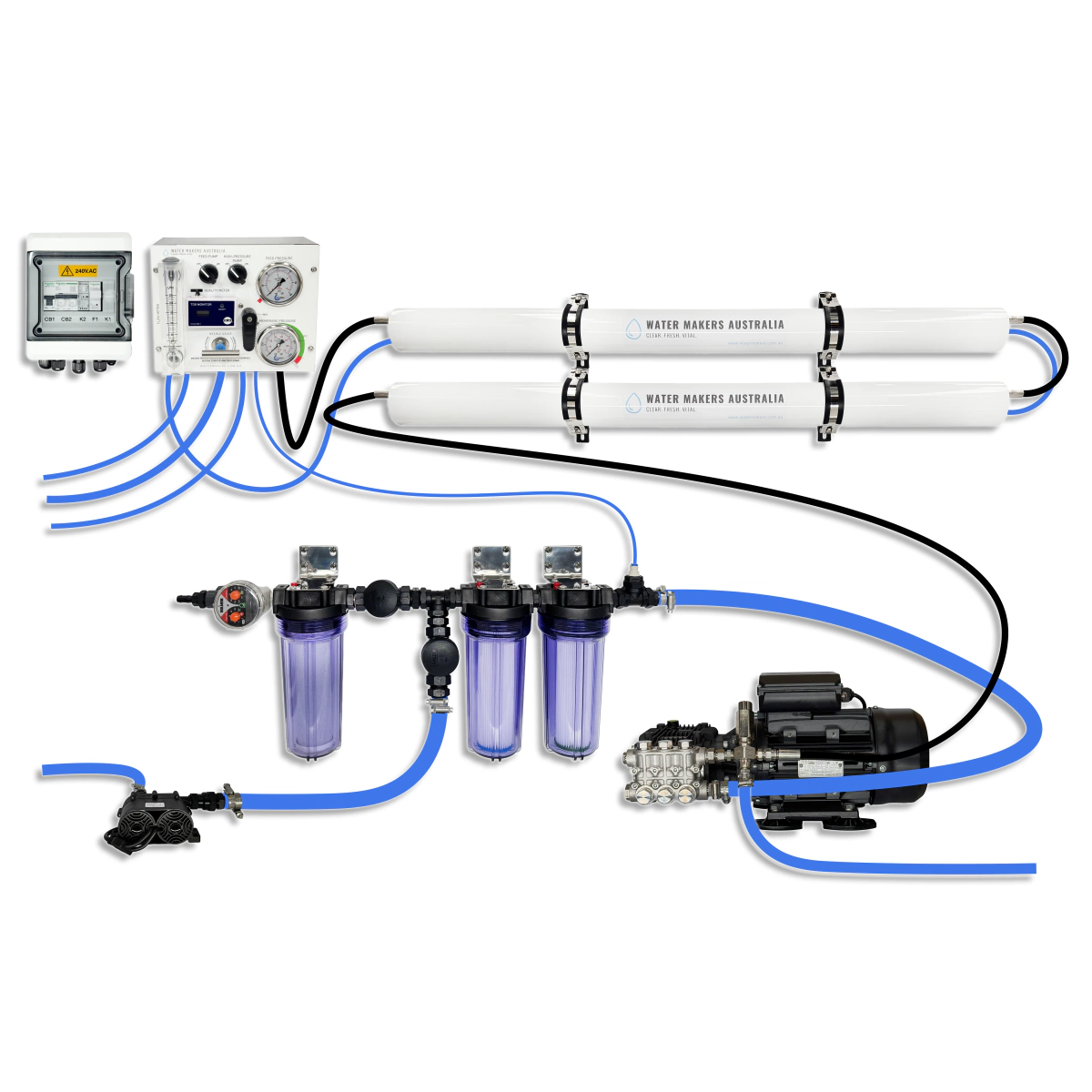
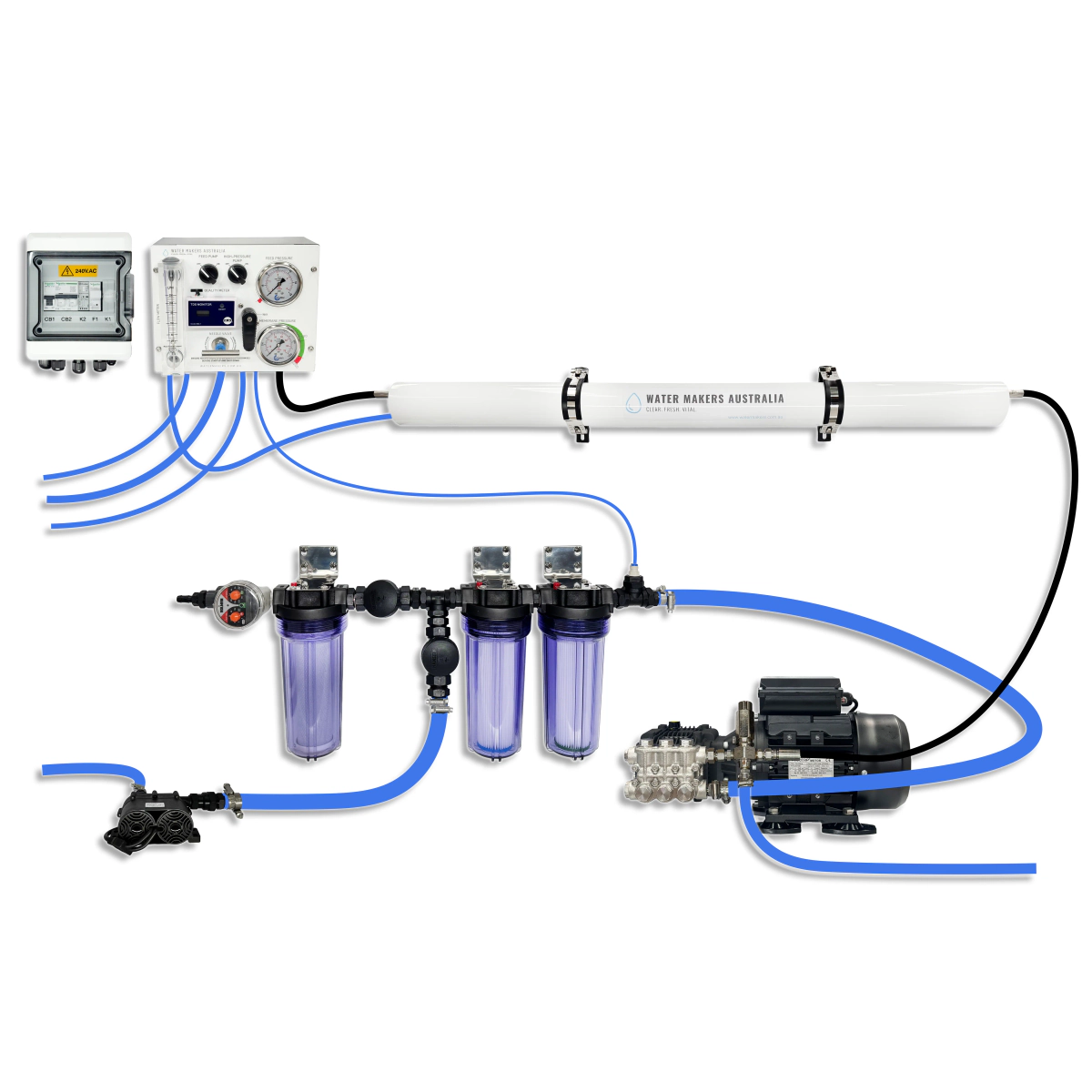
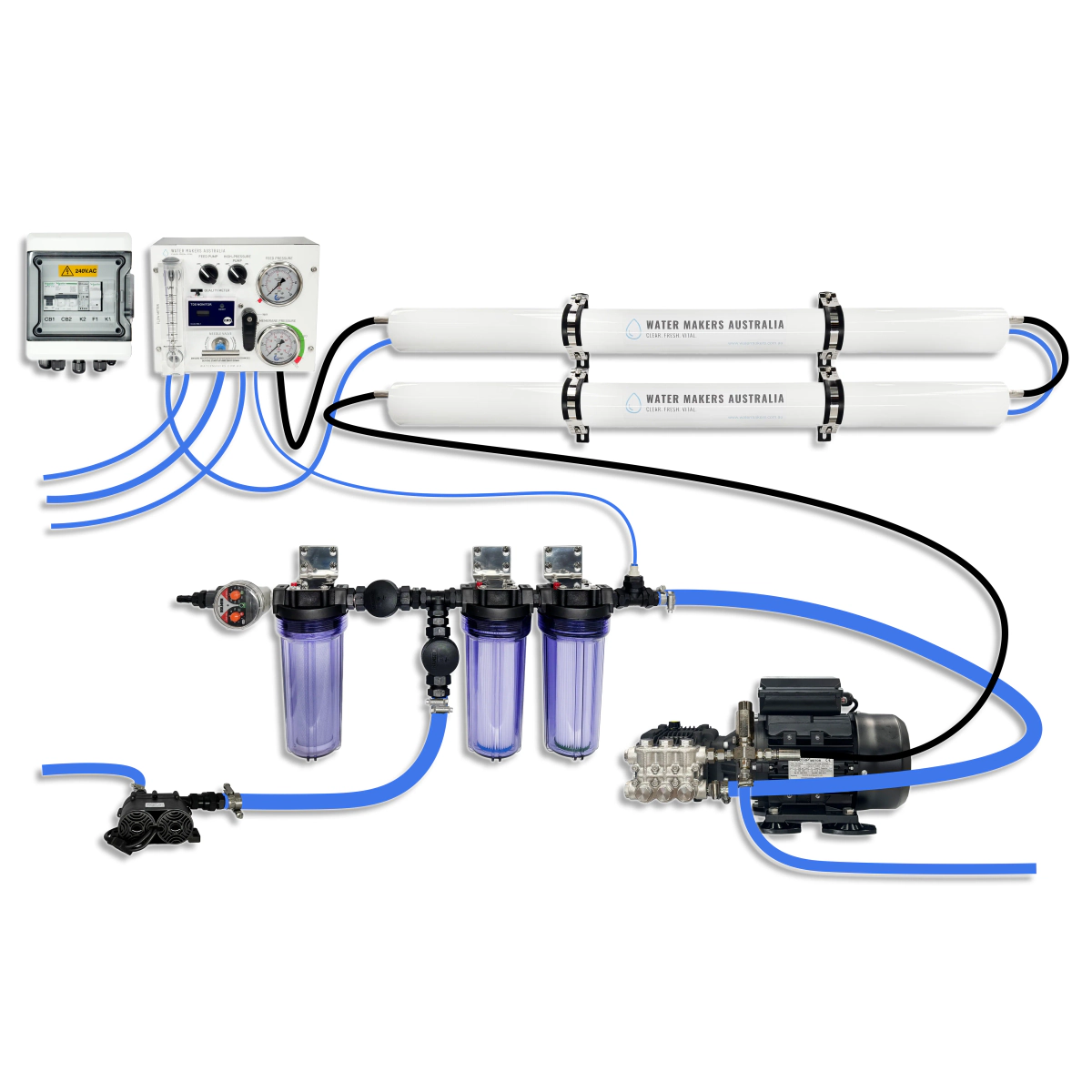
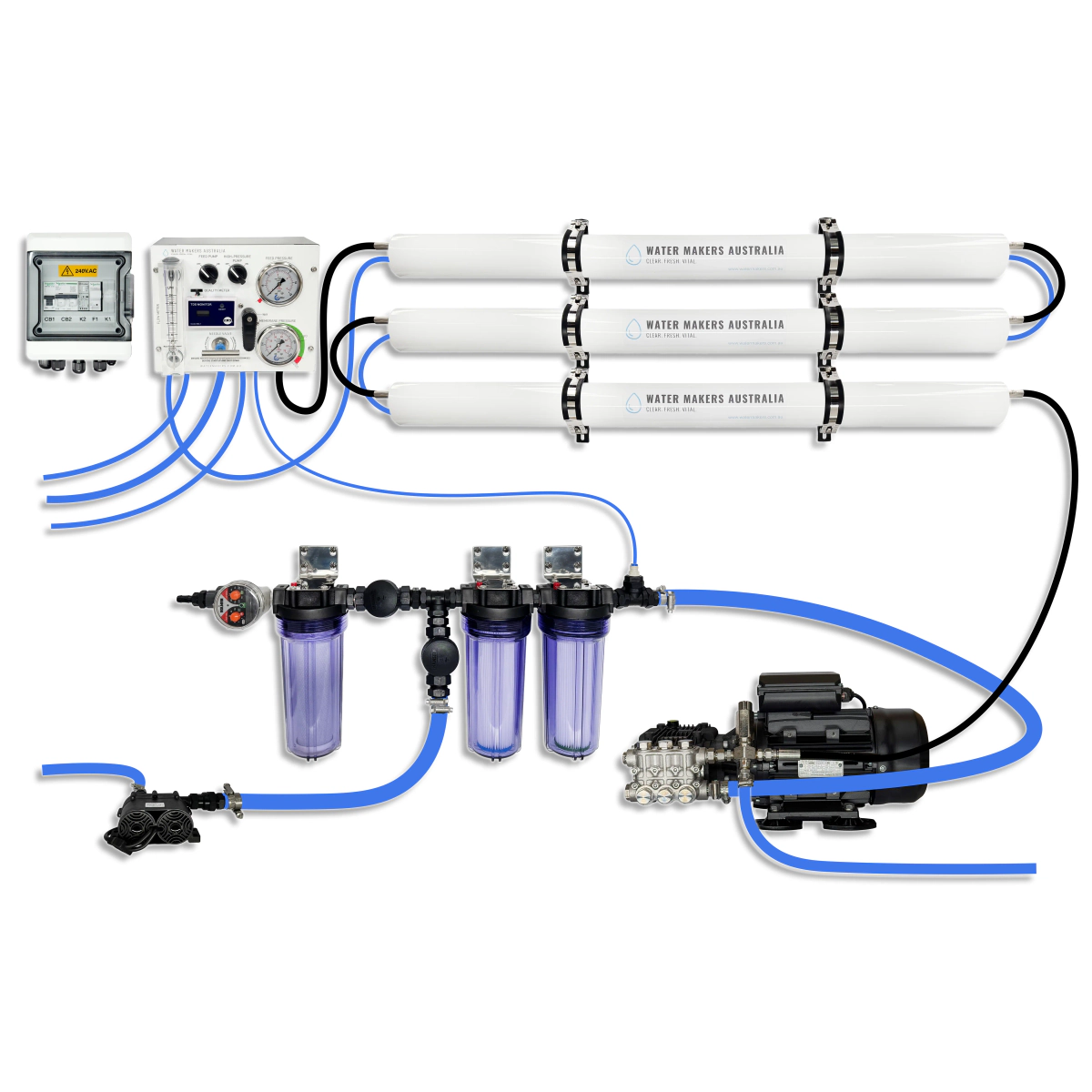
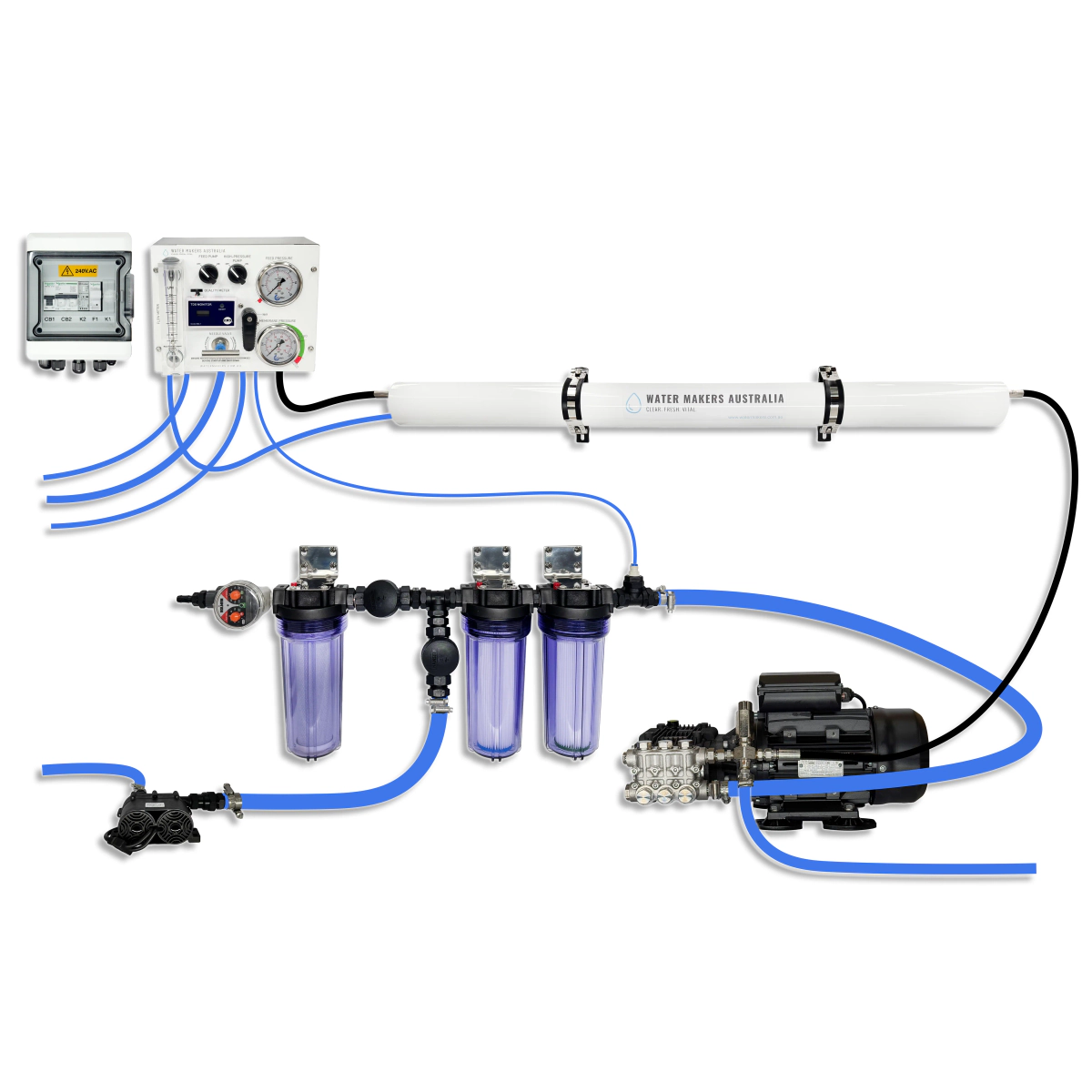
- You need room for the high pressure pump, the membrane housing, pre filters, a seawater intake and a brine outlet. Modular units let you split the parts around the boat.
- Give it a dedicated through hull intake low in the hull and forward of any toilet or sink outlets, so it does not suck air or dirty water.
What it asks of you
Honest version: a watermaker is not fit and forget.
- Run it often. Membranes like regular use. Left sitting in still seawater they foul within days in warm water.
- Flush it with fresh water after each use if it will sit for more than a few days. Many units do this automatically.
- Pickle it with preservative if the boat will be left for weeks.
- Change the pre filters regularly. They are cheap, and a blocked one starves the pump.
- Never run it in a dirty harbour, near fuel sheen or in silty river water. Oil and chlorine ruin membranes.
- Never feed it chlorinated tap water. Use product water for flushing, or fit a carbon filter.
Common mistakes
- Buying on litres per hour alone and finding the batteries cannot support it.
- Putting the intake where it draws air when the boat heels.
- Skipping the fresh water flush, then replacing the membrane after one season.
- Making water in a marina. Make it at sea or in a clean anchorage.
What to ask before you buy
- Who services this brand in Australia, and how fast can I get a membrane, seals and filters?
- Are the membranes and filters standard sizes I can buy anywhere, or only from the maker?
- What is the real power draw at my battery voltage?
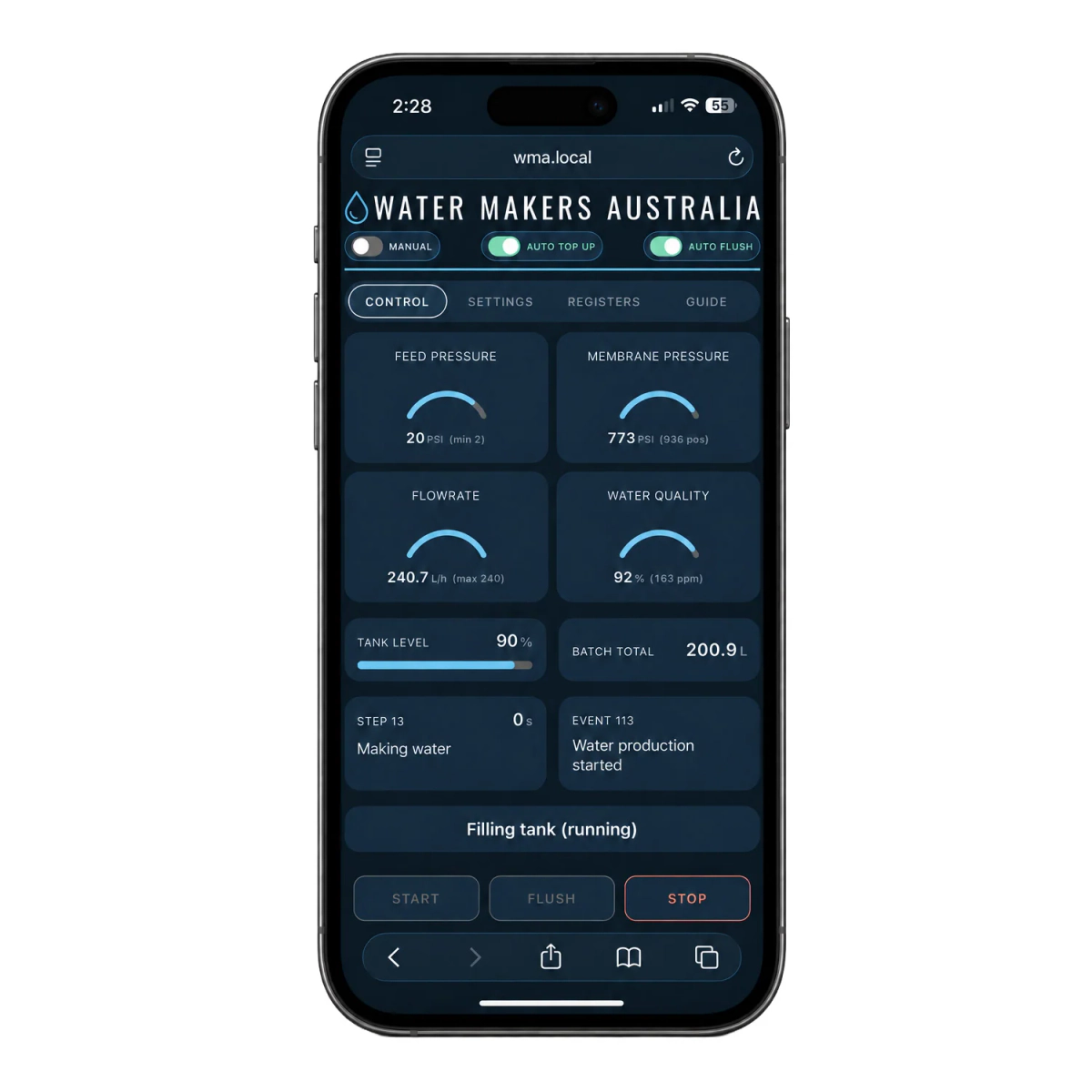
- Is there an automatic flush, and can it run when I am off the boat?
How it works
Seawater is filtered, then forced through the membrane at around 55 bar. Only about a tenth passes through as fresh water. The other nine tenths flush the salt away, which is why the intake and pumps look oversized for the trickle that reaches the tank.
Calculators
Calculator
Daily water use
What the crew gets through in a day.
- 40 L
- 280 L
Calculator
Watermaker output
The litres per hour to look for, from your daily use and how long you will run it.
- 30 L/h
- 40 L
Calculator
Watermaker power use
What making your water costs the batteries.
- 13 Ah a day
- 160 Wh a day
Water quality
- New product water reads under about 500 parts per million of dissolved solids on a handheld meter. Most healthy units make 150 to 350.
- Dump the first few minutes of every run over the side. Taste it or test it before it goes to the tank.
- A slow rise in the reading over months means the membrane is ageing. A sudden jump means a failed seal.
- Fit a carbon filter on the tank outlet if you ever fill from shore water as well.
The parts, and what each one does
- Seacock and strainer: keeps weed and jellyfish out of the pump.
- Pre filters: usually a 20 micron then a 5 micron cartridge. They catch silt and plankton before the membrane does.
- Feed or boost pump: pushes water to the high pressure pump so it never runs dry.
- High pressure pump: raises seawater to around 55 bar. The most expensive part to repair.
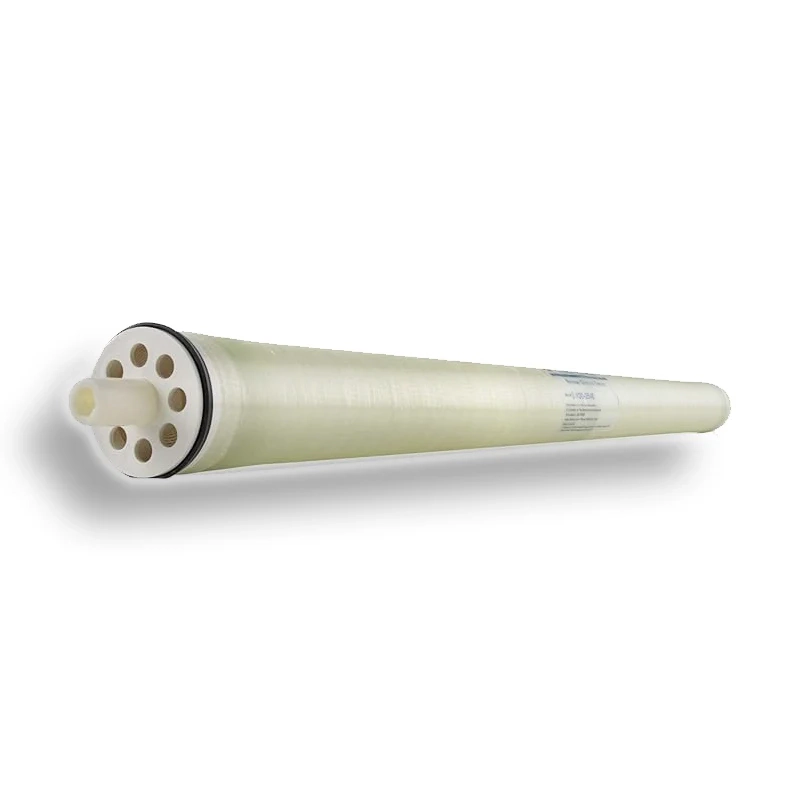
- Membrane and pressure vessel: where the separation happens. Membranes come in standard sizes; the common small ones are 2.5 inches across and 21 or 40 inches long.
- Pressure regulating valve and gauge: sets and shows working pressure.
- Flow meter: shows litres per hour. The first sign of trouble.
- Salinity probe or handheld meter: tells you the water is good.
- Diversion valve: sends product water to a test tap or the tank.
What affects output
- Water temperature. Ratings are at 25°C. Expect about 2 to 3% less for each degree colder, so a unit rated at 60 litres an hour may make 45 in a southern winter.
- Salinity. Saltier water needs more pressure for the same flow.
- Voltage at the pump. A DC unit on thin cable underperforms.
- Membrane age and how clean it is.
Tank strategy
- Keep one tank for watermaker water only, if you have two. Then a bad fill from shore cannot contaminate everything.
- Never run tanks to empty on the assumption the watermaker will work. Carry a reserve of at least a few days in a separate tank or containers.
- Product water is slightly acidic and has no chlorine. Clean tanks and a carbon filter at the galley tap keep it tasting good.
Running costs to expect
Pre filters several times a season, a flush filter yearly, pump oil or seals on the maker's schedule, and a membrane every five to seven years with good care. Add preservative for lay up. Ask for these as a yearly figure when you compare units; a cheap unit with dear proprietary filters costs more over five years.
Who should not fit one
Boats that return to a marina most weeks, boats with no room for the pre filters within reach, and boats whose batteries are already marginal. Fix the power first.
Common questions
Can you drink watermaker water every day? Yes. It is very low in minerals, so it tastes flat. Many crews add a pinch of mineral salts or just eat normally.
How long does a membrane last? Five years or more if it is run often, flushed and never fed oil or chlorine. One season if it is left to sit in seawater.
Can I run a watermaker off solar? A small energy recovery unit, yes. Around 300 to 400 watts of panel covers a couple's water as well as the fridge. A conventional unit needs a bigger bank or the engine running.
Does it work in rivers and harbours? It will make water, but silt blocks filters fast and oil ruins the membrane. Make water offshore or in clean anchorages.
Tutorials
Step by step guides are listed at the top of this page and in the sidebar: choosing a unit, planning the install, running it day to day, pickling it for lay up, and fault finding.